






AI
Healthcare Solutions
 Chand Prakash
10 September 2026
Chand Prakash
10 September 2026
Why Standard SOC 2 compliance for AI systems Fails During Healthcare Procurement?
 Chand Prakash
Cutting manual bottlenecks speeds revenue cycles. Robotic process automation in healthcare frees clinicians for direct patient care. This operational shift is necessary because administrative complexity accounts for nearly a quarter of total national healthcare expenditures. To combat this massive financial waste, clinical facilities are fundamentally restructuring how they manage daily operations.
A January 2026 McKinsey review shows intelligent systems lower the cost to collect by 30 to 60 percent. Consequently, hospital leadership is shifting from manual spreadsheet management toward autonomous software bots executing rules-based tasks. Deploying RPA in healthcare routes patient information accurately across fragmented billing platforms without human intervention.
These AI automation solutions handle the background coordination required to keep large hospital networks operating smoothly. This guide examines the main operational benefits, proven use cases, and emerging hyperautomation trends influencing modern care delivery.
Healthcare organizations face rising labor expenses, ongoing staffing shortages, and strict compliance mandates. Manual teams cannot scale to meet these growing operational demands. Relying on human workers to manage massive volumes of data entry creates expensive bottlenecks in patient verification and claims submission. A 2026 CAQH report found a remaining $21 billion savings opportunity through the full automation of manual healthcare transactions.
To solve this, clinics are adopting healthcare process automation to handle repetitive administrative work. This technology deploys programmed software bots to execute structured digital tasks across electronic health records, portals, and billing software. These systems maintain uninterrupted clinical operations with around-the-clock reliability.
Implementing robotic process automation in healthcare delivers clear, measurable operational improvements across clinical departments.
By implementing healthcare automation solutions, medical facilities ensure a scalable digital workforce that never experiences fatigue.
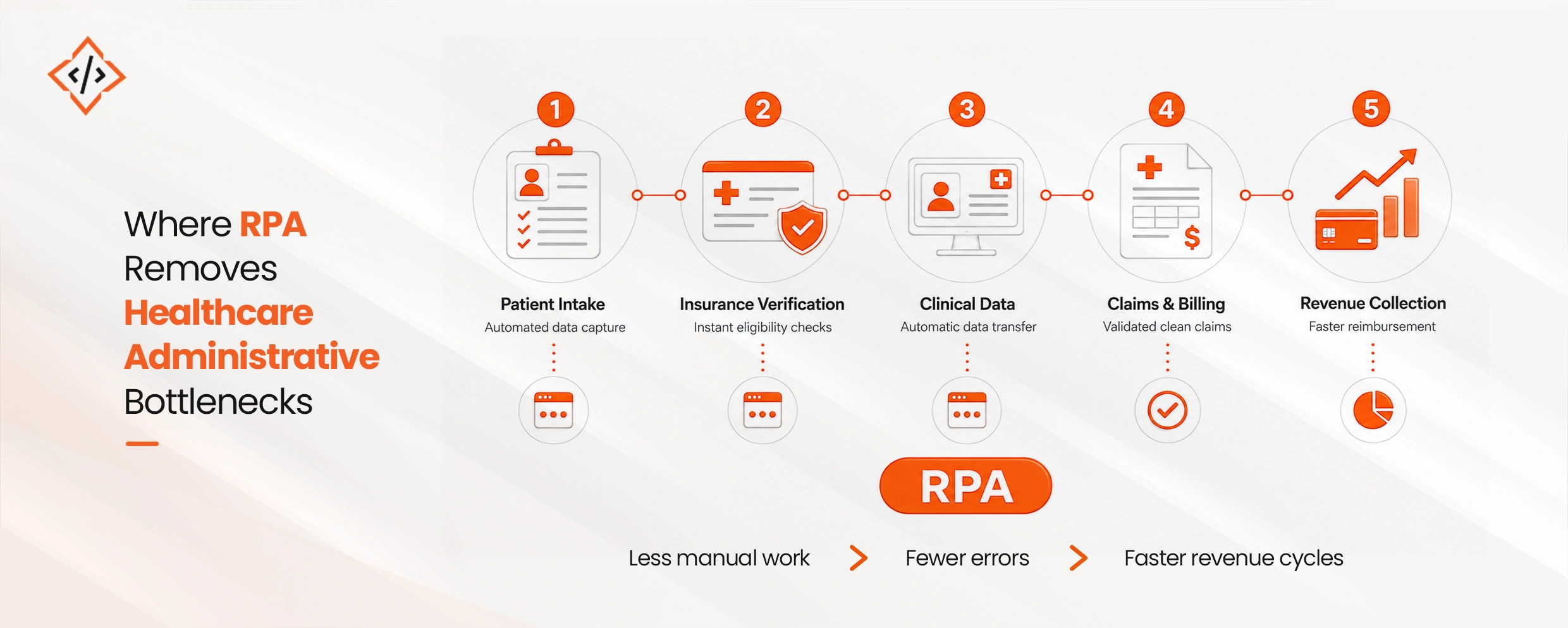
RPA automation in healthcare reduces operational costs, eliminates data transcription errors, and shortens care delivery timelines. Transitioning from legacy manual tracking to automated digital workers optimizes efficiency across high-volume administrative departments.
Manual claims management and prior authorizations consume substantial clinical budgets each year. Automating insurance verification and coverage checks reduces reliance on external processing vendors and overtime labor. Software bots handle massive transaction volumes without requiring additional headcount. This efficiency allows hospital systems to eliminate millions in recurring overhead spending.
Billing errors and incorrect diagnostic codes frequently trigger expensive claim denials. Software bots cross-reference patient encounter data with payer fee schedules before submission. This verification catches missing modifiers and formatting issues immediately. Fewer initial rejections lead to faster collections and reduce denial management costs significantly.
Manual registration creates long waiting lines and frustrates patients before they see a provider. Automated bots verify insurance eligibility before appointments by confirming active coverage overnight. This advance clearance eliminates waiting room delays and prevents registration bottlenecks at the front desk.
Clinical teams spend too many hours on repetitive data transcription and form submissions. Implementing healthcare workflow automation absorbs these administrative burdens directly. Reallocating nurses and administrative staff to direct patient support improves daily productivity. This shift reduces workplace fatigue and strengthens staff retention across departments.
Patients expect clear communication and transparent financial interactions from their healthcare providers. Automated systems deliver appointment reminders, schedule follow-ups, and generate accurate estimates without manual intervention. This clarity minimizes billing surprises, prevents missed visits, and builds long-term patient trust.
High-yield RPA healthcare use cases focus on structured, high-volume transactional tasks across administrative and financial operations. When implemented across repetitive workflows, software bots process massive datasets with absolute accuracy. This shift eliminates human error and establishes a dependable foundation for intelligent automation.
Manual billing workflows frequently delay reimbursements and introduce costly administrative errors. Software bots extract diagnostic codes and clinical data directly from patient charts. They cross-reference each entry against complex payer rules and verify patient coverage details in real time.
The system then submits clean claims to clearinghouses within seconds. This immediate validation resolves filing discrepancies before submission. It also significantly shortens payment turnaround times for hospital accounting departments.
Coordinating clinic visits manually consumes hours of receptionist phone time daily. Automated bots match incoming patient requests with physician schedules across multiple clinical locations.
They verify doctor availability, allocate appropriate room resources, and send automated confirmation messages to patients instantly. If a patient cancels a visit, the bot immediately contacts waitlisted individuals to fill the open slot. This coordination keeps provider calendars full without requiring receptionist involvement.
Healthcare networks regularly struggle with fragmented patient histories trapped inside disconnected legacy databases. Digital bots extract structured data from older software and transfer it into modern electronic health record platforms.
This automated migration ensures complete data integrity without requiring manual typing from clinical staff. As a result, physicians gain immediate access to updated medical histories during active consultations.
Protecting sensitive patient data requires continuous digital oversight and precise activity tracking. Automated bots monitor health systems around the clock to record every file access and credential check. When an unauthorized user attempts to view restricted records, the bot alerts compliance officers immediately. These automated logs ensure comprehensive audit readiness for privacy regulations without manual oversight.
Managing medical inventory manually often leads to stockouts of critical supplies or expired pharmaceuticals. Dedicated software bots monitor storage room stock levels and track expiration dates in real time.
When essential items hit predefined minimum thresholds, the system automatically creates purchase orders. When essential items hit predefined minimum thresholds, the system automatically creates purchase orders for medical suppliers. This automated monitoring prevents operational delays in operating rooms and intensive care units.
Modern healthcare automation solutions are rapidly shifting from simple task execution to autonomous, cognitive decision-making. As health systems scale, basic bots are integrating with advanced machine learning models to solve complex operational challenges.
Pairing large language models with robotic bots changes how hospitals handle unstructured clinical data. These combined systems read doctor dictations, lab summaries, and referral letters automatically. The software extracts key medical findings and converts them into structured billing codes and patient records. This eliminates hours of manual data entry and reduces transcription backlogs for clinical documentation teams.
Physicians spend an unsustainable amount of time documenting patient interactions into electronic health records. Ambient listening tools capture natural dialogue during consultations and generate structured clinical notes in real time.
Doctors review and approve the draft with one click before moving onto the next patient. This workflow eliminates computer distractions during exams and frees doctors from typing after clinical hours.
Unexpected equipment breakdowns in diagnostic imaging departments delay patient scans and cost hospital networks thousands of dollars per hour. Connected software bots continuously track sensor telemetry from MRI and CT machines. When vibration or temperature anomalies appear, the bot flags components wear immediately to schedule preemptive maintenance. The system automatically schedules maintenance during off-peak hours before critical hardware fails.
Emergency departments and urgent care clinics frequently experience severe patient intake bottlenecks. Intelligent patient intake bots evaluate self-reported symptoms through digital registration kiosks and mobile portals. The software prioritizes acuity scores based on clinical protocols and flags urgent cases immediately for triage nurses. This automated sorting shortens critical wait times and prevents emergency room overcrowding.
Healthcare networks are replacing isolated departmental tools with interconnected bot ecosystems. These systems share live patient data across pharmacy, radiology, and accounting platforms without human intervention. If a doctor prescribes a specialized medication, the network simultaneously updates inventory, verifies insurance coverage, and sends administration alerts to the floor nurse. This coordinated digital infrastructure directly improves clinical outcomes.
Healthcare systems adopting automation today build the operational resilience required to navigate rising clinical demands and tight margins. Transitioning administrative friction into autonomous digital workflows protects staff from burnout and elevates patient care standards. Clinical leadership must assess their current administrative bottlenecks immediately. Partnering with specialized AI development services helps build high-yield automation systems that deliver measurable returns.
Moving from a modular pilot project to a fully automated hospital network requires careful planning. Choosing the right technical partner determines the long-term success of these complex clinical integrations.
CodeTrade builds reliable healthcare process automation systems for large medical networks. The engineering team maps exact administrative bottlenecks before developing custom robotic process automation healthcare solutions. CodeTrade deploys intelligent automation in healthcare to ensure your facility operates with maximum financial and operational efficiency.
 Chand Prakash
 Chand Prakash
 Chand Prakash