





LMS Development
 Chand Prakash
21 August 2026
Chand Prakash
21 August 2026
How Much Should Institutions Budget for LMS Software Development Cost in 2026?
 Chand Prakash
Key Takeaways:
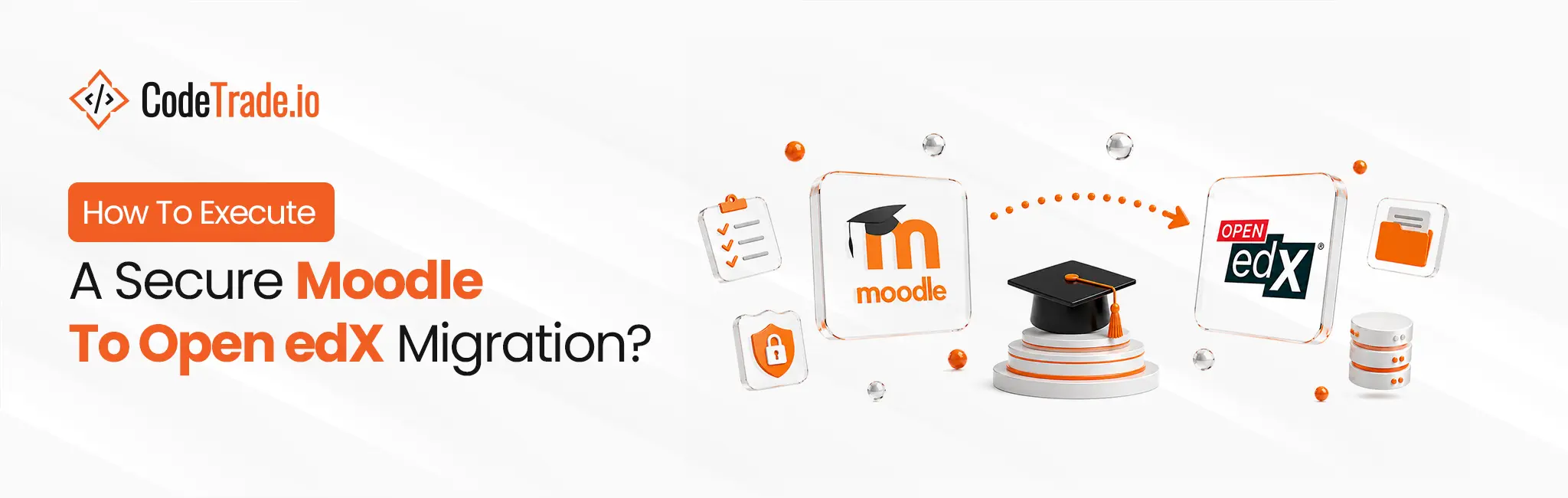
Executing a successful Moodle to Open edX migration for universities requires a phased technical strategy that strictly prioritizes data integrity. Transferring an entire digital campus involves complex architectural mapping rather than simply moving files from one server to another.
Replacing a legacy learning platform demands specialized Open edX development services alongside precise execution across database extraction, custom course restructuring, and secure user record preservation.
According to the 2026 EDUCAUSE Top 10 report, collaborative cybersecurity and data privacy represent the leading technical priorities for institutional leaders. Academic technology administrators must safeguard sensitive student transcripts while modernizing legacy digital infrastructure.
Partnering with professional Open edX migration services helps eliminate the risks of database corruption and unexpected semester downtime. This guide delivers the complete, step-by-step technical roadmap for planning an enterprise Moodle LMS migration from initial audit to live deployment.
Preparation dictates the success of a major platform transition, requiring a comprehensive asset inventory before any data moves. Rushing directly into data extraction leads to severe formatting corruption, broken dependencies, and lost academic records.
A certified Open edX migration partner establishes a clear technical baseline and realistic deployment timeline for the institution. This structured discovery phase ensures that all legacy databases and custom modules align with institutional standards. Proper preparation reduces technical risks and sets up a predictable migration path.
Engineering teams begin by evaluating server configurations, database structures, and existing network dependencies across the institution. This detailed review identifies which third-party plugins and custom code blocks are actively used by faculty. Outdated or unsupported extensions are marked for removal rather than migrated into the new environment.
Completing this infrastructure audit establishes the exact storage footprint and compute capacity required for deployment. It also clarifies existing hosting expenses to optimize the target cloud architecture.
Technical teams map legacy course hierarchies directly into modern, component-based architectures. Proprietary file types and unique grading configurations must be flagged early for conversion into open standards. Incompatible interactive elements require customized scripts to ensure they function properly after the transfer.
This systematic mapping allows specialized Moodle to Open edX migration services to preserve core instructional design. Instructional designers verify that all translated media assets retain their original pedagogical quality.
Large-scale transitions must be planned around academic calendars to avoid disrupting active semesters and exam periods. IT administrators establish strict content freeze dates to prevent faculty from uploading new files to legacy servers. Dedicated maintenance windows are scheduled to execute isolated data validation checks and verify complete system backups.
A structured rollout timeline ensures that LMS migration for US universities proceeds on schedule without service interruptions. This organized phased approach protects critical institutional workflows from unplanned platform downtime.
Data extraction is executed through scripted database queries that pull records in isolated batches to prevent system timeouts. Attempting to pull terabytes of university data simultaneously creates severe server latency and risks permanent database corruption.
Professional Moodle to Open edX migration services handle this complex operational workload using automated extraction pipelines. This phased approach isolates critical academic tables and protects complex relational dependencies across all student records. Following a disciplined data extraction methodology ensures total operational stability during the migration window.
Core database extraction begins by querying primary SQL tables in small batches during scheduled maintenance windows. Technical teams deploy specialized API endpoints and automated migration scripts to extract records without locking active production databases.
Every data stream is encrypted in transit using TLS protocols to comply with strict federal privacy mandates. These secure pipelines protect academic records while transferring complex grading schemas into intermediate staging environments. This disciplined extraction model ensures zero packet loss during complex Open edX LMS migration projects.
Moving static file repositories requires transferring vast volumes of lecture videos, course syllabi, and administrative documents into modern cloud storage. Deeply nested legacy directory paths are systematically flattened to match the modern object storage framework used by Open edX.
Technical engineers utilize lossless compression methods to speed up data transfers across network connections without degrading asset quality. Automated checksum hash comparisons run across all files to verify that every document arrives without corruption. This careful verification process guarantees that instructional media remains intact and fully accessible.
Data cleansing purges orphaned course assets, redundant grade logs, and outdated database records before the final import phase. Removing obsolete data lowers overall custom LMS development cost and increases platform responsiveness post-launch. Automated validation routines cross-reference every extracted course entity against baseline records to confirm absolute completeness.
Detailed audit summaries are delivered to institutional leadership to confirm structural compliance and data accuracy. Experienced LMS migration services USA rely on these validation protocols to deliver a clean, high-performance learning environment for universities.
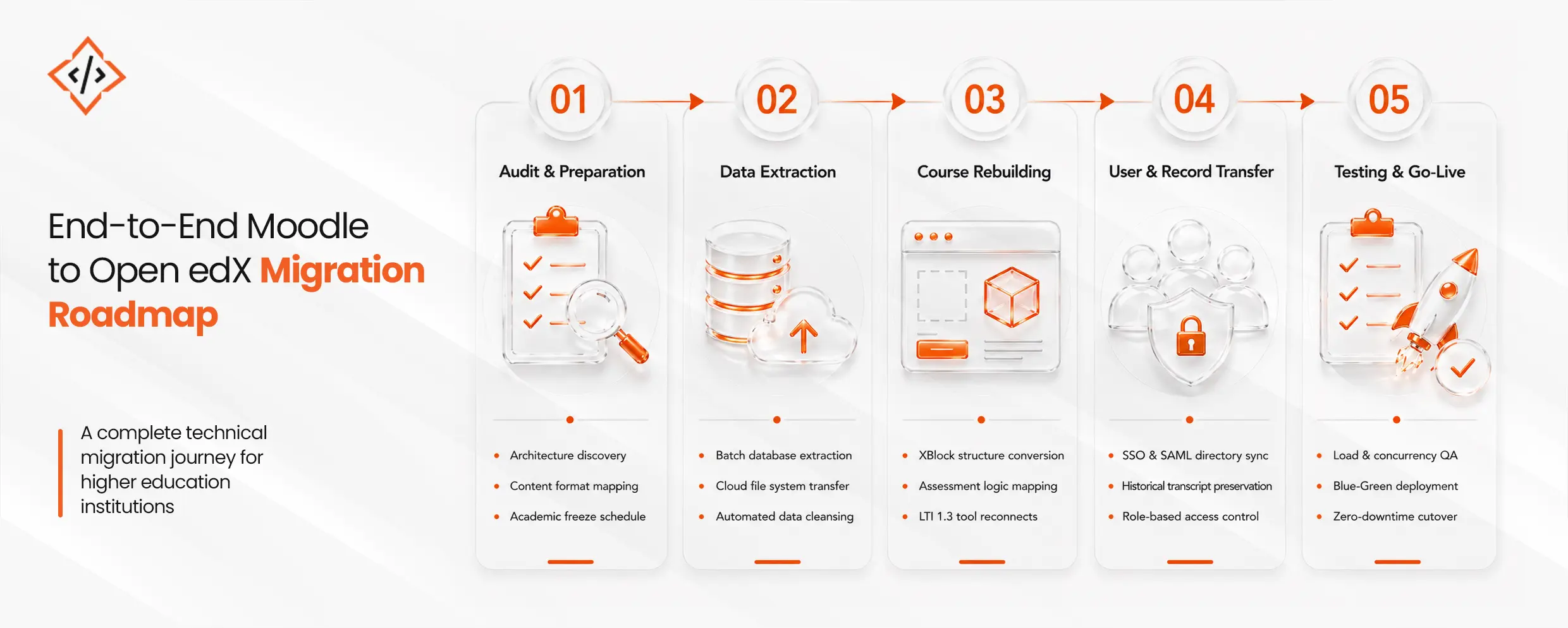
Moodle course migration requires translating unique pedagogical structures into the modular, block-based XBlock architecture used by Open edX. A direct copy-paste approach fails because legacy topic formats lack the structural hierarchy needed for modern learning paths. Professional Open edX implementation services systematically decompose legacy modules and rebuild them into sequential learning units.
Executing this transformation ensures that digital course materials take full advantage of cloud-native learning features. This careful restructuring optimizes platform navigation, improves page load times, and preserves instructional design standards across every department.
Rebuilding academic assessments demands converting complex question banks, multi-part rubrics, and automated grading rules into native components. Unique question formulas, timed exams, and advanced math notation often require custom development scripts to function identically. Technical teams carefully map grading logic to ensure complete scoring parity across every academic program.
Engineers then validate these rebuilt grading engines by running automated test suites against archived student submission records. Faculty members retain their customized assessment structures without experiencing grading discrepancies. This thorough verification confirms that grading rules remain accurate and fully compliant with university standards.
Multimedia integration involves re-linking embedded lecture streams, interactive SCORM packages, and external downloadable course documents into modern responsive containers. Legacy media formatting frequently breaks on modern mobile viewports, requiring automated updates to contemporary HTML5 standards.
Instructional designers review embedded captions and transcripts to ensure every asset satisfies institutional accessibility requirements. Quality assurance teams conduct rigorous multi-device testing to confirm smooth media playback across various browsers and screen sizes. This detailed process guarantees an intuitive viewing experience for all enrolled students.
Modern digital campus platforms rely on an interconnected ecosystem of specialized external academic tools. Technical engineers reconnect vital third-party applications like Turnitin, Zoom, and digital library repositories using modern LTI 1.3 standards. Configuring these updated protocols establishes secure token-based data handoffs and protects sensitive student information during transit.
Developers execute extensive end-to-end integration tests to confirm that single sign-on authentication functions properly within every course unit. Deploying Open edX for higher education ensures these academic extensions operate reliably without requiring separate user logins.
User migration relies on exact database mapping to ensure every student login, historical grade, and certificate remains permanently tied to their profile. Moodle user migration is frequently considered the most compliance-heavy phase of the entire project. Specialized LMS migration services USA handle these sensitive academic histories by applying strict data governance frameworks.
Technical teams map relational databases precisely to prevent any orphaned accounts or lost accreditation data. This meticulous approach guarantees that universities meet regulatory standards during complex platform transitions.
Connecting the new learning environment to a university’s central identity provider ensures a smooth administrative transition. Engineers establish secure SSO and SAML configurations to bridge the gap between institutional databases and the platform. This specific setup ensures students use their existing university credentials without interruption when logging into their coursework.
Technical teams also configure automated provisioning rules to handle new student enrollments instantly upon their first authentication. This integration eliminates duplicate profile creation and streamlines campus-wide IT management.
Preserving academic integrity requires safely importing past transcripts and course completion records into the new system architecture. This specific data mapping remains critical for maintaining institutional accreditation and strict federal compliance standards. Migration experts create read-only archival states for older cohorts to protect historical data from unauthorized modifications.
Storing these permanent records securely allows universities to generate accurate transcripts for alumni whenever requested. Preserving this legacy data provides long-term continuity for all educational programs.
Mapping user roles accurately prevents unauthorized access to sensitive academic data or administrative control panels. Technical teams systematically distinguish between adjunct faculty, teaching assistants, instructional designers, and senior system administrators. Granular access controls are applied in the new system to limit visibility based on specific departmental assignments.
These strict permission boundaries ensure that faculty only see the courses they are assigned to manage. Proper role configuration protects institutional privacy and maintains structural order across the digital campus.
The final launch relies on blue-green deployment strategies to guarantee zero downtime when switching live server traffic. Higher education institutions cannot risk unexpected platform outages during an active academic semester.
An experienced Open edX development company USA executes comprehensive testing routines before redirecting user traffic. These operational steps validate every system component under realistic institutional workloads.
Specialized Moodle to Open edX migration services simulate concurrent student usage during peak enrollment and final exam periods. Quality assurance engineers systematically review every migrated course to verify media links, interactive elements, and layout integrity.
Faculty members and department leads then participate in structured user acceptance testing to confirm operational readiness. This end-to-end validation ensures that course content functions as expected before the official release.
Blue-green deployment runs two identical server environments to make the transition invisible to end users. The new production environment is fully configured and tested while the legacy system continues serving active courses. Network routers instantly shift live traffic to the target platform once the final verification checks pass. A comprehensive automated failover plan remains active, allowing engineers to revert traffic immediately if anomalies arise.
Moving beyond traditional Moodle LMS Development thoroughly modernizes a university’s digital infrastructure. This transition operates as a highly structured engineering project rather than a simple software update. Executing data extraction, course restructuring, and user mapping carefully guarantees long-term scalability.
Academic IT leaders must evaluate their current databases and plan their transition strategically. Partnering with an Open edX migration partner helps map out a secure transition timeline.
Finding the right technical team determines whether this complex platform shift succeeds or stalls. Institutions require dedicated engineers who deeply understand strict academic compliance frameworks.
CodeTrade delivers expert Moodle to Open edX migration services for higher education facilities. Specialized engineering teams guarantee zero downtime while strictly protecting sensitive student records. Partner with a leading Open edX development company USA to safely upgrade your institutional learning ecosystem.
 Chand Prakash
 Chand Prakash
 Chand Prakash
 Chand Prakash
 Chand Prakash