





LMS Development
 Chand Prakash
29 September 2026
Chand Prakash
29 September 2026
What Are The Best Canvas And Moodle Alternatives For Universities?
 Chand Prakash
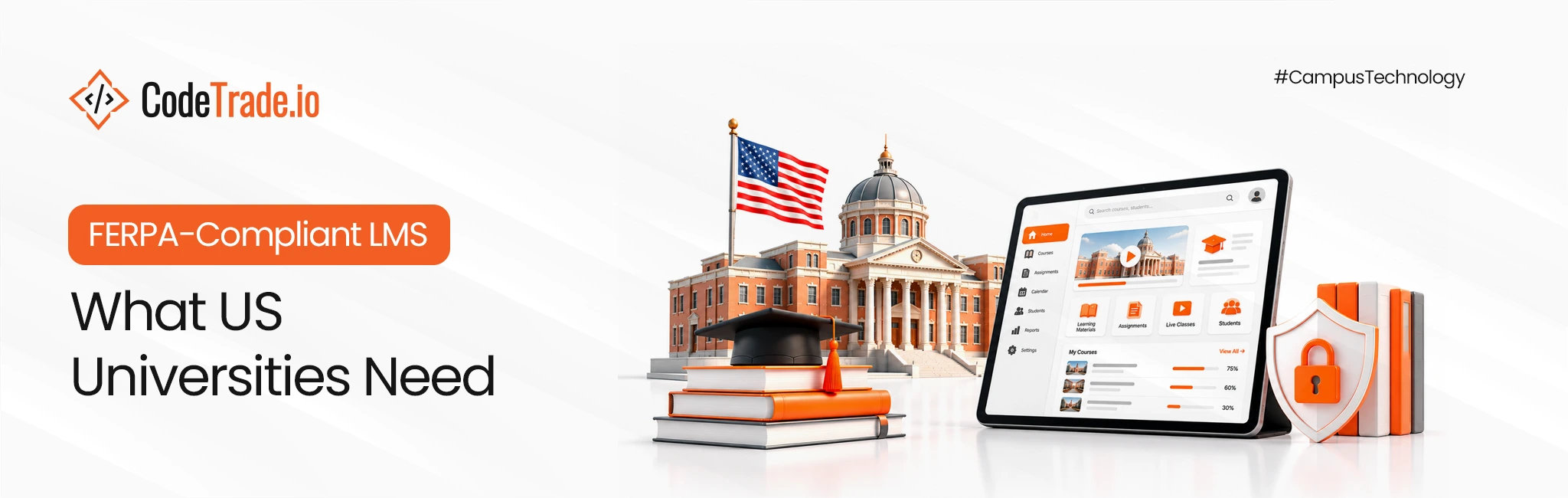
Universities require a FERPA-compliant LMS to avoid strict federal penalties and widespread data exposure. Learning management systems function as the central hub for storing grades, personal details, and behavioral analytics. Protecting this sensitive information demands more than basic policy updates.
Educational institutions face severe operational risks if these central platforms fail. According to 2025 research from Deepstrike, the education sector endures an average of 4,388 cyberattacks per organization every single week. A secure LMS for universities directly prevents these costly compliance failures.
This guide breaks down the core legal mandates and financial risks associated with digital learning tools and Moodle LMS services. It also details the specific architectural requirements necessary for higher education technology infrastructure.
Administrators must understand how LMS security for higher education dictates server environments and access controls. Upgrading to a properly protected system guarantees regulatory alignment without straining internal resources.
A FERPA-compliant system is an advanced digital infrastructure designed specifically to protect educational records from unauthorized access. This secure architecture ensures that universities meet strict federal regulations regarding student information.
By implementing a FERPA-compliant learning management system, institutions actively shield sensitive data from external breaches and internal mishandling.
Federal law places specific restrictions on sharing personally identifiable information without explicit student consent. Institutions cannot legally distribute grades, behavioral analytics, or financial details to unauthorized third parties.
Compliance also requires enforcing a strict “need to know” standard for all faculty and staff. This means an academic advisor or professor can only view records directly related to their assigned students. A student data privacy LMS automates these permissions to prevent accidental internal disclosures.
Data ownership laws dictate that universities must retain ultimate authority over all educational records. Software vendors providing the platform cannot claim ownership or freely analyze the stored information. Educational institutions must maintain complete control over data retention, archiving, and deletion policies.
This structural control prevents third-party vendors from compromising institutional integrity. Choosing the right platform ensures that the university remains the sole guardian of student privacy.
Financial liability and active ransomware threats are directly driving the massive demand for secure infrastructure. Vulnerable educational technology creates severe legal and operational risks for institutions nationwide. Implementing a reliable LMS for US universities mitigates these modern cyber threats directly. IT administrators must prioritize systems that actively defend against sophisticated external attacks. Ignoring these security requirements invites disastrous financial and reputational consequences.
The financial risk of exposing unprotected student data is undeniably massive. According to the Cloud Security Alliance, the average cost of a ransomware incident in the education sector reached $4.02 million in 2024. Immediate legal fees, regulatory fines, and forensic investigations quickly drain operating budgets.
Extensive recovery efforts require significant capital that schools simply cannot afford to lose. Upgrading university LMS security prevents these devastating financial losses before they occur. A proactive infrastructure approach saves millions while preserving vital institutional trust.
Cybercriminals consistently target higher education platforms for their highly valuable personal data. Deepstrike research (https://deepstrike.io/blog/education-cybersecurity-statistics) from 2026 shows that 77% of higher-education ransomware attacks result in complete data encryption. This destructive action locks administrators and students out of critical systems instantly.
Vulnerable legacy systems continuously expose institutions to these direct and costly cyber threats. Schools without a secure learning management system face prolonged operational downtime during these attacks. Centralizing administrative records securely blocks unauthorized encryption attempts entirely. Modernizing the foundational platform architecture is the only viable long-term defense strategy.
Unsanctioned data collection practices create severe regulatory compliance blind spots for schools. A 2026 EdTech Magazine report reveals that expanding AI usage creates a dangerous hidden data layer. This undocumented information flow causes immediate compliance failures across complex university networks.
Centralizing information within a heavily protected platform prevents this dangerous exposure completely. A FERPA-compliant LMS gives IT teams full visibility over all institutional records. This strict architecture guarantees true higher education data security across the entire campus. Administrators can safely encourage academic innovation without ever compromising student data privacy.
Compliance requires granular system architecture rather than just a basic institutional policy document. Meeting the core FERPA requirements for LMS deployment involves implementing strict and permanent access controls.
A compliant LMS for higher education relies on structural defenses to protect sensitive information continuously. Without technical barriers, even well-intentioned staff can accidentally violate federal student data privacy laws.
Institutions must deploy Role-Based Access Control to govern exactly how staff interact with academic data. This architectural standard ensures individuals only access information directly necessary for their daily administrative responsibilities. For example, a teaching assistant should only see grades for their specific assigned section.
They must never view the entire department database or access unrelated student financial profiles. Limiting these access points drastically reduces the risk of widespread internal data exposure. Role-based restrictions guarantee that permissions scale securely as staff change roles or departments.
Universities also need comprehensive and immutable audit logs built directly into their core platforms. These detailed digital records track exactly who viewed or downloaded a specific student record. The logs must record the precise time of access, the IP address, and the action taken.
Administrators rely heavily on this indisputable trail during complex regulatory audits or security investigations. Without these immutable logs, schools cannot prove their compliance to federal privacy regulators.
Protecting this stored information requires implementing strict end-to-end encryption standards across the entire network. Data moving between the main server and the user must use TLS 1.3 encryption protocols. This secures the transit phase against external interception or malicious network monitoring.
Furthermore, all stored academic records require AES-256 encryption at rest to prevent unauthorized database extraction. These cryptographic standards ensure data remains completely unreadable even if attackers breach the perimeter.
Finally, verifying user identities accurately remains the most critical defensive layer for educational portals. Relying on traditional passwords leaves systems highly vulnerable to automated brute-force attacks and credential theft. To combat this widespread threat, institutions must enforce Multi-Factor Authentication for every single login attempt.
Administrators should combine this with Single Sign-On integration via SAML or OAuth frameworks. These secure authentication protocols confirm identities reliably while blocking automated credential stuffing attacks entirely. By combining advanced encryption with verified access, universities establish a truly resilient digital learning environment.
Open edX is uniquely positioned for higher education because its open-source framework gives institutions total control over the server environment. This architecture allows universities to customize security controls according to strict federal privacy standards.
Achieving Open edX FERPA compliance ensures IT teams enforce verified data boundaries without relying on third-party vendor promises. This transparent architectural model actively prevents unwanted external data harvesting.
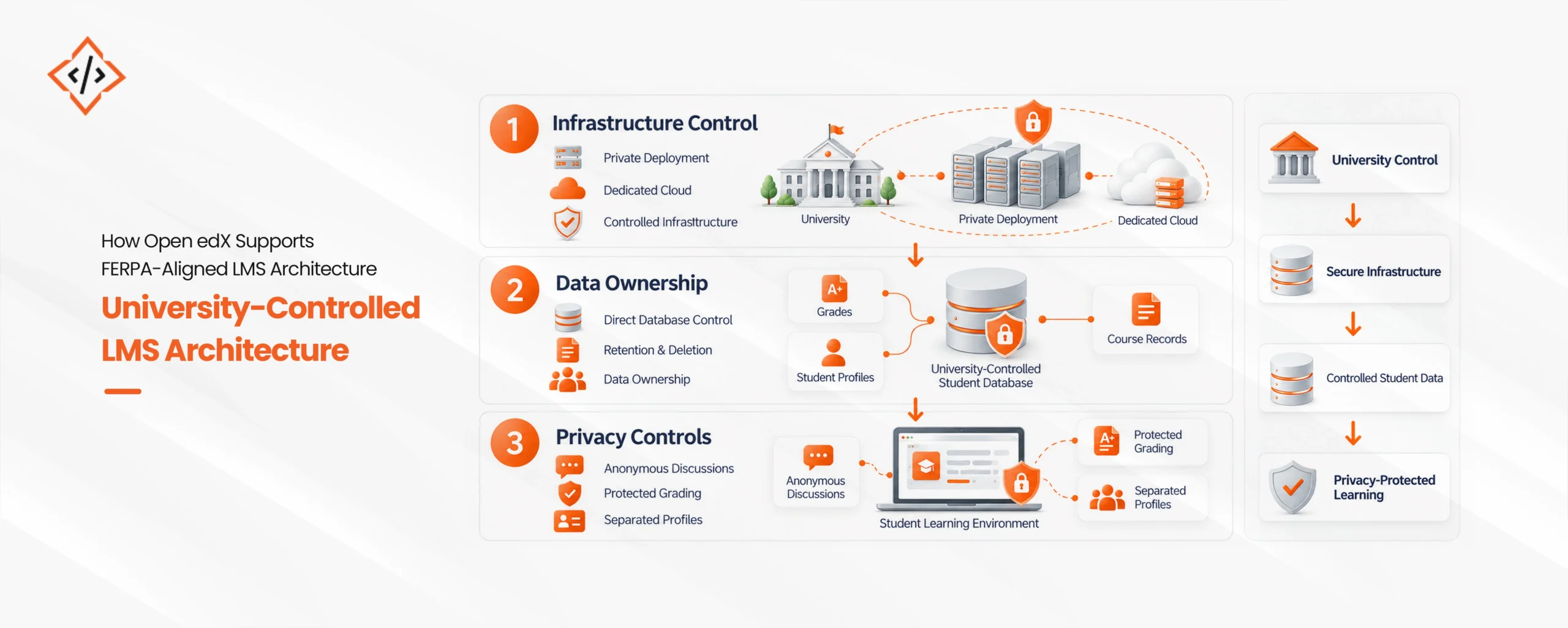
Institutions can host Open edX on their private servers or dedicated cloud instances like AWS GovCloud. This structural freedom ensures sensitive student records never touch a shared multi-tenant commercial database.
University engineers maintain direct administrative control over system firewalls, network subnets, and infrastructure patches. Isolating these academic workloads eliminates cross-tenant data leaks and unauthorized vendor telemetry entirely. Deploying Open edX for US universities creates an isolated infrastructure that aligns precisely with federal mandates.
Many proprietary SaaS platforms restrict database access and hold institutional records hostage behind rigid APIs. In contrast, Open edX gives university IT teams direct access to the underlying SQL databases. Administrators can configure custom data retention schedules, automated archiving, and permanent deletion protocols natively.
This deep administrative access guarantees that educational records are managed strictly according to institutional governance policies. Direct database oversight actively strengthens FERPA student data protection while simplifying annual audit reporting.
The platform includes native privacy features engineered to protect student identities during daily digital coursework. Instructors can anonymize forum discussions to encourage participation without exposing personal user details. The system also masks student identifiers during grading workflows to prevent evaluation bias and protect grade records.
In addition, personal directory profiles remain separated from open course forums and shared group workspaces. These native configurations consistently reinforce LMS privacy and security across every university department.
IT leaders must demand rigorous third-party validation before signing any long-term vendor contracts. Evaluating a compliant LMS for higher education requires looking beyond basic marketing promises. Administrators should demand verifiable proof that the platform actively protects sensitive student data daily. This critical evaluation phase prevents educational institutions from inheriting severe technical vulnerabilities.
Universities must require software vendors to supply current SOC 2 Type II compliance reports. This specific audit proves that security controls operate effectively over a continuous operational period. Furthermore, IT teams should request recent penetration testing results from independent security firms.
These external assessments verify that the secure LMS for universities can withstand real-world cyberattacks. Relying solely on internal vendor assessments creates an unacceptable institutional security risk.
Vendor service level agreements must include a strict 24-hour mandatory notification window. If a data breach is suspected, the platform vendor must alert the university immediately. Delayed notifications severely hinder the institution’s ability to mitigate damage and inform affected students.
Clear incident response protocols ensure that IT departments maintain total operational awareness during crises. Explicit contractual terms guarantee that universities never lose control during a security emergency.
University IT leaders must immediately audit their digital learning infrastructure for shadow data leaks and outdated access controls. Protecting student privacy requires closing these internal exposure points before federal compliance audits begin. Upgrading legacy software to an open-source framework like Open edX shields institutional integrity and preserves complete operational control.
Executing this architectural transition requires specialized technical execution alongside deep regulatory knowledge. Migrating from vulnerable proprietary software to dedicated environments demands Open edX development services with proven sector experience. This technical precision ensures that institutions satisfy every audit benchmark without interrupting daily academic workflows.
CodeTrade designs enterprise learning platforms that enforce the highest standards of higher education data security. Our engineering team configures Open edX for US universities with strict database isolation and granular role permissions. Partner with CodeTrade to deploy a resilient and fully FERPA-compliant LMS built for modern institutional needs.
 Chand Prakash
 Chand Prakash
 Chand Prakash