



Open edX Development
LMS Development
 Chand Prakash
24 August 2026
Chand Prakash
24 August 2026
How To Execute A Secure Moodle To Open edX Migration?
 Chand Prakash

Finding the right Canvas and Moodle alternatives for universities is essential to overcoming high costs and rigid software architectures. Legacy systems often burden institutions with expensive per-student licensing or massive IT requirements for self-hosting. Evaluating an Open edX vs Moodle vs Canvas breakdown helps academic technology leaders solve this ongoing financial strain.
IT directors are actively seeking platforms that offer more control without the steep price tags. According to a 2025 report by Grand View Research, the global higher education LMS market reached $6,188.9 million. This significant market growth is directly driven by the urgent need for better academic infrastructure. Schools can no longer justify maintaining outdated platforms that constantly drain their operational budgets.
This guide will evaluate an enterprise LMS for universities that delivers better customization and significantly lower overhead. Choosing a modern higher education LMS allows institutions to deploy a truly scalable and secure academic environment.
Legacy systems are failing to meet evolving security and administrative efficiency standards across higher education. This strict reality forces academic technology leaders to rethink their digital infrastructure and abandon older software frameworks.
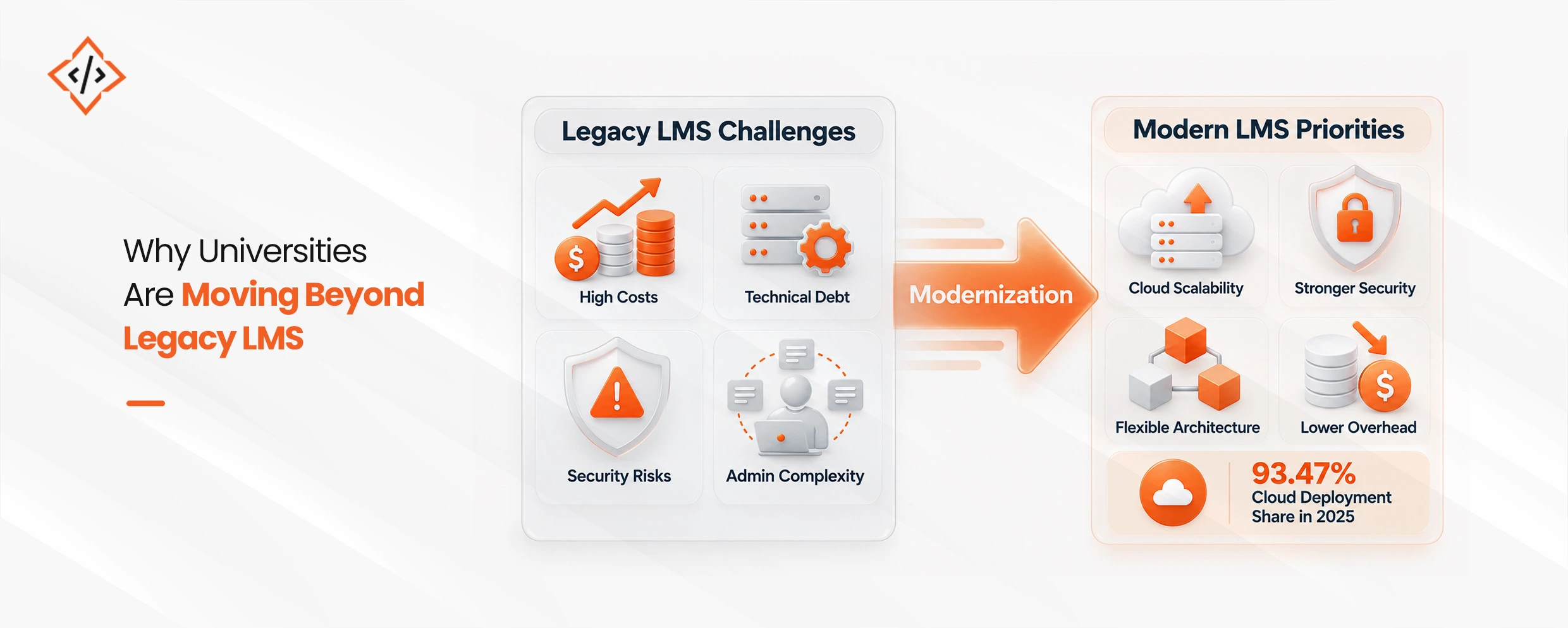
A 2026 report by Market Research Future reveals that cloud deployments captured 93.47% of the market share in 2025. This overwhelming adoption highlights a rapid institutional shift away from restrictive on-premise legacy systems. University administrators must take these critical upgrade steps to keep pace with modern digital learning demands.
An outdated higher education LMS consistently drains vital IT budgets across various academic departments. These aging software platforms often hide highly expensive maintenance fees within rigid long-term vendor contracts. Furthermore, they force institutions to purchase required third-party plugins just to maintain basic daily functionality.
Schools simply cannot afford to sustain this heavy technical debt while trying to improve student outcomes. Replacing an older platform provides immediate and measurable financial relief for campus IT departments.
Transitioning to a modern cloud system reduces overall administrative costs significantly over time. This massive cost reduction naturally pushes schools toward a more scalable LMS for universities. However, financial efficiency represents only a portion of the current institutional problem.
Frequent cyber disruptions carry a heavy psychological impact across diverse academic environments. Data breaches and unexpected system outages quickly erode essential student and faculty trust.
Users fully expect their digital classrooms to remain entirely safe and functional at all times. This specific security pressure drives the immediate need for highly secure university LMS alternatives. Executing a proper LMS migration for universities effectively prevents future catastrophic software failures. Institutions must prioritize advanced Canvas and Moodle alternatives for universities to protect sensitive data while streamlining daily academic operations.
The best alternative to Canvas LMS must offer cost predictability while maintaining high user engagement. Institutions need robust platforms that deliver consistent performance without unexpected yearly pricing spikes. Administrators require intuitive tools that keep students actively involved in their daily digital coursework.
Modern academic technology leaders carefully evaluate multiple platforms to achieve these precise financial goals. Finding the right system ensures long-term sustainability for campus IT departments.
Open edX for universities stands out as a superior open source LMS for universities. It provides academic institutions with unmatched structural flexibility and complete technological independence. When conducting an Open edX vs Canvas comparison, the underlying architectural differences become immediately clear.
Open edX allows complete control over institutional data storage and complex system security protocols. Universities can quickly build custom learner pathways to suit highly specific academic degree programs. They achieve this high level of personalization without facing expensive and rigid tiered licensing models.
This open architecture completely eliminates the restrictive vendor lock-in that heavily burdens many IT budgets. Technology leaders appreciate the ability to modify the source code to meet exact campus needs.
D2L Brightspace serves as an exceptional system alternative that focuses heavily on competency-based education. The platform prioritizes tracking actual student skill mastery over simple online course completion metrics. It successfully provides a highly customizable LMS for higher education across various academic departments.
While institutions that hire Open edX developers build custom modules from source code, Brightspace users configure branding directly through the interface. Faculty members can adjust the software to support their unique pedagogical frameworks very easily. This structural adaptability ensures the technology supports preferred teaching methods instead of dictating them.
Instructors use detailed analytics to monitor student progress and intervene when learners struggle. The focus remains entirely on delivering targeted academic experiences at a massive scale.
Blackboard Learn Ultra features an updated cloud architecture representing a strong LMS platform for higher education. Engineers modernized this cloud system to handle heavy concurrent academic user loads highly effectively. This new software iteration directly targets the specific user experience gaps commonly found in Canvas.
Students navigate the digital interface intuitively with significantly fewer clicks required to access course materials. Furthermore, the platform offers deep technical integration with existing university enterprise resource planning tools. IT directors appreciate how seamlessly it connects with complex campus student information systems.
Administrators can sync massive academic databases without requiring extensive custom middleware development. This native synchronization drastically reduces the manual administrative workload for university IT staff.
Moodle maintains widespread global adoption across academic institutions. However, many IT leaders actively seek an alternative to Moodle LMS. They want to reduce self-hosting complexity and improve the native user interface. Managing constant server patches and custom database configurations places a heavy burden on campus technical teams.
Evaluating reliable Moodle alternatives for universities allows departments to deploy modern cloud systems. These platforms simplify daily administration while giving students and faculty a significantly cleaner digital experience.
Sakai functions as a community-driven open-source platform built directly by higher education institutions. The system places a strong emphasis on collaborative learning and research-based workflows. Faculty can coordinate multi-institution research projects and cross-departmental academic initiatives within a secure shared space. This design makes the platform a viable enterprise LMS for universities seeking independence from commercial vendors.
Academic boards retain complete sovereignty over their student data and underlying digital infrastructure. In addition, the active global academic community continually refines core educational tools to meet real classroom requirements. The open development model guarantees that feature roadmaps remain aligned with actual educational priorities rather than corporate profit targets.
Docebo introduces intelligent automation and corporate learning mechanics into a university learning management system. The platform automates repetitive content curation and routine administrative tasks with high precision. This structured automation directly solves the heavy manual labor often associated with managing Moodle.
Administrators spend far less time manually tagging learning assets and assigning course modules to incoming cohorts. The underlying engine analyzes student performance metrics and surfaces relevant supplementary study materials automatically.
Campus IT teams also benefit from a modernized cloud environment that scales without requiring manual server maintenance. This automated framework allows academic advisors to focus on student intervention rather than processing back-end records.
Schoology acts as an intuitive platform that effectively bridges secondary school pipelines and early higher education programs. The system features strong communication tools that encourage natural collaboration and rapid peer feedback. This familiar user experience drastically reduces the steep learning curve that faculty often face with Moodle.
Professors can build structured assignments, launch interactive discussions, and grade submissions with minimal technical training. Clear interface navigation keeps first-year students focused on academic coursework rather than struggling with confusing site layouts.
Centralizing course announcements and shared calendar events keeps entire cohorts aligned throughout the term. Consequently, campus help desks resolve far fewer routine support tickets during busy enrollment periods.
Selecting the best LMS for universities requires mapping academic goals directly to concrete technical and financial constraints. Institutions cannot afford to select software based purely on surface-level feature lists. They must evaluate how the underlying architecture impacts daily academic operations and long-term campus IT budgets.
A rigid software platform will eventually force an institution into expensive custom development cycles. Administrators must prioritize platforms that offer true systemic adaptability. Careful evaluation prevents costly mistakes and ensures the chosen system effectively supports both students and faculty.
Any new system must prioritize strict data privacy and actively prevent breaches that cause campus anxiety. Cyber attacks severely damage institutional reputations and compromise sensitive student academic records.
Modern platforms require compliance with regional academic data laws like FERPA in the United States or GDPR in Europe. Analyzing Open edX vs Moodle for US Universities shows how self-hosted architectures meet these statutory rules through dedicated, encrypted cloud infrastructure.
IT directors must thoroughly audit vendor compliance documentation before committing to any long-term digital contract. Secure systems protect vulnerable student information while ensuring continuous digital learning availability.
Institutions must look far beyond initial software licensing fees when evaluating the financial aspect of new platforms. True financial planning requires a deep analysis of hidden long-term operational expenses.
Schools often face unexpected costs related to ongoing maintenance, secure cloud hosting, and continuous technical support. An Open edX vs Moodle comparison frequently centers precisely around this total cost of ownership. While both systems are open-source, they require vastly different internal IT resources to maintain and update securely. Calculating these hidden technical expenses upfront prevents severe budget shortfalls during the academic year.
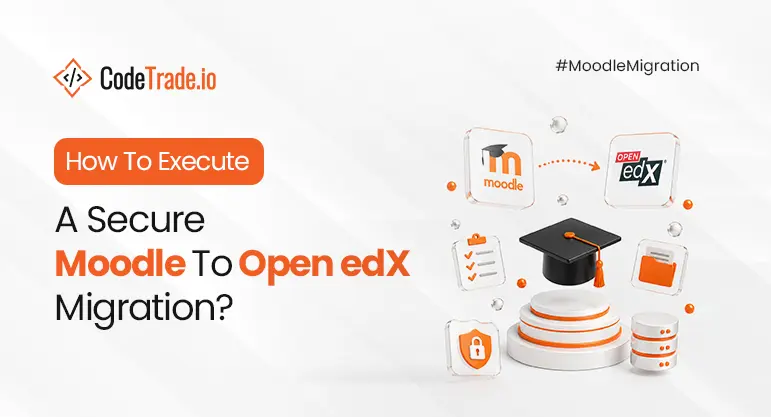
Executing a successful LMS migration for universities demands a carefully structured and phased deployment approach. Technical teams must rigorously test mass data transfer protocols before moving live student records. Administrators should schedule comprehensive faculty training sessions well before the official system launch date.
A smooth transition requires integrating the new platform tightly with existing academic databases and campus identity systems. Careful testing prevents catastrophic data loss and minimizes frustrating downtime during critical exam periods. This structured implementation strategy ultimately guarantees high user adoption and immediate operational stability.
The future of academic technology depends on flexible systems that adapt to evolving pedagogical needs without budget inflation. Transitioning to modern Canvas and Moodle alternatives for universities builds an agile academic infrastructure prepared for 2026 and beyond. Academic technology leaders should audit their current digital constraints now. Planning a strategic migration to a modern LMS platform for higher education ensures long-term operational resilience.
Navigating complex platform replacements requires specialized engineering support and structured execution to prevent campus downtime. Partnering with experienced technical specialists ensures your critical academic data and integrations transfer accurately.
CodeTrade delivers proven engineering expertise in building Canvas and Moodle alternatives for universities. The technical team delivers end-to-end Moodle LMS customization services and scalable deployments of Open edX for universities. These tailored solutions establish secure learning environments that keep long-term operational expenses fully manageable.