AI, AI/ML 13 August 2026Agentforce vs Custom AI Agents: A Build-or-Buy Framework
Key takeaways
- The deciding factor in Agentforce vs custom AI agents is where the authoritative data lives, not which option is more capable. Both automate a workflow competently.
- Platform AI agents inherit an access-control model. Custom AI agents have to build and audit one, which is real work frequently missing from build estimates.
- Custom builds win on model choice, cross-system reasoning, and portability. Those matter more over five years than in year one.
- Consumption pricing and infrastructure pricing scale differently. A successful deflection program raises platform spend and barely moves custom infrastructure cost.
- Most enterprises need both. The interesting engineering question is the boundary between them, not which one wins.
Data gravity decides Salesforce Agentforce vs. custom AI. Whichever system already holds the authoritative records has a structural advantage that no capability comparison overturns.
An agent grounded where the data lives avoids an integration layer, a synchronization problem, and a permission model it would otherwise have to reimplement. Everything else is secondary, and most vendor comparisons invert that order entirely.
This covers the four questions that settle the decision, how the cost models actually differ, and where the boundary usually falls. It assumes you know what a platform runtime provides, which is covered in the Agentforce enterprise guide.
How to decide between Agentforce and custom AI agents
Four questions can settle almost every case. They should be asked in this order because the first two usually carry the most weight.
- Where does the authoritative data live? If the records an agent needs are all in one platform, the agent usually belongs there. If it has to reach into another system at every step, you add integration latency and have to rebuild its permission model outside that system.
- Whose permissions apply? A platform agent inherits the platform’s sharing model. A custom agent has to define, implement, and audit access for every retrieval path. Teams often underestimate this because the complexity stays hidden until an audit.
- How bespoke is the required behavior? Standard summarization, retrieval, and guided updates work well with a platform runtime. Domain-specific reasoning, unusual sequencing, custom scoring, or a specialized model choice may require a custom agent.
- What is the five-year portability requirement? Platform agents are not portable. If the system is strategically permanent, that may be fine. But if it could be replaced, locking the agent logic into that platform can create migration costs later.
Questions one and two settle most cases. Questions three and four help break the tie.
Agentforce vs. custom AI agents: how the cost models differ
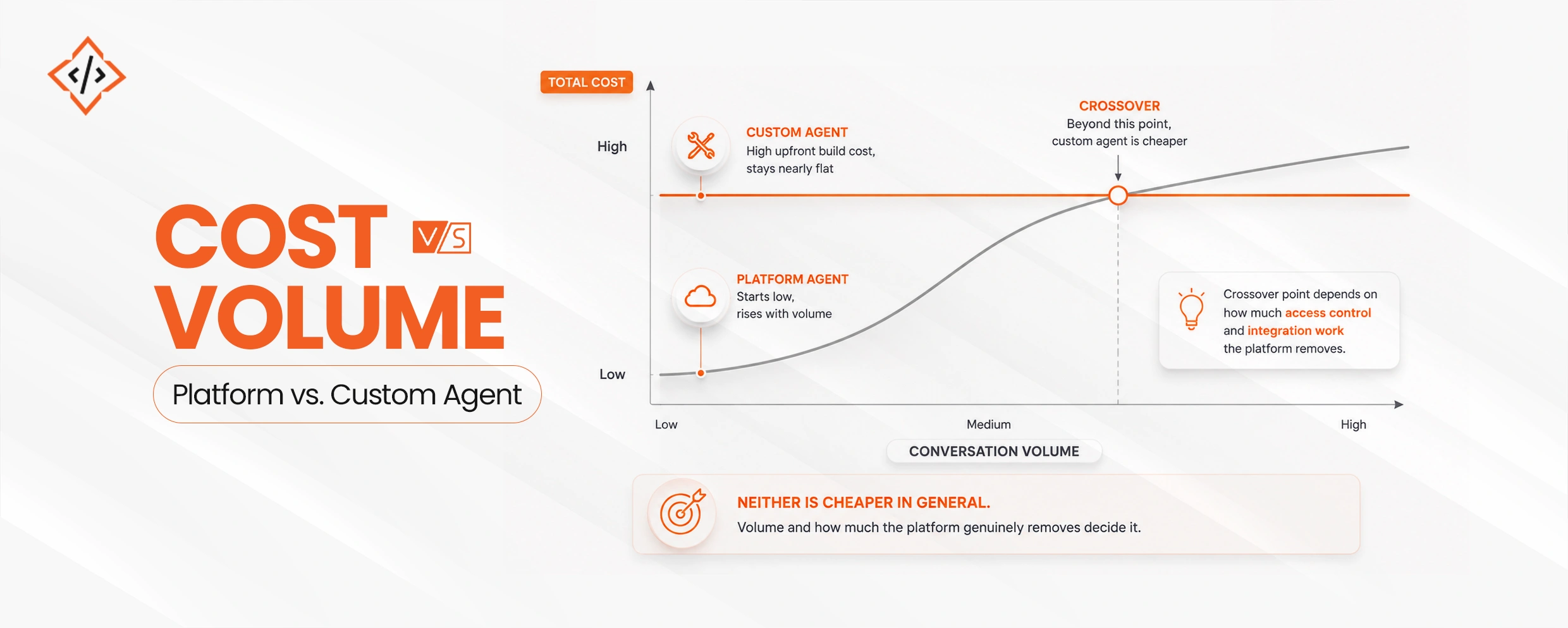
Platform AI agents and custom AI agents do not fail the same way financially. One is cheap to enter and expensive to succeed with.
The other inverts both.
The asymmetry worth naming is the cost of success.
Consumption pricing means a deflection program that works to increase spending, which is economically correct and frequently surprises a budget holder who framed the project as cost reduction. Custom infrastructure barely notices additional volume and carries a larger fixed cost to get there.
Neither is cheaper in general.
Platform agents are cheaper to start and more expensive at high volume. Custom builds invert that. The crossover depends on volume and on how much of the access-control and integration work the platform genuinely removes.

Where the boundary falls between Salesforce AI agents and custom builds
Three patterns recur across enterprise deployments, and they sort cleanly by where the authoritative data sits.
- Customer-facing service inside the CRM, so a platform agent. Case deflection, order status, entitlement questions. The data is present, the permissions are correct, and volume is high enough to justify the runtime. This is the standard case for Salesforce AI agents.
- Cross-system operational reasoning, so a custom agent. An agent reading an ERP, checking a warehouse system, and consulting a contract repository is orchestrating systems no single platform owns. Building it inside one of them makes that platform a bottleneck. Architecture patterns are covered in multi-agent orchestration.
- Internal productivity across unstructured content, so a custom agent. Document-heavy reasoning over contracts, policies, and specifications rarely fits a CRM-native runtime, because the corpus does not live there.
The boundary is usually the system-of-record edge. Work whose authoritative data is inside the platform stays inside it. Work that spans systems sits outside, and the two connect through an explicit interface instead of one absorbing the other.

Not sure which side your use case falls on? A one-hour architecture review draws the boundary against your actual systems.

Three cases where a custom build is the wrong purchase
Three situations where the honest answer is that a custom build is the wrong purchase.
- Salesforce already owns the data, and the requirements are standard. Do not buy a custom build from us. You would be paying to recreate a permission model you already have. Our Salesforce development services team can configure the same behavior on the platform for less.
- Custom is being chosen mainly to avoid vendor lock-in. Price the access-control work honestly first. Portability is real, but it is not free. Sometimes, the lock-in is simply the cheaper problem.
- The boundary between the two is not defined. Do not start either one. Undefined seams are where these programs actually fail. No amount of good engineering on one side can fix a boundary nobody has agreed on.
Custom AI agent cost: what build estimates omit
Custom-agent estimates are optimistic in four consistent places, and each one is something a platform supplies free.
- Access control:
Deciding which user may cause which retrieval and proving it during audit. Platform agents inherit this. Custom builds have to construct it, and constructing it correctly is not a sprint. - Integration maintenance:
Every connected system’s API is a dependency that changes. Permanent, not a one-off. - Evaluation infrastructure:
A test set, graders, and a regression suite built from production failures. Required on both sides, and platform tooling supplies part of it. - Operational monitoring:
Traces, quality signals, and cost per resolved task. Full picture in AI agent observability.
Those four are most of the gap between a quoted number and a real one, which is why custom AI agent development quotes vary so widely across apparently similar scopes.
The distortion runs the other way too. Platform estimates understate data remediation and lock-in.
An org needing deduplication and field documentation before agents work reliably is paying a build cost under a different name.
How to document the Agentforce vs custom AI agent decision
Whichever way it goes, three things belong in writing before work starts.
- The data-gravity rationale: Which system holds the authoritative records, and why the agent sits there. Revisit this decision if that changes.
- The exit position: For platform agents, define what it would take to move the logic elsewhere. Nobody enjoys writing this, but everyone needs it at renewal.
- The boundary contract: Define where the platform agent stops and everything else begins. Express it as an interface, not a convention. Undefined boundaries are how a CRM agent slowly takes responsibility for an ERP workflow.
Running Salesforce alongside an ERP makes the third one urgent. Settle record ownership before building either agent, because that decision constrains both.
The same applies to Magento-to-Odoo integration, where two systems can both assume they own pricing.
Where this framework breaks down
Question one asks where the authoritative data lives. It is a clean question, and it assumes there is an answer.
Often, there is not. The customer record may live in Salesforce, while billing lives in the ERP, with both systems authoritative for overlapping fields. That is normal in a mid-market enterprise, not a pathology. Two problems follow.
- The question stalls instead of sorting.
Asking where the authoritative data lives can produce a pause, two different answers, and a longer conversation about ownership nobody has resolved. - The framework is doing more than a sorting step.
Surfacing that gap is genuinely useful. But resolving it is not quick. It can become a months-long data governance project, and presenting it as a simple decision point understates the work involved.
The honest version is that build-or-buy for agents cannot always be decided before data ownership is settled. Organizations that have not resolved ownership will keep revisiting the agent decision.
The framework could say that plainly. But “resolve your master data governance first” is advice nobody acts on. Four questions at least get the conversation moving.
That is the compromise: useful enough to start a decision, but not so simple that it pretends the underlying data problem does not exist.
Salesforce AI automation: what to take away?
Ask where the authoritative data lives and whose permissions apply. Those two decide most build-or-buy cases correctly, and they decide them before anyone compares feature lists.
Platform agents are cheaper to start, inherit an access model worth real money, and cost more as adoption succeeds. Custom AI agents cost more upfront, stay flat under load, and keep model choice and portability. The crossover depends on volume and on how much the platform genuinely removes.
If question one has two answers, stop and resolve that first. Any Salesforce AI automation decision made on top of unsettled record ownership will be revisited.
Then write down the boundary. Most organizations running AI automation for enterprises at any scale end up with both runtimes, and the failures come from leaving the seam undefined, not from choosing wrongly.
Our AI agent development services team draws that boundary against your actual systems as a fixed-scope engagement before either build starts.
FAQs
Decide by data gravity. If the authoritative records live in Salesforce and the required behavior is standard, the platform agent wins. If reasoning spans systems Salesforce does not own, or behavior is highly bespoke, custom AI agent development is the better fit.
Cheaper to start and often more expensive at high volume, because pricing scales with conversations. Custom agents carry a higher build cost and stay comparatively flat under load. Volume determines which is cheaper overall, so custom AI agent cost and platform cost both have to be modeled against projected conversation counts.
Access control, integration maintenance, evaluation infrastructure, and operational monitoring. A platform supplies much of that, so an AI agent development estimate excluding them is not comparing like with like.
Yes, and that is the common outcome. The platform agent handles CRM-resident work while a separate agent covers cross-system reasoning, connected through an explicit interface instead of one absorbing the other. This is the usual shape of an Agentforce implementation in an enterprise that also runs systems Salesforce does not own.
Chand Prakash founded CodeTrade India and continues to lead it as CTO, shaping the technical direction of the company since its early days. He has spent his career solving hard engineering problems and building teams that ship reliable software, with a focus on ERP, e-commerce, and custom enterprise platforms.







 Chand Prakash
22 September 2026
Chand Prakash
22 September 2026 Chand Prakash