






AI
 Chand Prakash
01 September 2026
Chand Prakash
01 September 2026
What Is AI Powered Search? A Complete Guide You Need
 Chand Prakash
Moving from an AI proof of concept to full-scale deployment requires operational discipline rather than further technical experimentation. Most enterprises fail to scale their models because they overlook data readiness, governance, and long-term operational ownership.
According to IDC research conducted with Lenovo, 88% of AI proof-of-concept projects never reach widescale deployment, highlighting the gap between experimentation and execution. This practical 90-day AI deployment playbook bridges the divide between isolated pilots and repeatable business outcomes.
By addressing AI risk management early, enterprise AI development teams can establish a structured framework that delivers measurable ROI. This timeline provides a clear AI deployment strategy to help CIOs stabilize engineering environments without losing organizational momentum.
Successful sandboxed testing rarely guarantees operational stability when moving an AI PoC to production environments.
Proving technical feasibility in an isolated lab environment requires minimal operational overhead. Achieving genuine operational reliability means your AI model deployment must deliver consistent outputs under constantly changing business conditions. Code validation is simple, but maintaining live reliability requires rigorous engineering frameworks.
The path to successful production deployment includes complex security reviews and backend legacy integration requirements. According to McKinsey’s State of AI research, governance challenges, organizational alignment, and risk management remain among the most significant barriers to scaling AI initiatives successfully. A mature governance framework mitigates these risks by combining expert AI consulting services with clearly defined data privacy guardrails before deployment.
A prototype handling limited test records fails when subjected to real-time enterprise workloads. High transaction volumes expose underlying database bottlenecks that break fragile infrastructure components. Enterprise AI solutions demand robust stress testing to ensure the entire system architecture survives live consumer traffic.
Establishing a resilient information infrastructure during the first month determines whether the remaining 60 days succeed or fail.
Executing structural data classification and strict PII access controls secures critical regulatory compliance approvals early. Deep legal scrutiny must always happen before deployment planning to protect sensitive corporate assets. Establishing a proactive AI adoption framework prevents costly compliance violations down the road.
Enterprises require a stable reference dataset with high label quality and edge-case coverage before scaling operations. Gartner predicts that through 2026, organizations will abandon 60% of AI projects unsupported by AI-ready data, highlighting the importance of building reliable training and evaluation datasets early in the deployment process. Curating clear evaluation benchmarks helps ensure that models remain reliable during production workloads and changing business conditions.
Building an enterprise AI solutions framework demands reliable model versioning and robust CI/CD engineering pipelines. Teams must select an MLOps stack that sustains long-term automated operations instead of supporting a single deployment. Stable infrastructure decisions minimize engineering friction across regional data centers.
Clear deployment strategies require defining balanced business KPIs, technical benchmarks, and direct user adoption metrics. Tracking cost per inference alongside system resolution time confirms true financial performance. This structured observation process aligns technical engineering achievements with broader executive expectations.
A testing environment model can still fail in production if vital reliability controls are entirely missing.
Enterprises need repeatable evaluation frameworks to run regular stress testing and adversarial testing. Continuous regression testing guarantees that system updates do not cause unforeseen behavioral drops. This disciplined approach ensures that your deep enterprise AI development remains stable before broad integration occurs.
Establishing human-in-the-loop workflows and clear escalation paths acts as protective risk management instead of creating technical overhead. Rule-based backups ensure unbroken service continuity when an active SaaS AI-Powered Chatbot solution faces complex edge-case anomalies. This safety net keeps your overarching AI transformation strategy secure against operational downtime.
Proactive output monitoring and drift detection are essential to track latency spikes and system errors. According to the 2024 New Relic Observability Forecast Report, 46% of organizations identified improved system uptime and reliability as the primary benefit of observability investments. Embedding an analytical layer helps teams detect performance degradation early and resolve issues before they impact end users.
Unchecked token consumption and infrastructure overhead often emerge unexpectedly after your live AI production deployment. Accurate API usage forecasting and tight budget guardrails help predict real-time transactional costs. Active management ensures that your ongoing AI automation strategy remains highly profitable at scale.
Launching a production model requires a controlled staged deployment strategy rather than a sudden enterprise wide release.
Initial access should go to internal pilot users and limited business units before initiating a wider rollout. This careful constraint isolates technical issues and ensures effective risk containment across departments. Gradual adoption provides a stable buffer that reduces sudden operational disruptions for active teams.
Enterprise leadership evaluates system performance by monitoring concrete business outcomes on a dedicated tracking interface. This dashboard reviews technical efficiency metrics and real-time financial impact to verify true project viability. Gathering clear adoption data helps executive stakeholders measure the true ROI of your enterprise AI implementation.
Moving infrastructure ownership from development squads to regular IT operations requires comprehensive documentation and structured support processes. Clear incident response paths convert seasonal technology experiments into a permanent institutional capability. Dedicated AI integration services simplify this management transfer by standardizing core engineering workflows.
User commentary and automated retraining triggers establish a reliable foundation for continuous optimization over time. Regular AI change management reviews help identify operational inefficiencies and subtle data drift patterns. These post deployment checkups prevent unexpected cost overruns that frequently emerge as real consumer workloads expand.
Most structural deployment failures follow highly predictable technical and operational errors during the integration phase.
Building complex models first and delaying safety verification introduces severe security vulnerabilities to the infrastructure. Operating without an active AI governance framework exposes the organization to massive compliance and regulatory penalties.
Optimizing technical evaluation scores while ignoring specific business outcomes wastes valuable engineering resources. Real corporate success requires aligning your core AI transformation strategy with measurable financial and operational metrics.
Failing to assign a dedicated operational leader after launch causes long term system neglect. A clear management structure ensures that the system receives necessary optimization and consistent executive supervision.
Neglecting real time operational metrics leads to unexpected inference and backend hosting price overruns. A successful AI automation strategy depends on early budgeting for computational usage before expanding the consumer base.
Deploying a live system without continuous performance visibility makes early error detection completely impossible. Without constant observational tracking data drift will quietly degrade the overall quality of your enterprise AI solutions.
An anonymized implementation framework demonstrates how structured operational planning converts a complex AI PoC to production successfully.
Dedicated discovery workshops assess immediate validation requirements by aligning enterprise goals with scalable POC development services across core business units. Teams execute a thorough safety review to align the structural engineering roadmap with your established AI governance framework.
Engineers curate a comprehensive golden dataset to establish reliable performance baselines. This stage focuses on secure repository infrastructure setup to streamline future data scaling tasks.
Development teams prioritize deep model refinement alongside rigorous evaluation framework development. Iterative stress testing ensures the underlying architecture maintains high processing precision during high traffic loads.
Deploying a proactive observability layer allows real time error analysis and latency tracking. Integrating robust fallback mechanisms and strict token cost modeling prevents budget overruns before launching.
A controlled pilot deployment introduces the live model to a small group of internal users. This limited testing environment isolates potential engineering bugs and minimizes broader operational risk.
Final stages include clear KPI measurement and extensive stakeholder training for seamless platform adoption. A formal operational handover successfully completes this comprehensive 90-day AI deployment roadmap.
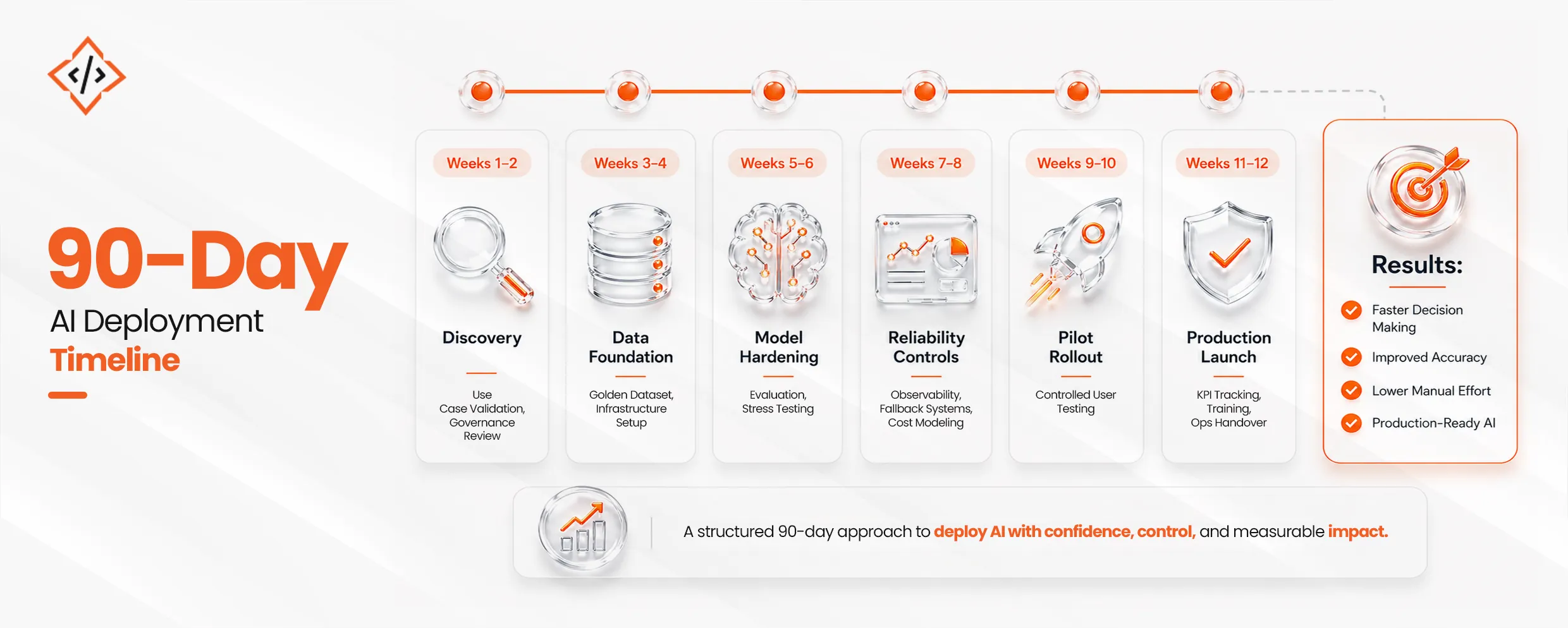
This structured engineering methodology ultimately delivers a 40% reduction in document processing time. Corporate teams achieve drastically improved response accuracy alongside faster operational decision making. Centralizing asset access also lowers manual employee effort to sustain long term business value.
Enterprise success is no longer determined by who can build an isolated proof of concept. Long term market leadership belongs to organizations that can deploy, govern, monitor, and scale systems reliably. Treating architectural execution as a structured operational process yields faster financial returns and minimizes deployment risks.
This structural discipline gives leadership ultimate confidence when initiating future computational workflows. Future business advantages will not come from launching more disjointed pilots. True enterprise value comes from turning existing experimental victories into repeatable corporate assets.
CodeTrade accelerates this transition by offering specialized engineering guidance to manage the complex journey from AI PoC to production. Technical teams deliver customized deployment strategies that integrate directly with your existing infrastructure architectures. This practical operational support establishes a scalable engineering foundation designed for continuous performance optimization.
 Chand Prakash
 Chand Prakash
 Chand Prakash
 Chand Prakash
 Chand Prakash