






Odoo Development
ERP
 Hardik Soni
29 September 2026
Hardik Soni
29 September 2026
How US Enterprises Can Execute A Flawless Odoo ERP Migration Without Operational Downtime?
 Hardik Soni

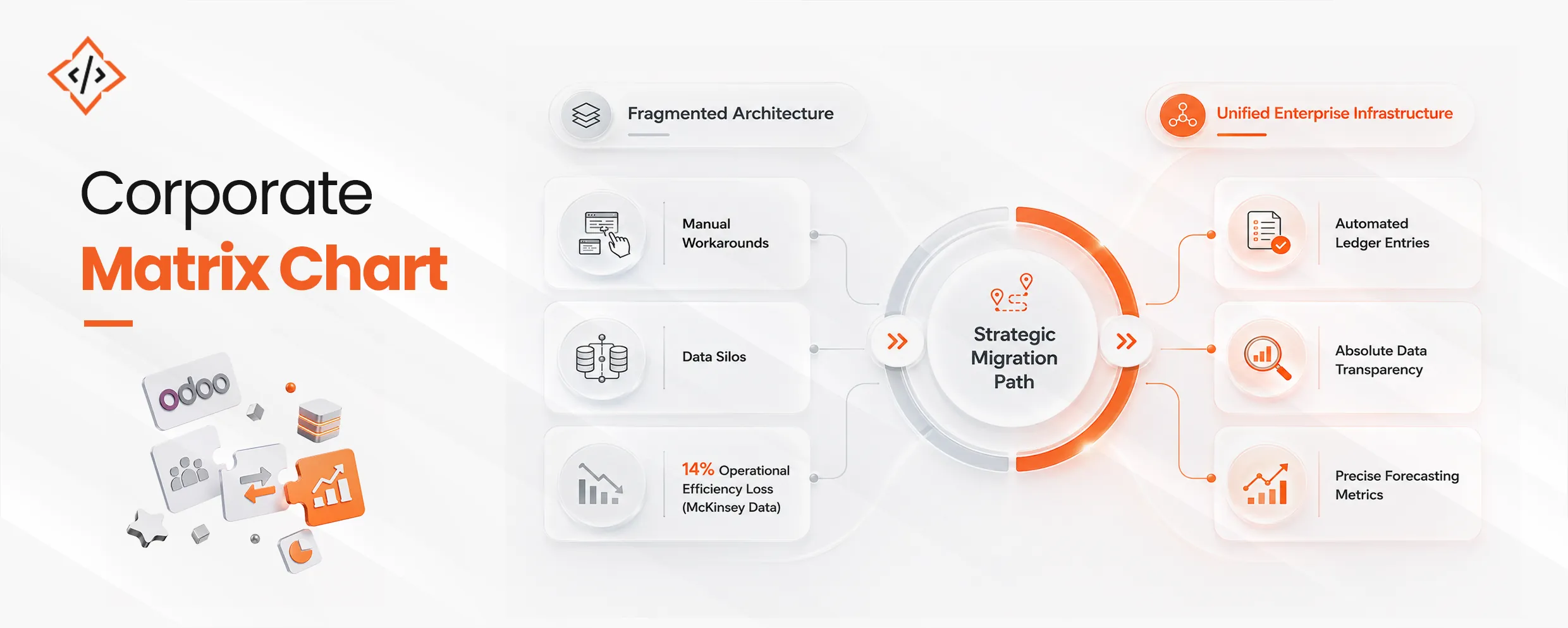
Corporate scaling requires absolute data transparency, yet relying on entry-level open-source software routinely restricts executive financial visibility. Mid-market Chief Financial Officers often outgrow basic accounting configurations, leading to manual workarounds that stall department-wide administrative production.
According to a McKinsey research study on enterprise applications, mid-market firms lose up to 14% in operational efficiency due to fragmented data silos and manual financial tracking. Executing an Odoo community to enterprise migration resolves these systemic friction points by unifying operational data for proper board-level reporting.
Moving from Odoo community to enterprise introduces advanced cash-flow management tools directly into the corporate infrastructure. CFOs can upgrade to replace disparate, localized spreadsheets with automated ledger entries.
This transition equips financial directors with the precise forecasting metrics required to minimize operational risk and successfully scale company operations.
Upgrading your corporate system eliminates manual operational friction while securing complete data alignment across expanding enterprise business departments.
The open-source community edition lacks the deep automation required for complex financial operations. Growing mid-market businesses frequently face processing delays because ledger data remains trapped inside legacy departmental siloes.
According to a 2026 Gartner report on cloud enterprise resource planning software, embedded system automation drives a 30% faster financial close. Transitioning to advanced corporate accounting solutions removes the necessity for manual entry validations.
Maintaining compliance across multiple jurisdictions requires a unified enterprise resource planning software environment. Utilizing specialized tools within the Odoo enterprise edition provides dynamic localization packages that update tax codes automatically. CFOs who execute a strategic Odoo community to enterprise migration effectively eliminate the risk of regulatory penalties.
Fragmented banking operations stall corporate liquidity analysis and complicate daily asset tracking. Choosing to upgrade Odoo community to enterprise introduces automated bank synchronization modules that link accounts directly with global institutions. Corporate treasury teams can deploy the premium Odoo accounting enterprise interface to reconcile transaction records continuously.
Deploying advanced accounting applications alters corporate ledger management while reducing manual labor overhead across administrative departments.
The community tier lacks deep multi-company synchronization tools required for instantaneous corporate financial health summaries. According to an industry McKinsey corporate financial analysis report, modern accounting departments utilizing integrated platform systems reduce time spent on manual number crunching by roughly 30%.
Transitioning to premium corporate software enables accounting teams to generate dynamic balance sheets instantly. CFOs who execute a strategic Odoo community to enterprise migration gain access to real-time financial tracking widgets.
Relying on basic accounting features forces management to compute depreciation values through unstable manual calculations. Manual asset monitoring introduces calculation discrepancies that complicate corporate tax filings and board auditing procedures.
Utilizing specialized Odoo enterprise features provides automated asset tracking modules that calculate amortization schedules systematically. Financial directors can upgrade Odoo community to enterprise to manage asset life cycles without human error. This advanced level of business process automation keeps corporate equipment valuations perfectly current.
Fragmented transaction matching loops delay month-end closings and consume critical operational hours inside corporate treasury branches. The enterprise tier changes how finance departments handle transaction matching by integrating smart vendor bill OCR tools.
Accounting staff use premium Odoo enterprise modules to match bank statements against open invoices automatically. Choosing the modern Odoo enterprise edition helps businesses minimize operational risks associated with regulatory compliance.
This comprehensive enterprise resource planning software upgrade allows companies to optimize cash flow monitoring effortlessly.
Evaluating long-term enterprise platform investments requires financial officers to project multi-year operational expenses alongside initial baseline deployment quotes.
Standard user subscription fees represent the most visible component of your initial corporate management software transition projection. Analytical decision-makers leveraging Odoo implementation services must calculate variable contract tiers early to prevent unexpected budgetary expansions during multi-departmental software rollouts.
According to recent ERP research tracking global software trends, companies utilizing integrated system infrastructure experience an average 15% reduction in overall corporate operational expenses. Securing a predictable Odoo licensing cost allows commercial enterprise boards to allocate corporate capital resources with absolute statistical precision.
Relying on basic open-source database setups often introduces hidden, unmanaged local server maintenance outlays for mid-market IT departments. Upgrading system frameworks alters infrastructure funding because companies transition data storage responsibilities to regulated, secure cloud-hosted enterprise networks.
Financial managers look past basic Odoo community features to select fully supported enterprise environment hosting structures. Selecting the modern premium Odoo enterprise edition helps corporate networks reduce independent hardware dependencies while preserving sensitive consumer account information security.
Maintaining legacy internal configurations requires continuous developer intervention to patch bugs and update standard accounting compliance modules manually. Executing an Odoo community to enterprise migration allows corporations to reallocate internal IT labor toward profitable technical growth assignments.
Transitioning to advanced Odoo enterprise features provides direct access to publisher support networks that resolve processing issues instantaneously. This strategic implementation approach helps finance directors establish sustainable business process automation guidelines that shield corporate margins over time.
A sequenced, phased implementation playbook protects critical data assets while maintaining uninterrupted operational continuity across enterprise departments.
Relying on unverified legacy tables introduces critical system formatting calculation mismatches that compromise real-time ledger reporting accuracy. An IDC research whitepaper regarding mid-market digital transformations highlights that over 40% of ERP implementation delays stem from poorly mapped data migration paths.
Financial directors looking to help an Insurance Company Automate Finance Operations avoid administrative overruns by strictly auditing community historical record structures before beginning technical execution procedures. This foundational preparation phase allows internal IT groups to cleanse historical transactional balances effectively.
Outgrown community dependencies require precise developer analysis to check whether existing functional extensions align with premium software frameworks. Maintaining older, unmanaged code configurations introduces database processing instabilities that routinely trigger costly administrative workflow bottlenecks.
CFOs evaluate their current structural landscape to map necessary custom modifications against standard Odoo enterprise features. This assessment step helps executives isolate necessary program adaptations from obsolete operational scripts.
Deploying complete system modifications simultaneously across multiple international departmental branches introduces major systemic disruption vulnerabilities to commercial enterprises. Modern financial officers employ a disciplined data transition roadmap that introduces specific corporate application suites sequentially.
Transitioning to advanced Odoo enterprise modules through structured departmental waves preserves active customer transaction pipelines. This modular implementation blueprint shields corporate operational margins from costly server downtime spikes.
System changes can falter if localized internal departments cannot navigate advanced operational ledger compliance screens after final database cutovers. Accounting supervisors coordinate sandbox testing exercises using premium Odoo accounting enterprise interfaces to verify calculation accuracy manually.
Upgrading Odoo community to enterprise relies on rigorous user validation loops to secure team alignment before full deployment sign-offs. This deliberate training phase establishes sustainable business process automation guidelines that board members can verify.
Transitioning away from foundational system limitations allows modern corporate finance teams to shift from basic ledger keeping to high-impact economic growth analysis. Executing an Odoo community to enterprise migration remains a strategic financial investment that builds a highly scalable foundation for extensive business process automation.
Upgrading to this premium enterprise resource planning software tier removes localized informational operational silos while securing structural corporate longevity. Financial directors utilize advanced Odoo enterprise features to maximize resource visibility and protect long-term market operational profitability.
Partnering with an experienced development firm offering specialized Odoo migration services simplifies technical deployment paths while minimizing database conversion execution liabilities. CodeTrade provides targeted technical proficiency to manage your full corporate Odoo migration strategy without risking disruptive processing platform downtime.
Our engineering specialists configure custom Odoo enterprise modules to match specific multi-currency accounting reporting guidelines. Corporate boards rely on our proven implementation frameworks to optimize their total Odoo migration cost.
 Hardik Soni
 Hardik Soni
 Hardik Soni
 Hardik Soni
 Hardik Soni