






AI
 Chand Prakash
09 September 2026
Chand Prakash
09 September 2026
AI Adoption Framework: A Complete Guide for Enterprise AI Success
 Chand Prakash
Customer relationships are becoming harder to manage through manual workflows alone. Sales and support teams now manage larger pipelines, faster response expectations, and growing customer data across multiple channels. This shift is increasing the demand for AI agents in CRM systems that can handle repetitive operational tasks with less manual involvement.
Through AI CRM integration, businesses are using automated lead qualification, workflow updates, and customer communication inside existing CRM platforms. Salesforce reports that 83% of sales teams using AI saw revenue growth in the past year, compared with 66% of teams not using AI.
This reflects how quickly AI is moving into everyday CRM operations. As CRM automation using AI becomes more common, businesses are evaluating AI agents cost against measurable operational outcomes. The discussion is now centered on CRM AI benefits, implementation challenges, and the long-term ROI of AI in CRM.
Customer operations are becoming harder to manage through manual CRM workflows alone. Businesses now require faster execution, cleaner customer tracking, and better operational visibility across growing sales pipelines.
Sales and support teams manage constant follow-ups, manual CRM updates, and fragmented customer records every day. These repetitive processes slow response times and increase lead management pressure across growing customer pipelines. AI agents in CRM help reduce operational delays through continuous workflow coordination and automated activity handling.
CRM platforms are evolving from passive storage systems into active operational environments. Through AI CRM integration, businesses are using systems that respond to customer behavior instead of only displaying information. Gartner predicts that by 2028, 70% of customer service journeys will begin with conversational AI. This shift is changing how CRM platforms function within daily workflows.
Businesses are also improving sales execution through CRM automation using AI across routine customer operations. AI-powered CRM tools now support lead scoring, meeting summaries, customer intent analysis, and automated responses within existing workflows. This improves workflow consistency while reducing repetitive administrative work across customer-facing teams, especially when supported by AI development services.
AI CRM integration changes how customer operations are managed across sales, support, and reporting workflows. Businesses gain faster execution, stronger visibility, and improved workflow coordination without increasing repetitive manual effort.
Sales teams are improving pipeline management through predictive forecasting, deal-risk detection, and opportunity prioritization. AI agents in CRM help businesses identify high-value opportunities before delays impact conversion performance. These systems also improve forecasting accuracy across growing customer pipelines and revenue operations.
Customer communication is becoming faster and more consistent through automated outreach and AI-generated replies. According to McKinsey, generative AI can reduce the time spent on customer service activities by up to 30%. Businesses are also improving conversational continuity across multiple customer touchpoints.
Businesses now operate with centralized activity tracking and stronger workflow intelligence across customer operations. Real-time customer insights help teams identify engagement patterns, sales delays, and pipeline changes more efficiently. AI CRM integration also improves visibility across disconnected customer communication channels.
CRM automation using AI is reducing repetitive operational work across customer-facing teams. Automated updates, intelligent task routing, and reporting assistance improve workflow consistency without increasing administrative workload. These operational improvements are becoming one of the strongest CRM AI benefits for growing businesses.
AI agents cost varies based on how deeply the system is integrated into existing CRM workflows and shaped through generative AI consulting.
| Layer | What’s Included | Cost Impact | Pricing |
|---|---|---|---|
| Infrastructure | APIs, cloud hosting, storage, model access | Higher usage increases operational costs | $5K–$25K yearly |
| CRM Integration | CRM connectors, ERP syncing, workflow mapping | Legacy systems increase setup complexity | $10K–$40K one-time |
| Customization | Agent behavior, prompt logic, automation rules | Custom workflows require deeper development | $15K–$60K+ |
| Security Setup | Permissions, access control, governance layers | Enterprise compliance adds implementation effort | $5K–$20K+ |
| Workflow Automation | Task routing, automated updates, escalation handling | Multi-team workflows increase configuration time | $8K–$35K+ |
| Ongoing Operations | Monitoring, retraining, optimization, support | Continuous maintenance affects long-term ROI | $2K–$12K monthly |
Businesses are adopting AI agents in CRM to improve operational efficiency and revenue visibility across customer-facing workflows. The strongest returns usually come from faster execution, reduced manual coordination, and more consistent customer engagement.
Finally, businesses are boosting lead engagement through faster responses and less waiting between messages, across those customer pipelines. AI-powered CRM tools can also reduce sales-cycle length by running automated follow-ups and supporting better opportunity prioritization.
CRM automation using AI reduces repetitive coordination work across sales and customer support operations through practical AI automation solutions. Automated workflows also improve task execution speed while lowering administrative workload for customer-facing teams.
Businesses are improving customer retention through proactive engagement and personalized communication across multiple interaction channels. This is especially visible in AI in fintech use cases, where customer responsiveness directly impacts retention. AI CRM integration also helps teams identify churn indicators before customer relationships begin weakening.
AI agents in CRM improve forecasting confidence through stronger pipeline visibility and better operational reporting accuracy. These insights support sales planning decisions while improving the long-term ROI of AI in CRM initiatives.
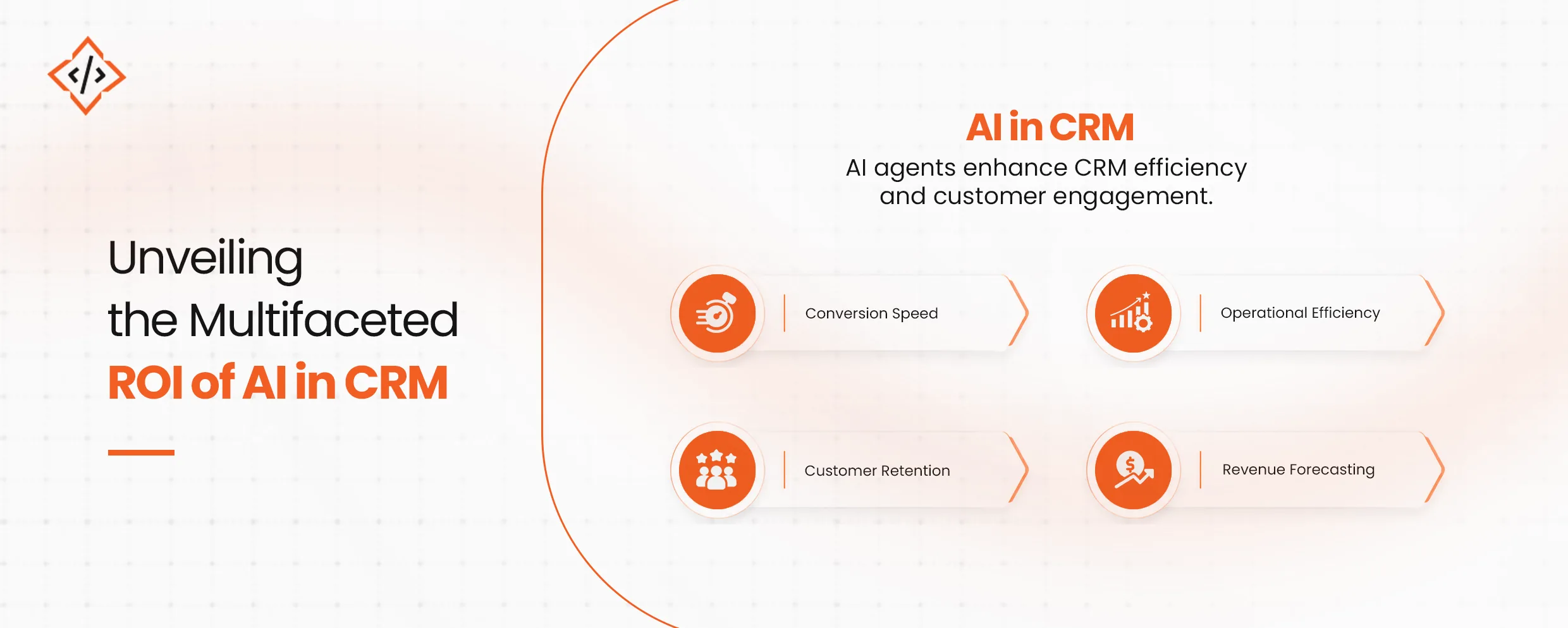
The ROI of AI in CRM depends more on integration quality and workflow design than the AI model itself. Businesses adopting AI-powered CRM tools are improving response speed, forecasting accuracy, and operational efficiency through proper implementation.
AI CRM implementation often fails when businesses automate operations without fixing workflow and data management issues first. Most implementation problems begin with poor operational planning rather than limitations in the technology itself.
Disconnected systems and inconsistent records create unreliable customer information across sales and support operations. Incomplete customer history also reduces the accuracy of AI agents in CRM environments and workflow recommendations.
Businesses sometimes create excessive workflows that add operational complexity instead of improving efficiency. CRM automation using AI also fails when low-value tasks are automated without proper human escalation processes.
Employee resistance often increases when teams receive limited onboarding and unclear workflow instructions after deployment. AI CRM integration also struggles when businesses fail to define practical day-to-day usage processes.
Many businesses expect immediate ROI without improving existing workflows before deployment begins. Replacing operational strategy with automation often creates long-term inefficiencies across customer management and reporting systems.
The ROI of AI in CRM is expected to move beyond basic automation toward continuous operational decision support. Businesses are now preparing for AI systems that improve customer management with minimal manual coordination.
AI agents in CRM are gradually handling multi-step workflows without requiring constant human supervision. They can manage approvals, customer updates, and operational coordination across connected business environments.
Also, companies are boosting customer engagement through intent forecasting, plus earlier outreach inside sales workflows. As Gartner notes, 75% of customer interactions are expected to include AI supported engagement tech by 2026, so it’s becoming the default. This shift is increasing demand for AI CRM integration across customer operations.
Businesses are using AI-powered CRM tools to manage coordination while teams focus on relationship-building and strategic decision-making. This operational balance improves workflow consistency while maintaining human oversight across customer interactions.
CRM automation using AI is becoming part of everyday operational infrastructure instead of functioning as a separate feature. Businesses are increasingly evaluating AI CRM implementation as a long-term operational investment rather than a short-term automation project.
AI agents in CRM are becoming part of everyday customer operations instead of functioning as optional automation tools. Businesses are focusing on measurable operational outcomes such as faster execution, stronger forecasting accuracy, and lower administrative workload.
The long-term ROI of AI in CRM depends less on automation volume and more on workflow quality, integration planning, and operational clarity. Businesses approaching AI CRM implementation with structured processes and realistic adoption goals are seeing stronger operational stability over time.
As customer expectations increase, AI-powered CRM tools will play a larger role in customer engagement and sales coordination. They also improve reporting accuracy without adding operational complexity.
This shift also requires implementation partners that understand both operational workflows and long-term system scalability. CodeTrade helps businesses build AI CRM integration strategies that align with real operational requirements instead of generic automation goals.
By implementing AI agents in CRM tailored to business workflows, CodeTrade helps organizations improve customer engagement, accelerate sales processes, enhance reporting accuracy, and build scalable customer operations for long-term growth.
 Chand Prakash
 Chand Prakash
 Chand Prakash
 Chand Prakash
 Chand Prakash