







AI
 Chand Prakash
11 September 2026
Chand Prakash
11 September 2026
Generative AI in Software Testing: Transforming QA and Test Automation
 Chand Prakash
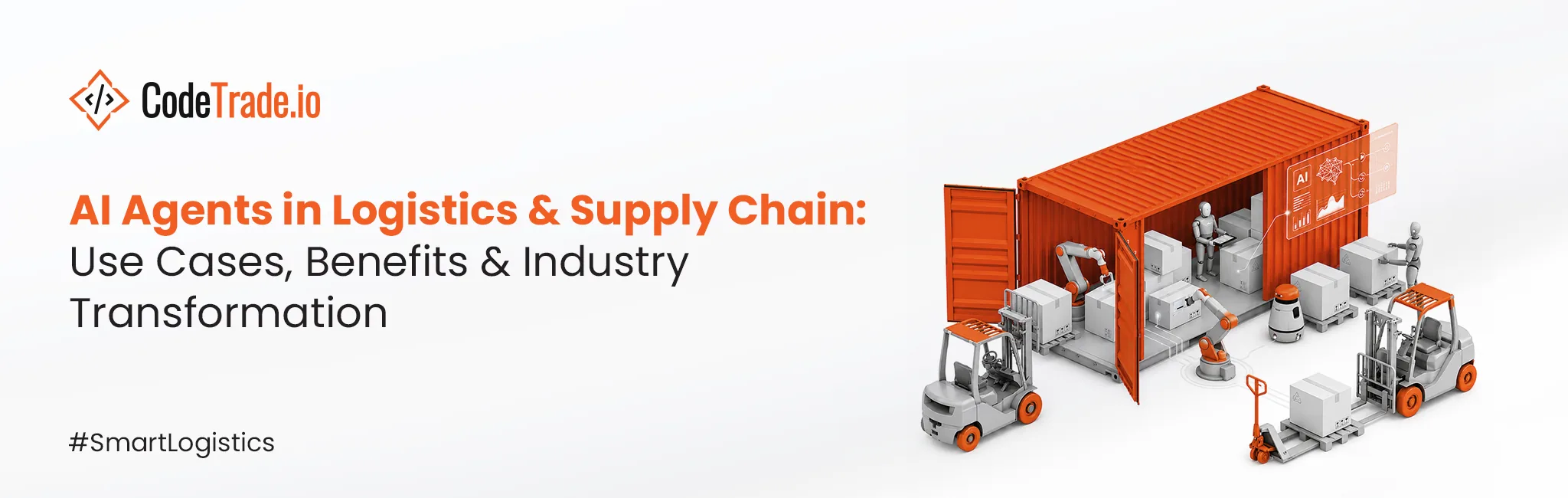
Most logistics software is good at one thing, and that is, they alert you instantly when something goes wrong. The system notifies users when a warehouse slot is empty or when a shipment is delayed. What comes next is still a human problem that takes hours of back-and-forth email correspondence and manual involvement to address.
This is the gap that AI agents in logistics are built to close. Traditional automation works in a linear way where rules are set in advance, and data is processed based on those fixed conditions. When reality falls outside these narrow rules, the problem is handed back to a manager. AI agents in logistics work differently because they possess reasoning capabilities. When a shipment is delayed, the agent investigates the cause, looks into alternative carriers, and estimates the costs before recommending a reroute.
According to the research, the 2025 IEEE IRASET Conference on Intelligent Systems, these autonomous systems are shifting the industry from “visibility” (seeing the data) to “agency” (acting on the data). This evolution effectively changes the role of technology from a passive observer to an active participant in your supply chain.
To understand how this shift happens in real-time, we must look at the internal logic that allows these agents to “think” like an experienced logistics coordinator.
Deploying intelligent logistics systems requires a departure from traditional “if-then” programming. Instead, we use a dynamic, three-layered cognitive approach that mimics human decision-making.
Think of this as the agent’s digital nervous system. It stays plugged into live data streams—GPS feeds, port congestion reports, and weather patterns. It doesn’t wait for a person to upload a CSV; it “senses” the global environment as it changes.
This is where the actual logic happens. If a delivery is running late but rerouting adds $500 in fuel, the agent doesn’t just panic. It weighs the late-delivery penalty against that fuel spend. It uses AI supply chain optimization to pick the most profitable path forward based on current constraints.
Once the choice is made, the agent just does it. It updates the manifest, pings the customer, and re-sorts the warehouse picking sequence. You only get a notification if the risk hits a threshold you’ve already locked in.
By automating this loop, companies move away from reactive firefighting and toward the high-impact use cases that define the modern supply chain.
The following are the top use cases that one could see in the supply chain:
Agents monitor live transit conditions and adjust routes mid-journey based on weather or labor disruptions. These agents constantly recalculate to make sure that every mile driven is required, unlike the static tools that lock in one path at the start. The global logistics leader DHL is a very well-known example of this. It has implemented an AI-driven route optimization tool to lower carbon emissions and fuel waste by determining the most efficient routes in real-time, even when road conditions fluctuate.
AI in warehouse management addresses sequencing by predicting order priority before the work day even begins. Agents analyze overnight orders and carrier pickup windows to plan the picking sequence automatically, ensuring that high-priority shipments are staged first. Amazon famously uses these sophisticated AI agents to predict demand and strategically “slot” inventory, placing products closer to the customers most likely to buy them before the order is even placed.
Freight invoices contain errors more often than most teams realize, leading to high “hidden” costs. AI-powered logistics solutions cross-reference every invoice against contracted rate cards in real-time to flag discrepancies before payment is processed. Industry-leading platforms already use this technology to automate the audit and payment process, thus helping firms recover millions in overcharged freight spend that would otherwise go unnoticed during manual reviews.
These useful applications offer more than simply convenience. They lay the groundwork for long-term financial success and operational robustness.
Transitioning to an agent-led operation provides a clear competitive advantage by addressing the three most common pain points in modern logistics. AI agents in logistics, in contrast to traditional software, do more than merely supply data. They actually enable the agency to act upon it without any human supervision!
By mastering logistics automation using AI, firms eliminate “empty miles” (trucks driving without the cargo) and minimize warehouse idle time. This direct reduction in overhead allows for a much leaner operational model without sacrificing the service quality or delivery speed.
A supply chain backed by AI agents doesn’t freeze when things go wrong. The system self-corrects and updates stakeholders automatically, creating a “self-healing” network. As noted in IBM’s insights on supply chain resilience, this self-correcting capability is the difference between a supply chain that bends and one that breaks under pressure.
Normally, growth usually requires hiring more dispatchers and coordinators. However, AI agent development services allow volume to increase significantly without a corresponding rise in staff. Agents absorb the coordination work, fundamentally changing the growth equation for firms that want to expand rapidly without bloating their back-office costs.
For most mid-market firms, the transition to intelligent logistics systems results in a 10–15% reduction in total logistics spend within the first 12 months, primarily through recovered freight overcharges and optimized asset utilization.
It takes a strategic approach to digital transformation and not new tools if you want to harness these benefits. By focusing on AI supply chain optimization, businesses can finally separate their operational complexity from revenue development.
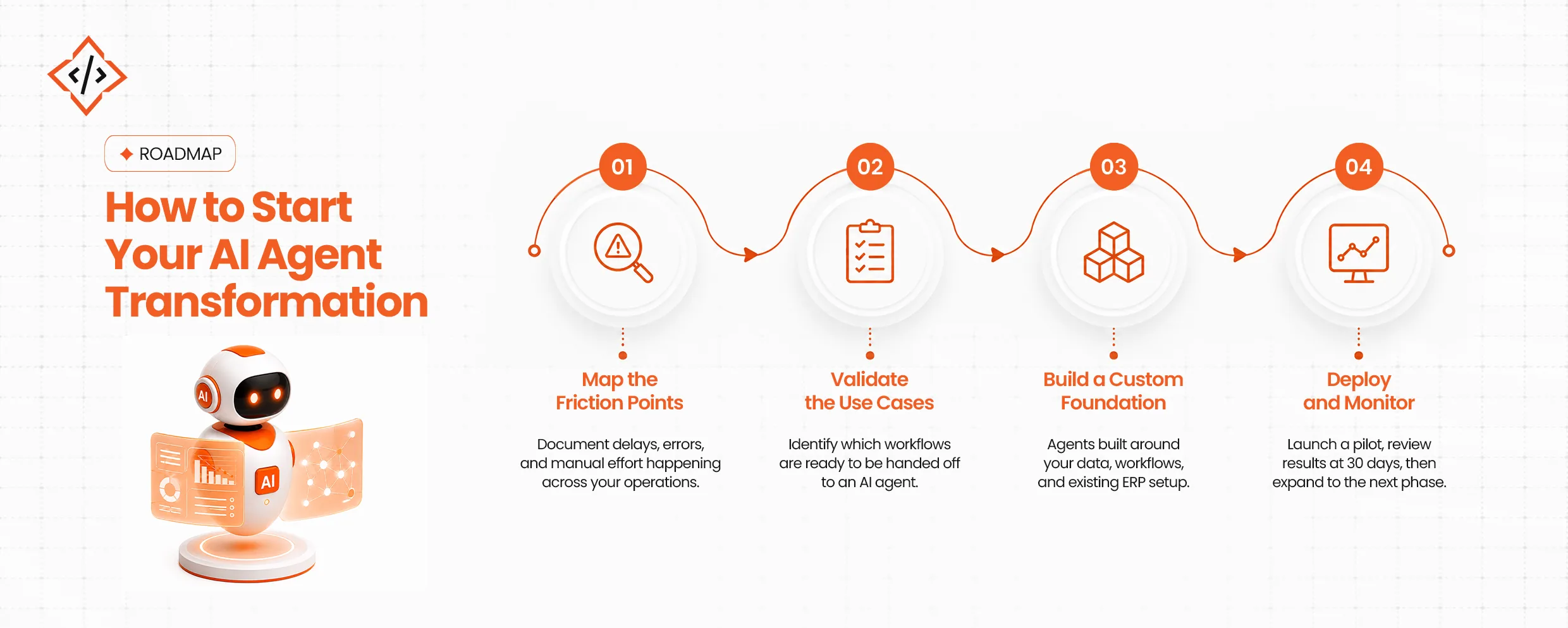
Building an autonomous supply chain is a sequenced journey. You can’t just flip a switch; you have to find where human effort is currently being wasted.
You need to sit down and document where the delays, errors, and manual emails are actually happening.
We use generative AI consulting services to see which of those messy workflows are actually ready to be handed off to an agent.
You work with AI agent development services to build agents that speak the language of your specific data and your Odoo ERP setup.
We launch a pilot, check the numbers at 30 days, and then use those wins to justify the next phase of the rollout.
As your team moves through these steps, the focus shifts from manual oversight to the future of truly autonomous trade.
As we move through 2026, switching from manual monitoring to autonomous agency will be a competitive necessity rather than being an experimental option. The logistics leaders of tomorrow will be those who adopt systems that are capable of independent thought, reasoning, and action rather than relying solely on “dashboards.”
At CodeTrade, we believe that the true power of AI lies in its ability to handle the routine, freeing your human team to focus on high-level strategy and market growth. The window to gain a first-mover advantage in autonomous trade is closing, and the time to build your intelligent infrastructure is now.
 Chand Prakash
 Chand Prakash
 Chand Prakash
 Chand Prakash
 Chand Prakash