







Odoo Development
Enterprise Application
 Hardik Soni
07 October 2026
Hardik Soni
07 October 2026
What ERPNext Actually Costs: Free Software, Real Budget?
 Hardik Soni

The Freshworks Cost of Complexity Report 2025 put a number on something most business owners already felt.
Based on a global survey of 706 professionals across IT, finance, and operations, it found that organizational and software complexity drains an average of 7% of annual revenue every year. Companies waste one in every five software dollars due to failed implementations and underused tools, and at the employee level, nearly seven hours are lost every week to fragmented processes and disconnected systems.
Now apply those numbers to a cleaning business. Multiple job locations, rotating staff, last-minute reschedules, recurring contracts, and manual invoicing are all running simultaneously, every single day. The problem is not disorganization alone. The entire operation depends on coordination happening correctly each time, and when it breaks down, the business pays directly through missed jobs, delayed payments, and clients who do not return.
This is exactly where Odoo for cleaning businesses fits, not as another tool to manage but as a system that connects every operational function and removes the friction that quietly drains revenue.
Running a cleaning company is operationally complex in ways that most service businesses are not. Several structural factors make the day-to-day harder to hold together, and understanding them explains why a generic solution never quite solves the problem.
Cleaning activities, unlike those in firms where teams work from a central location, are carried out simultaneously at various customer sites. Without real-time sync between the field and the back office, every update turns into a phone call. Even small changes lead to long message threads, and mistakes become hard to avoid.
In most industries, an internal error stays internal. But in the cleaning businesses, errors surface immediately because the client is directly affected. A lost contract, a duplicate assignment, or even a missed task can result from a missed schedule update. Compared to most service categories, the stakes on scheduling accuracy are much higher here.
A service business has no inventory buffer. There is no way to get the money back if a job is missed. The impact on cash flow is immediate and grows over time when invoicing is delayed, which is common, especially in manual settings.
Most cleaning businesses manage operations across WhatsApp, Excel, and separate billing software. Each tool creates a data gap. Those gaps collectively account for the operational loss that businesses rarely measure but consistently absorb in wasted time and missed revenue.
Odoo is not niche cleaning software. It is a full cloud ERP for cleaning services, and that distinction matters when comparing it to tools built around a single function.
As an Odoo ERP for service businesses, it includes field service management, CRM, invoicing, and workforce tracking as native modules that work together without requiring custom development. Field teams can access their jobs in real time, no matter where they are. On the other side, owners don’t have to keep checking messages to understand what’s going on. They can do that from a single place.
If you want a full breakdown of what the platform offers across its latest version, the Odoo 19 Guide covers every module in detail.
Because Odoo is designed around service-based workflows, it handles recurring jobs, client histories, and contract-based billing naturally, not as workarounds. Businesses do not have to bend the software to fit their process; the platform configures to how the operation already runs.
Being a cloud-based platform means field teams can check job details, confirm the assignments, and log their updates from any device. Office managers and owners, too, get a live view of the full operation from a single dashboard. This closes the visibility gap that fragmented tools leave open.
Each module directly addresses a specific operational gap that manual processes cannot reliably close. Thus, this is where Odoo for cleaning businesses creates the most tangible value.
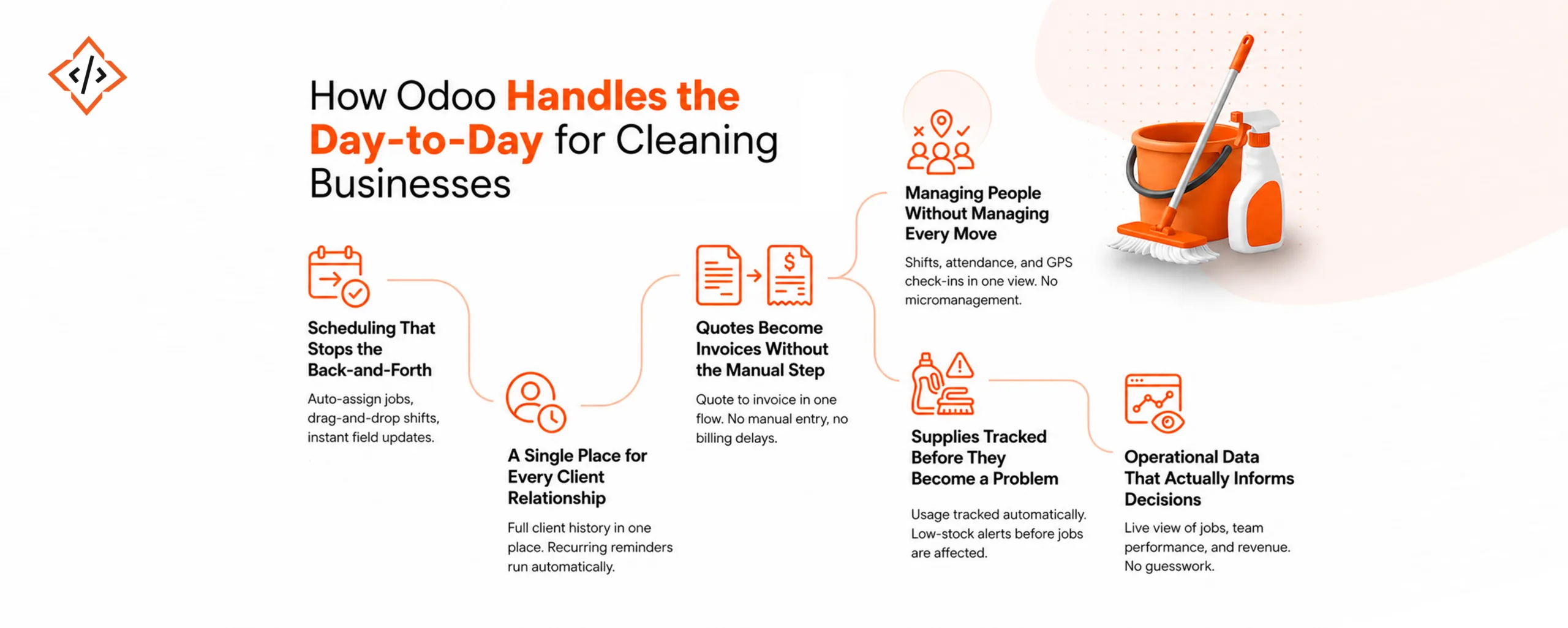
The cleaning service automation system in Odoo auto-assigns jobs based on staff availability and location. Drag-and-drop scheduling makes shift planning fast, and real-time updates push to field teams instantly when plans change. The coordination gaps that drive the most daily chaos get closed before they reach the client.
Odoo cleaning service management stores complete client histories, service preferences, visit frequency, and contact details in one accessible place. Recurring job reminders are automated, so repeat business does not fall away because someone forgot to follow up. Missed renewal revenue stops being a recurring problem.
Quotes convert to jobs, and jobs convert to invoices automatically once the work is complete, with no manual entry required. Payment tracking and follow-up reminders are built into the same workflow. The billing delays that create cash flow gaps in manual setups are eliminated at the process level, and this is one of the clearest examples of cleaning business automation software producing a direct financial impact.
Odoo service management covers shift planning, attendance tracking, and workload distribution in a single view. GPS-based check-ins give managers field visibility without constant phone calls, and balanced assignment across the team prevents the uneven workloads that lead to burnout and inconsistent service quality.
Odoo monitors cleaning material usage and sends automatic alerts when stock drops below set thresholds. Running out of supplies mid-job is a preventable problem, and the system handles that prevention consistently without anyone having to track it manually.
The cleaning business ERP dashboard gives owners a live view of job completion rates, team performance, and revenue in one place. When decisions are based on real data rather than end-of-week estimates, operational inefficiency becomes visible and correctable before it compounds into something larger.
The shift that follows implementation is not just about features. It is about how the business functions on an ordinary working day.
Scheduling is handled by the system rather than relying on someone catching an error before it reaches the client. Conflicts and duplicate assignments are flagged before they happen, which means the client-facing impact of internal mistakes drops significantly.
When invoicing is automated at the point of job completion, the gap between service delivery and payment shrinks. Businesses that previously waited days for invoices to go out see cash flow improve within the first few billing cycles.
Owners stop spending the majority of their day in operational firefighting and start focusing on bringing in new contracts and expanding capacity. That shift from operations to strategy is where real growth becomes possible.
Adding more clients to a manual operation increases the admin proportionally. With Odoo, the system absorbs that volume, so growth does not arrive with a matching increase in coordination problems.
Not every cleaning business is at the same stage, but the fit for Odoo tends to be consistent across a few clear situations.
Odoo for cleaning businesses is the right match for growing companies dealing with scheduling chaos, teams managing multiple client locations every day, businesses running recurring service contracts, and owners currently holding the operation together through spreadsheets and messaging apps. If any of those descriptions are accurate, the operational cost of staying with the current setup is higher than it might appear from the outside.
Most cleaning businesses eventually outgrow whatever tool they started with, and the reasons tend to follow a familiar pattern.
Niche cleaning business software solves one part of the workflow. Odoo solves the entire thing, from the first client inquiry to the final invoice. The productivity cost of switching between multiple tools, re-entering data, and chasing updates across platforms is a cost most businesses never formally calculate but consistently absorb.
Odoo’s modules are tailored to the particular needs of the operation, in contrast to inflexible tools based on a set procedure. A business running large commercial contracts has different workflow needs than one handling residential bookings, and Odoo accommodates both without forcing a compromise.
Replacing multiple software subscriptions and recovering the revenue lost through scheduling gaps and billing delays makes Odoo significantly more cost-efficient over any 12-month period. Working with professional Odoo development services ensures the platform is configured to the specific operational requirements of the business from day one, rather than using a generic setup that needs ongoing correction.
Running a cleaning business means handling schedules, teams, clients, billing, and supplies all at once, every single day. Odoo for Cleaning Businesses brings everything into one system, so nothing slips through the cracks and you’re not juggling multiple tools to keep things running. Here are the features that directly impact day-to-day operations.
Inefficiency is one of the most expensive problems a cleaning business carries, and one of the hardest to see clearly when the team is in the middle of running daily operations. The coordination demands of a distributed service business make operational gaps more costly here than in almost any other industry.
Odoo for cleaning businesses connects the scheduling, customer management, invoicing, workforce tracking, and reporting that most companies currently manage across a patchwork of tools. The result is not just a smoother process. It is an operation built to grow without the administrative load growing alongside it. To get started without the trial-and-error of self-configuration, hire an Odoo developer with hands-on implementation experience who can set the system up correctly from the ground up.
The difference between a busy cleaning business and a scalable one is the system running behind it.
 Hardik Soni
 Hardik Soni
 Hardik Soni
 Hardik Soni
 Hardik Soni