


Odoo Development
 Hardik Soni
19 May 2026
Hardik Soni
19 May 2026
Cost of Maintaining Odoo After Go-Live: Support, Upgrades, Cloud & Training
 Hardik Soni
Patient care may define a hospital’s reputation, but billing accuracy determines how financially stable that operation remains. Many healthcare providers continue to lose revenue through disconnected billing systems, delayed insurance approvals, duplicate records, and slow reconciliation cycles that gradually increase operational pressure over time.
As administrative workloads increase and reimbursement timelines become harder to manage, finance teams need systems that can track transactions with greater accuracy and visibility. This is why the Odoo hospital management system becomes critical, especially for providers already investing in Odoo development services to improve operational coordination.
Instead of functioning as standalone hospital software, it creates a connected financial workflow across billing, insurance, accounting, and collections.
According to a 2026 McKinsey & Company healthcare revenue cycle survey, 51% of healthcare leaders prioritized AI and automation in revenue cycle operations. These technologies help reduce claim denials and improve reimbursement timelines. They also strengthen financial performance across healthcare organizations.
Small billing inconsistencies often grow into larger financial losses when healthcare operations depend on disconnected systems and delayed coordination between departments.
Many healthcare providers still rely on spreadsheets and manual entries to manage invoices, patient records, and approvals. This increases the risk of duplicate billing, missing treatment charges, and inconsistent financial reporting across departments.
Teams working across disconnected systems also struggle to maintain accuracy during high patient volumes, which directly affects healthcare financial management.
Insurance claims often slow down because coding structures, approvals, and supporting documents are not aligned properly. Even minor mismatches can delay reimbursements for weeks. Without centralized workflows, finance teams spend additional time correcting rejected submissions instead of focusing on revenue cycle optimization and healthcare collections improvement.
Limited visibility into receivables and pending claims also makes it difficult to identify where revenue delays begin. Delayed reconciliation cycles also reduce financial clarity across departments and slow financial coordination. This is why many providers are adopting the Odoo hospital management system and Odoo billing automation to improve operational accuracy.
Disconnected financial processes often make it difficult for healthcare providers to identify where revenue delays begin and how much leakage exists across departments.
The Odoo hospital management system connects billing, insurance, patient records, and finance workflows within a centralized environment. This reduces dependency on disconnected tools and improves coordination between administrative and financial teams.
When operational data stays aligned, providers gain stronger control over healthcare financial management and more reliable day-to-day revenue tracking. Many healthcare organizations also hire Odoo developers to customize workflows around billing, insurance, and financial coordination.
Real-time visibility into receivables, unpaid invoices, and pending insurance payments helps finance teams respond faster to delays. Instead of waiting for end-of-month reconciliation, hospitals can monitor financial activity continuously and identify collection gaps earlier.
According to Deloitte’s 2025 Global Health Care Outlook, more than 70% of healthcare executives prioritized operational efficiency and productivity improvement. Many healthcare organizations are also increasing investment in ERP systems and financial workflow automation. These investments help reduce administrative inefficiencies and improve financial coordination.
Odoo billing automation improves consistency by standardizing invoice creation, approval routing, and payment reminders. This reduces manual follow-ups and supports healthcare collections improvement through more structured financial workflows.
Revenue leakage often begins with billing inconsistencies that remain unnoticed during daily financial operations. Over time, reimbursements slow down, claims rejection rates increase, and financial losses become harder to recover.
Odoo billing automation improves invoice accuracy by linking treatments, consultations, and diagnostic services directly with billing records. This reduces duplicate invoices and minimizes missing charge entries commonly found in manual workflows. The result is stronger billing consistency and fewer financial discrepancies across departments.
Verification checks built into the billing process help finance teams identify coding mismatches and incomplete claim details before submission. This reduces avoidable denials and improves reimbursement timelines. It also helps billing teams spend less time correcting rejected claims and more time maintaining consistent financial workflows across departments.
The Odoo hospital management system maintains centralized transaction records that improve reporting accuracy across financial operations. It also supports healthcare compliance software requirements during audits and operational reviews.
Insurance claim delays often increase when finance teams depend on manual coordination between billing staff, insurers, and administrative departments.
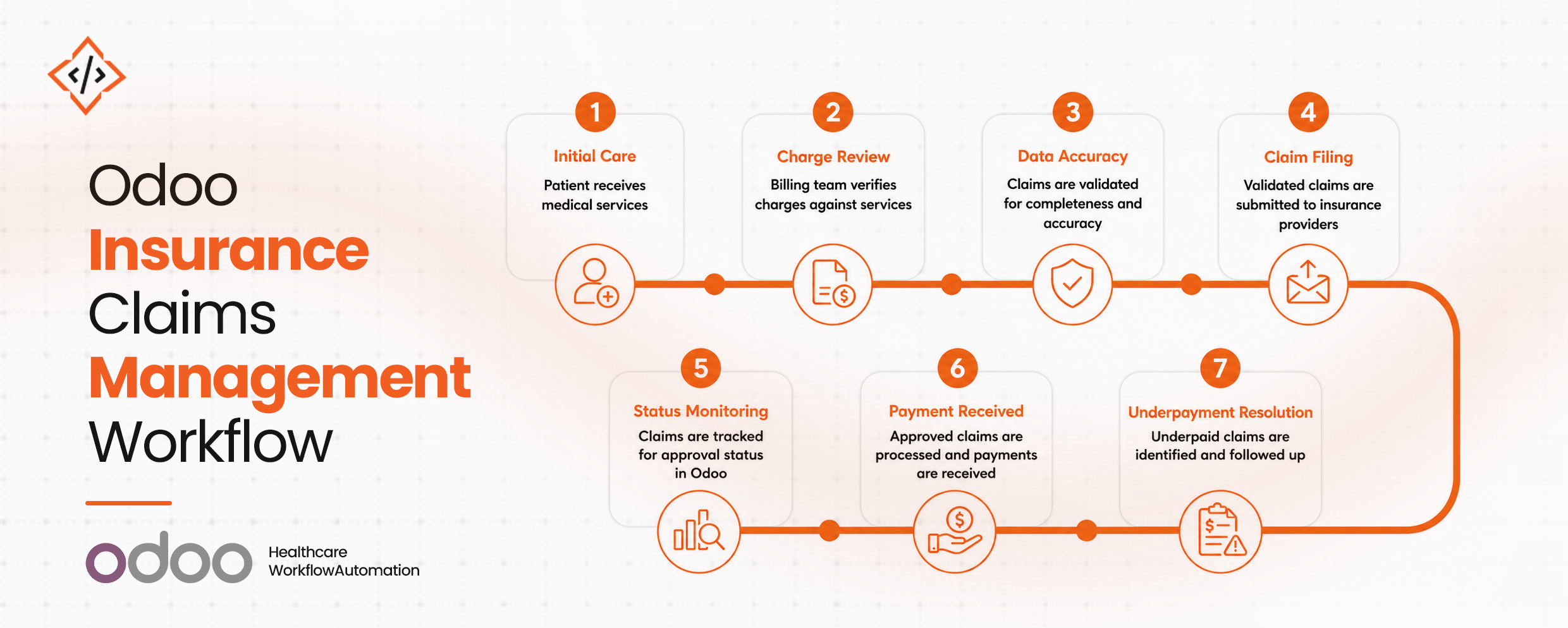
Odoo insurance claims management improves approval timelines by organizing claim documents and billing records within a connected workflow. This reduces repeated follow-ups and minimizes delays caused by missing paperwork or disconnected communication between departments.
The Odoo hospital management system also gives finance teams better visibility into pending approvals, rejected claims, and reimbursement status. Instead of reviewing multiple systems manually, teams can track claim movement from a centralized dashboard and respond to payment delays more efficiently.
Odoo billing automation also helps identify underpaid claims and incomplete reimbursements more quickly. Faster follow-ups improve healthcare collections improvement efforts and reduce revenue loss caused by delayed recovery cycles within healthcare financial management workflows.
Preparation plays a major role in how smoothly Odoo ERP implementation for healthcare performs after deployment. Many providers also evaluate Odoo implementation cost based on operational requirements and billing complexity.
Healthcare providers should first identify billing bottlenecks, delayed approvals, and gaps within insurance workflows. Clear process mapping helps teams understand how operational inefficiencies affect revenue cycle optimization and financial coordination.
Patient records, insurance details, and financial history should be reviewed before migration begins. Inconsistent or outdated records often create reporting errors and reimbursement delays after implementation.
The Odoo hospital management system should be configured with proper access permissions, audit trails, and reporting controls from the beginning. Strong healthcare compliance software practices help providers maintain financial accuracy and regulatory readiness across departments.
Healthcare organizations are no longer evaluated only by the quality of patient care. Financial responsiveness, reimbursement accuracy, and operational visibility now play a direct role in long-term sustainability. Providers improving collections today are building connected financial systems that reduce billing gaps, improve claims coordination, and strengthen reimbursement efficiency across departments.
The Odoo hospital management system supports this shift by creating more structured workflows across billing, insurance, accounting, and compliance operations. As administrative pressure continues to increase, healthcare providers need financial infrastructure that improves control without slowing operational efficiency.
At CodeTrade, healthcare-focused Odoo implementations are designed around real operational challenges, including billing accuracy, claims management, and healthcare financial management workflows.
With experience in Odoo ERP implementation for healthcare, the focus remains on building scalable systems that improve revenue visibility and support long-term operational stability.
The Odoo hospital management system reduces billing errors by connecting treatments, diagnostics, insurance details, and invoices within a single workflow. This minimizes duplicate billing, missing charge entries, and manual reconciliation issues that commonly affect reimbursement accuracy across healthcare operations.Odoo improves healthcare collections improvement by giving finance teams real-time visibility into pending invoices, delayed payments, and rejected claims. Automated payment reminders, centralized receivable tracking, and structured approval workflows help providers reduce collection delays and improve cash flow consistency.Yes, Odoo insurance claims management helps providers manage claim submissions, reimbursement tracking, approval status, and rejected claims from a centralized system. This reduces manual coordination between departments and improves response time when reimbursement delays or claim discrepancies occur.Odoo billing automation can handle invoice creation, insurance verification checks, payment reminders, reimbursement tracking, and approval routing within healthcare financial workflows. Automating these processes reduces administrative dependency on spreadsheets and improves operational consistency across finance and billing teams.The Odoo hospital management system provides real-time visibility into receivables, billing activity, claim status, outstanding payments, and financial performance metrics. This helps hospital administrators and finance teams make faster decisions without waiting for delayed reconciliation cycles or manual reporting updates.
 Hardik Soni
 Hardik Soni
 Hardik Soni
 Hardik Soni
 Hardik Soni