






Odoo Development
eCommerce
 Hardik Soni
12 October 2026
Hardik Soni
12 October 2026
How Can You Safely Manage A Complex Magento Odoo ERP Integration?
 Hardik Soni
Odoo is the optimal choice for complex, heavy-asset production, while Zoho dominates for service-based and sales-driven omnichannel retail. The core Zoho vs Odoo 2026 decision ultimately dictates how a company scales. Choosing the wrong system architecture inevitably leads to severe operational bottlenecks and bloated IT budgets. Many organizations underestimate the financial risk of software misalignment.
According to Gartner research, more than 70% of recently implemented ERP initiatives will fail to fully meet their original business goals by 2027. These failures often stem from selecting platforms that simply do not match the underlying business logic. This guide evaluates core system capabilities, actual deployment costs, and deep architectural differences relevant to Odoo implementation services.
Operational leaders can use this Odoo vs Zoho comparison to make the correct investment. A proper ERP ROI comparison helps decision-makers secure long-term scalability without overspending on unnecessary system customizations.
Odoo utilizes an open-source framework for deep modularity, whereas Zoho relies on a proprietary suite for unified business management.
| Architectural Dimension | Odoo ERP | Zoho ERP |
|---|---|---|
| Underlying Framework | Open-source, modular app ecosystem built on Python and PostgreSQL | Proprietary, closed-source cloud suite built on multi-tenant architecture |
| Source Code Access | Full access to source code for deep backend and frontend modifications | No access to underlying source code; restricted to low-code configurations |
| Customization Depth | Unlimited code-level tailoring for complex logic, custom tables, and routes | Restricted to Deluge scripting, standard workflow rules, and pre-built APIs |
| Hosting Flexibility | On-premise, private cloud, or managed hosting via Odoo.sh | Cloud-only hosting managed exclusively on Zoho proprietary servers |
| Application Scalability | Installs individual modular apps on demand to keep systems lightweight | Delivers a pre-packaged suite of applications through Zoho One |
| Cross-Module Sync | Modules share a single unified database with zero sync delays | Applications connect through internal APIs and background sync protocols |
| Vendor Dependency | Zero vendor lock-in; code and data remain fully portable across providers | High vendor lock-in; operations depend entirely on Zoho platform continuity |
| Implementation Speed | Moderate to long; requires precise architecture and development mapping | Rapid deployment; features offer out-of-the-box readiness with minimal setup |
| Core Operational Strength | Advanced discrete manufacturing, dynamic MRP, and multi-warehouse routing | Omnichannel customer management, inbound marketing, and pipeline tracking |
| Optimal Environment | Asset-heavy factories, batch processors, and complex supply chain networks | Sales-driven organizations, boutique retail chains, and service businesses |
Odoo is the best ERP for manufacturing businesses due to its native routing and dynamic Bill of Materials capabilities. Odoo customization services provide the deep shop floor visibility that basic inventory management applications cannot deliver. Industrial plants depend on live tracking across machinery, labor, and component availability.
Disconnected systems create data silos between procurement and the production floor. Selecting software requires verifying that engineering change orders sync directly with inventory reserves. In this direct Odoo vs Zoho for manufacturing comparison, system architecture on the factory floor becomes the deciding factor.
Odoo manufacturing software delivers fully integrated Material Requirements Planning and Product Lifecycle Management modules out of the box. Production planners can easily configure multi-level Bills of Materials with parallel routing steps.
Engineers can update design revisions without disrupting active work orders on the floor. The software automatically recalculates delivery schedules based on supplier lead times and actual workstation capacity.
Workflows remain connected from design engineering straight to final assembly. For instance, a supervisor can monitor raw material consumption at assembly stations and trigger automated quality checks on floor tablets. The system updates inventory levels instantly when technicians record component usage.
Maintenance alerts deploy right away if equipment registers unexpected performance drops. These integrated tools make Odoo manufacturing ERP uniquely suited for discrete, batch, and continuous production environments.
Zoho approaches factory operations from a sales and distribution perspective rather than true production management. Zoho Inventory handles basic product bundling, light kitting, and multi-warehouse stock replenishment exceptionally well. Growing brands can track finished goods across several storage hubs with high accuracy and speed.
However, companies searching for a dedicated Zoho manufacturing ERP will hit firm functional boundaries. The platform lacks native support for machine capacity planning, multi-stage routing, and shop floor operator interfaces.
Production teams cannot schedule preventative maintenance or track overall equipment effectiveness directly within the system. Managing heavy industrial assembly lines requires connecting external third-party applications through custom API bridges.
These middleware connections introduce sync delays, complicate data governance, and increase unexpected maintenance expenses over time. Mid-market manufacturers quickly outgrow these limitations as production volumes rise.
Zoho offers a fast and unified engine for e-commerce and customer retention. Conversely, Odoo retail ERP provides a vastly superior integrated Point of Sale and multi-location inventory engine. Selecting the best ERP for retail businesses requires evaluating exact sales channels. Omnichannel sellers face unique inventory synchronization challenges.
The Odoo vs Zoho for retail debate comes down to physical versus digital priorities. High-volume physical stores need reliable hardware connections. Digital-first brands demand deep customer behavior tracking. Retail directors must match their software to their core business model.
Choosing the right system prevents costly delays during peak shopping seasons. We must compare how both platforms manage the daily retail grind.
Odoo delivers a highly dependable Point of Sale application. The POS system remains fully functional even during internet outages. Retailers never have to halt checkout lines due to connectivity drops. The software syncs automatically with the central database upon reconnection.
Odoo provides extensive support for diverse retail hardware setups. This creates a resilient foundation for continuous physical store operations. Store managers can easily handle complex barcode configurations and unique product variants. Multi-location retailers benefit from automated stock replenishment features. The system updates inventory levels instantly across all global locations.
Cashiers process daily sales transactions directly into the main accounting ledger. This eliminates the need for manual batching at the end of shifts. This level of automation reduces human error significantly. It prevents costly bottlenecks during peak holiday shopping periods.
Retailers gain real-time visibility into local stock levels and financial health. These integrated features make Odoo retail management highly effective for complex physical storefronts.
Zoho provides a superior sales ecosystem for digital-first retail operations. It tracks the complete customer journey from the first click to final purchase. Retailers connect their e-commerce storefronts directly with Zoho CRM and Zoho Campaigns. This integration ensures smooth data flow across all customer touchpoints.
Marketers gain deep insights into buyer preferences and seasonal shopping habits. Retail management teams focus heavily on building customer loyalty programs. Zoho allows teams to design targeted email promotions easily. The software excels at delivering highly personalized marketing campaigns. Support agents resolve issues quickly using the unified ticketing system.
Fast issue resolution improves overall brand reputation and repeat purchase rates. This capability increases customer lifetime value and average order size. Zoho retail management acts as a cohesive revenue-driving engine.
Decision-makers appreciate the straightforward setup and reduced IT overhead. It scales exceptionally well for brands prioritizing online customer retention. The platform connects storefront traffic to backend fulfillment smoothly.
Odoo offers a unified per-user license but requires higher upfront developer capital. Zoho provides tiered bundle pricing that drastically reduces initial deployment expenses. Evaluating the true financial impact goes beyond checking basic monthly subscription rates. Decision-makers must calculate the hidden labor costs required to launch successfully.
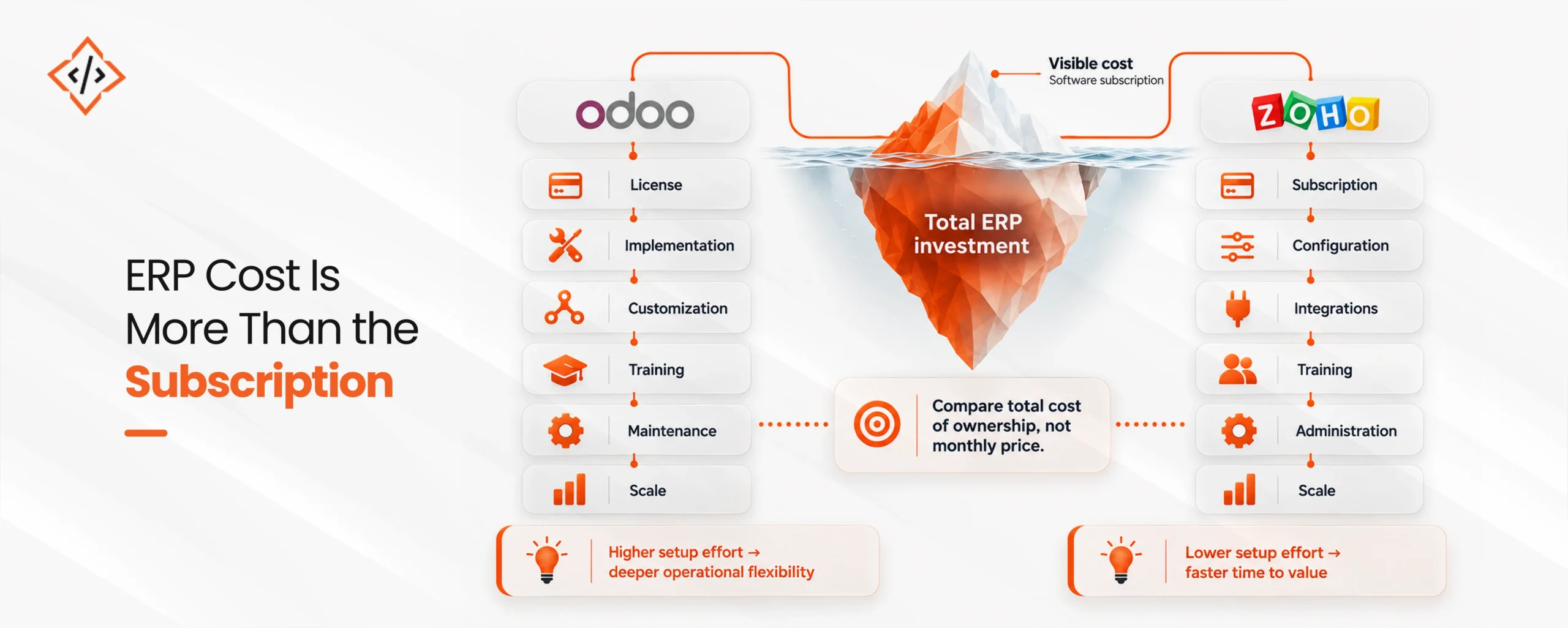
Odoo recently shifted to a simplified flat-fee pricing model. This structure charges a single rate per user across the organization. It grants full access to every application within the open-source ecosystem.
On paper, Odoo ERP pricing appears incredibly affordable for growing companies. However, software licenses represent just a fraction of the total investment. The real ERP implementation cost for Odoo stems from specialized technical labor. Companies must hire Odoo developers to map the software to their exact operations.
Adapting the system for complex supply chain logic takes precise coding work. Customizing workflows for intricate manufacturing processes demands significant upfront capital. Business leaders must carefully budget for these extended development cycles.
A low monthly fee does not guarantee an inexpensive system launch. The high initial setup investment pays off only through long-term operational scale.
Zoho approaches software deployment through a completely different financial model. The Zoho One suite utilizes a compelling all-employee pricing structure. This comprehensive bundle proves highly cost-effective for mid-market businesses.
Organizations gain access to over forty enterprise applications for one predictable fee. The main financial advantage is the elimination of heavy customization requirements. These native applications are pre-integrated to share data instantly upon activation. Businesses save significantly on initial IT architecture and complex system mapping overhead. This closed ecosystem design ultimately guarantees a much faster time-to-value.
Sales teams can deploy retail management tools and CRM modules almost immediately. Organizations avoid the steep consulting fees associated with extensive bespoke development. Directors can then redirect those saved IT funds into direct revenue generation. This makes Zoho highly attractive for companies wanting strict budget control.
The most accurate ERP ROI comparison relies entirely on matching system capabilities directly to your primary revenue drivers. Manufacturing firms achieve maximum Odoo ROI by eliminating fragmented third-party software subscriptions. The platform consolidates product lifecycle management and material requirements planning into one database. This deep native integration drastically reduces costly machine downtime on the factory floor.
Operational leaders gain complete production visibility without paying for extra middleware tools. Retail operations realize fast Zoho ROI through significantly reduced IT architecture overhead. The proprietary ecosystem connects customer relationship management directly with digital marketing pipelines.
Sales teams can launch targeted promotional campaigns and track storefront inventory simultaneously. This unified data flow speeds up revenue generation across all active sales channels. Retailers avoid long implementation cycles and begin capturing market share almost immediately. An objective Zoho vs Odoo financial assessment requires auditing your exact daily workflows.
Decision makers must choose the architecture that naturally supports their specific business model. Aligning software functionality with operational reality guarantees a highly profitable enterprise investment.
IT directors must stop treating ERP selection as a simple feature checklist. Operational leaders should thoroughly audit their internal technical resources first. Next, map out the most complex operational bottleneck in your organization. Determine if the primary challenge lies in factory production or multi-channel customer acquisition. This specific bottleneck must ultimately dictate your final software architecture choice. Organizations should consult with experienced integration specialists before finalizing any software licensing.
Navigating this complex deployment phase alone often leads to unexpected ERP implementation costs. Securing objective expert guidance ensures your chosen system aligns perfectly with long-term financial goals.
CodeTrade brings deep technical expertise to every Zoho vs Odoo deployment. Our Odoo development services build highly resilient business management systems for growing enterprises. We ensure your final platform configuration delivers the highest possible operational return on investment.
 Hardik Soni
 Hardik Soni
 Hardik Soni
 Hardik Soni
 Hardik Soni