






AI
Odoo Development
FinTech & Banking
 Chand Prakash
31 August 2026
Chand Prakash
31 August 2026
How AI Agents for Accounts Payable Reduce Expensive Exception Handling Costs?
 Chand Prakash
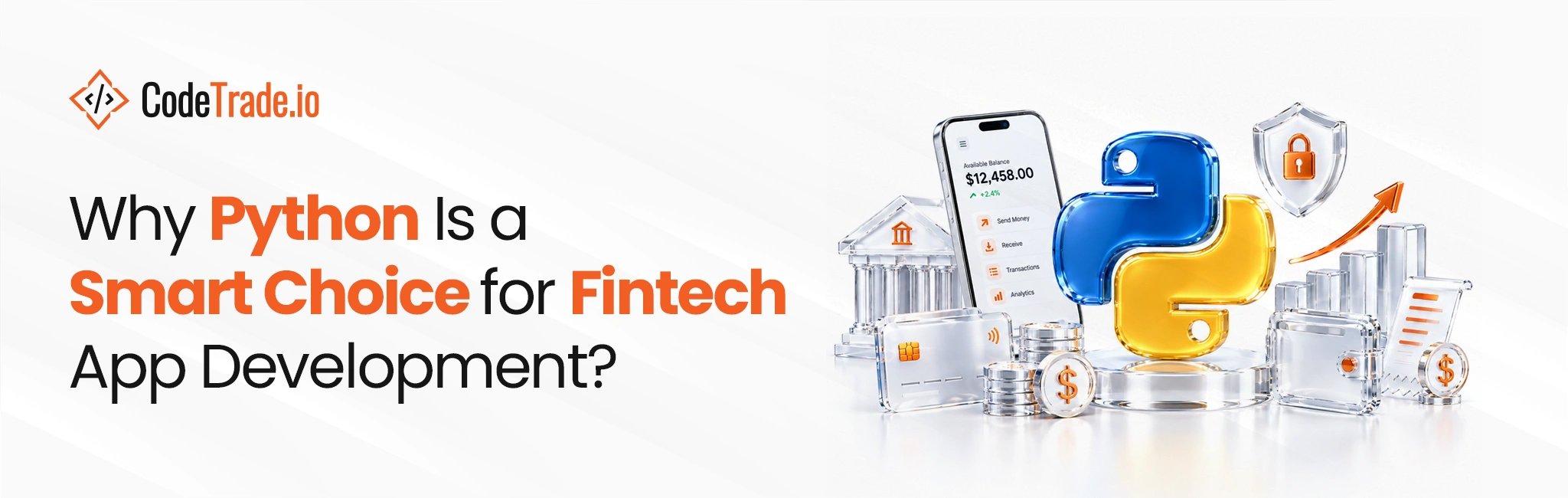
Python has become the default infrastructure language for financial technology. It processes complex quantitative data faster than alternative options while remaining highly readable for strict regulatory audits. Technical leaders increasingly choose Python fintech app development to build secure platforms that scale efficiently.
The global fintech as a service market size reached $416.85 billion in 2025, according to Precedence Research. Financial applications command a massive portion of this precise enterprise investment. Python for financial services supports this demand by handling heavy data loads without severe system bottlenecks.
This guide examines the core structural advantages of enterprise Python development services. It details advanced data processing capabilities, security frameworks, and overall system scalability. Engineering teams building modern trading systems and Python banking software will gain clear strategic direction here. The primary focus remains on rapid deployment and complex data management for modern fintech software development.
The language dominates the financial sector because its syntax mimics mathematical equations directly. This clear structure allows financial analysts and software engineers to collaborate on the exact same codebase. Python for fintech effectively bridges the gap between complex quantitative modeling and scalable backend engineering. Code logic remains completely transparent during critical regulatory audits.
The global development community actively prioritizes this architectural advantage. In 2024, Python overtook JavaScript to become the most popular programming language on the platform, according to the GitHub Octoverse report. This milestone highlights its total dominance in data-heavy and algorithmic environments.
Modern fintech software development demands rapid iteration cycles alongside uncompromising system stability. Python’s clean architecture prevents technical debt from accumulating during high-speed development sprints. Engineering teams can push complex updates faster without risking catastrophic system failure. This rapid execution speed directly improves the bottom line for any operating fintech development company.
These technical advantages deliver measurable business outcomes across the organization.
Python processes millions of financial transactions in seconds by bypassing native limitations through specialized data libraries written in C. This architecture gives Python fintech app development the exact computational power required for modern enterprise banking systems.
Engineering teams heavily rely on Pandas to clean dirty data formats efficiently. This includes normalizing chaotic merged broker dumps and fixing inconsistent net asset value files before execution. According to a recent JetBrains report, 72% of Python developers utilize NumPy for data processing. This cements it as the foundational mathematical library for scientific computing and Python financial applications globally.
These tools provide highly vectorized operations. Developers can manipulate large datasets directly in memory without writing repetitive loops. The resulting code remains exceptionally clean and easy to audit for strict financial compliance.
Traditional spreadsheet environments routinely crash when asked to process heavy transactional volume. Python completely avoids these system failures. The language can execute complex financial logic across millions of rows of daily trade prices without stalling.
This capacity is critical since IDC forecasts that global data generation will reach an overwhelming 221 zettabytes in 2026. Managing this massive information flow requires serious infrastructure capability. Engineering leaders use Python to build scalable pipelines that ingest this data reliably.
Modern financial markets operate on milliseconds. Python handles live data ingestion directly from global stock exchanges without severe latency. This rapid ingestion allows backend applications to compute accurate risk ratios continuously. Python fintech solutions then update complex financial models dynamically based on these live market feeds.
System architects deploy these models to predict sudden market volatility. This ensures institutional trading firms can adjust their portfolio positions instantly when global economic indicators shift.
The language provides enterprise-grade security by standardizing vulnerability protection at the framework level rather than leaving it to individual developers to configure manually. This centralized protection model minimizes human error during core infrastructure builds.
Standard libraries come fully equipped to handle advanced cryptography out of the box. Development teams implement AES-256 encryption and TLS protocol routing without relying on untested third-party scripts. This architecture guarantees that data at rest and data in transit remain completely protected from unauthorized access.
Modern Python banking software secures financial transactions through native identity management modules. These built-in security layers enforce strict operational controls across the entire platform:
Clean, readable codebases make it significantly easier for third-party auditors to verify regulatory compliance. When building platforms for financial app development, engineering teams must satisfy strict standards like PCI-DSS, SOC 2, and GDPR.
Python’s clear syntax eliminates ambiguous code structures during architectural reviews. Compliance teams can trace financial logic directly, verifying that sensitive customer data remains isolated and protected across every transaction pipeline.
Teams launch applications months faster by utilizing mature full-stack frameworks. These tools provide routing, database mapping, and administrative scaffolding straight out of the box. This approach fundamentally streamlines modern fintech application development for fast-moving enterprise teams.
Engineering leaders consistently rely on established Python frameworks to build secure backend systems. According to the 2025 JetBrains Python Developers Survey, Django maintains a strong 35% adoption rate among developers. Flask follows closely with a 34% adoption rate for backend development.
Engineering teams use Django as the default choice for heavy data applications. It handles complex financial user databases securely and reliably. Conversely, Flask manages lightweight microservices effortlessly across the distributed network. This structural division allows developers to allocate computing resources exactly where they belong.
Financial markets demand aggressive delivery timelines from engineering teams. Developers can build a minimum viable product in just a few weeks rather than months. Python fintech development relies on this speed to test product-market fit quickly.
Businesses avoid committing to expensive scaling infrastructure before validating their core financial model. This agile methodology protects the initial engineering budget effectively while ensuring rapid market entry.
Engineering teams do not need to build core components from scratch. As of early 2026, a PiWheels report found that the repository hosts over 736,344 live packages globally. This massive ecosystem gives developers instant access to pre-tested code. It entirely eliminates the need to reinvent fundamental financial mechanics.
Teams can integrate complex payment gateways and advanced blockchain protocols immediately. Utilizing these established libraries significantly speeds up the entire Python fintech app development cycle.
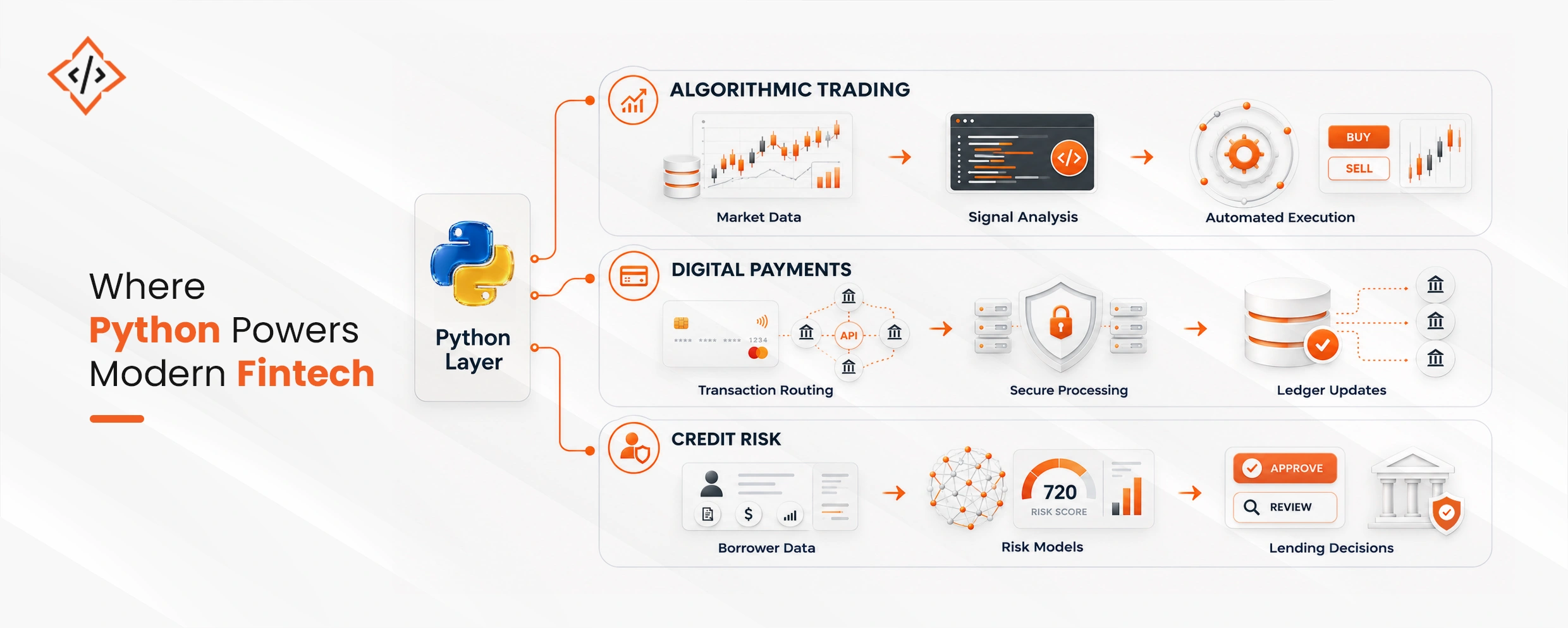
The language currently powers the core infrastructure of the largest digital banks, investment platforms, and institutional trading firms globally. Python fintech solutions run mission-critical operations where precision and computational speed directly dictate market success.
Institutional trading firms use Python to build automated high-frequency trading platforms. These intelligent systems execute complex market actions with minimal latency:
Modern digital payment gateways handle millions of concurrent transactions every day. Python manages high-volume routing operations securely between global merchants, consumer interfaces, and legacy banking networks. The software isolates financial transaction records and handles real-time ledger updates without degrading throughput. Engineering teams rely on its modular architecture to scale payment infrastructure reliably across diverse geographic regions.
Enterprise financial app development relies on Python to evaluate lending risks and forecast potential default events accurately. Data science teams build predictive models that calculate Probability of Default and Loss Given Default within seconds.
These automated statistical pipelines replace slow, manual spreadsheet workflows. Underwriters can assess borrower risk profiles in real time, dramatically improving approval speeds while keeping loan defaults to a minimum.
Selecting a development partner requires finding a team that understands financial compliance just as deeply as they understand code architecture. A generalist agency often lacks the technical nuance needed for mission-critical financial systems.
Technical leaders must carefully review past case studies before signing an engagement contract. Focus specifically on real-world implementations rather than generic software portfolios:
Prioritize a specialized fintech development company with proven experience over general web agencies.
Enterprise financial systems demand strict security vetting from day one. Engineering leaders must mandate rigorous automated code reviews and continuous dependency scanning across all repositories. Confirm that the external team has proven experience passing independent, third-party security audits.
They must demonstrate comprehensive compliance with critical standards like SOC 2, PCI-DSS, and ISO 27001. A capable partner builds defensive security measures directly into every layer of your fintech app development project.
The integration of artificial intelligence into financial services guarantees that Python will remain the dominant infrastructure language. The global developer talent pool actively prioritizes machine learning frameworks natively supported within this environment. Engineering organizations that hire Python developers gain direct access to specialized talent capable of connecting quantitative finance with production backend systems.
This vast developer ecosystem perfectly matches modern enterprise investments across the financial sector. The global artificial intelligence in banking market will reach $45.59 billion in 2026, per Precedence Research. Banks increasingly rely on this language to deploy complex models across their systems securely.
These advanced models deliver two critical operational benefits for financial institutions:
Ultimately, Python fintech app development provides the exact computational foundation required for this upcoming technological evolution.
Building modern financial software requires an engine that balances raw processing power with impenetrable security. Engineering teams looking to scale operations or modernize legacy banking infrastructure must align with a language built for heavy quantitative lifting. Python fintech app development delivers the exact architectural resilience required for long-term platform stability.
Stop battling performance bottlenecks and security vulnerabilities in outdated systems. Technical leaders must evaluate their current tech stack against aggressive scaling targets now. Modernizing your backend infrastructure ensures your fintech software solutions remain competitive, compliant, and ready for rapid market expansion.
Executing this architectural transition demands a development partner with proven domain expertise. CodeTrade builds secure, high-performance Python fintech solutions for global financial institutions and fast-growing startups. Our engineers design scalable banking backends, automated risk models, and compliant transaction systems built for the future of digital finance.

 Chand Prakash
 Chand Prakash
 Chand Prakash
 Chand Prakash
 Chand Prakash