






AI
Odoo Development
 Hardik Soni
29 July 2026
Hardik Soni
29 July 2026
Odoo AI in 2026: The Complete Guide to Native AI in Odoo 19 & 20
 Hardik Soni
Businesses using Odoo already have more data than they know what to do with. Sales pipeline history, inventory movement, cash flow patterns, customer records – it is all there. But having data and being able to act on it at the right moment are two completely different things.
Most Odoo users are looking at what already happened instead of looking at what will happen next. That is where predictive analytics comes in and changes what you look at. Instead of reports that explain the past, you get signals that tell you what is coming – early enough to do something about it.
Every module in Odoo captures something useful. Your CRM shows where deals stand while the inventory tells you what’s in stock. On the other hand, accounting gives you a view of your cash.
But most of this is backward-looking. By the time something shows up in a report, it’s often too late to do much about it. You notice a stockout after it happens. A deal slows down after momentum is already lost. Cash issues become visible only when the gap is already there.
According to Fortune Business Insights, the global predictive analytics market was valued at $22.22 billion in 2025. And it is on track to reach $91.92 billion by 2032! That level of investment reflects a clear directional shift, that is, businesses are moving from explaining outcomes to anticipating them.
Without predictive analysis built into the system where decisions actually happen, Odoo captures signals that arrive too late to change anything.
Typically, predictive analytics lives outside Odoo, split between a BI tool, a data warehouse, and a dashboard that rarely gets used in real decisions. The models get built, the insights get generated, and then they sit in a tab that nobody opens when they are in the middle of making an actual decision.
This is the core failure pattern. Predictive analytics software fails not because the models are wrong, but because the insights are disconnected from the workflows where action needs to happen. A sales manager does not pause the CRM to go check a separate forecasting tool. A warehouse manager does not switch platforms to see a demand curve. The insight has to be where the decision is.
This is where the approach shifts. Embedding predictive analytics solutions inside Odoo does not mean adding another dashboard on top. It means the prediction is part of the workflow itself.
When a deal reaches a certain stage in CRM, a churn probability score updates automatically. When inventory hits a threshold, a demand forecast fires and suggests a reorder quantity rather than just flagging low stock. When a cash flow gap is projected three weeks out, the system flags it before the shortfall arrives, not after.
Predictive analytics AI makes this possible by sitting inside the data layer and not above it. The architecture looks something like this:
The use cases that matter are the ones where timing is everything.
Without prediction, inventory decisions are based on past sales averages. With predictive analysis for business, demand is forecast at the SKU level using seasonality, trends, and external signals. Overstock and stockouts both drop because the system is acting on what is coming, not what already happened.
A lot of finance teams in Odoo see current cash positions. What they need is a 30 to 60 day forward view that flags gaps before they become problems. Predictive models built on historical payment patterns, invoice cycles, and upcoming obligations make that possible.
Churn is almost always visible in the data before it happens. Order frequency drops. Response rates fall. Engagement thins out. Predictive analytics AI identifies these patterns early enough for a sales or support team to intervene, rather than discovering the loss after the customer has already left.
In each case, the pattern is the same. Odoo shows state while the predictive analysis for business shows what happens next.
The benefits that actually move the business rarely show up in a product demo. They show up six weeks into using the system, when a decision gets made two days earlier than it would have before, or when a problem gets caught before it becomes expensive.
Here is where the real impact lands:
The catch is that none of this happens if the predictions live outside the system where decisions are actually made. A risk flag buried in a separate analytics tool is a risk flag that gets ignored. People do not switch platforms mid-workflow to check a forecast. They act on what is in front of them.
The predictive analytics benefits that stick are the ones where the system surfaces the right information at the right moment, inside the tool the team is already using, without anyone having to go looking for it.
Most predictive analytics projects that get started inside ERP environments do not fail because of bad models but for more fundamental reasons like:
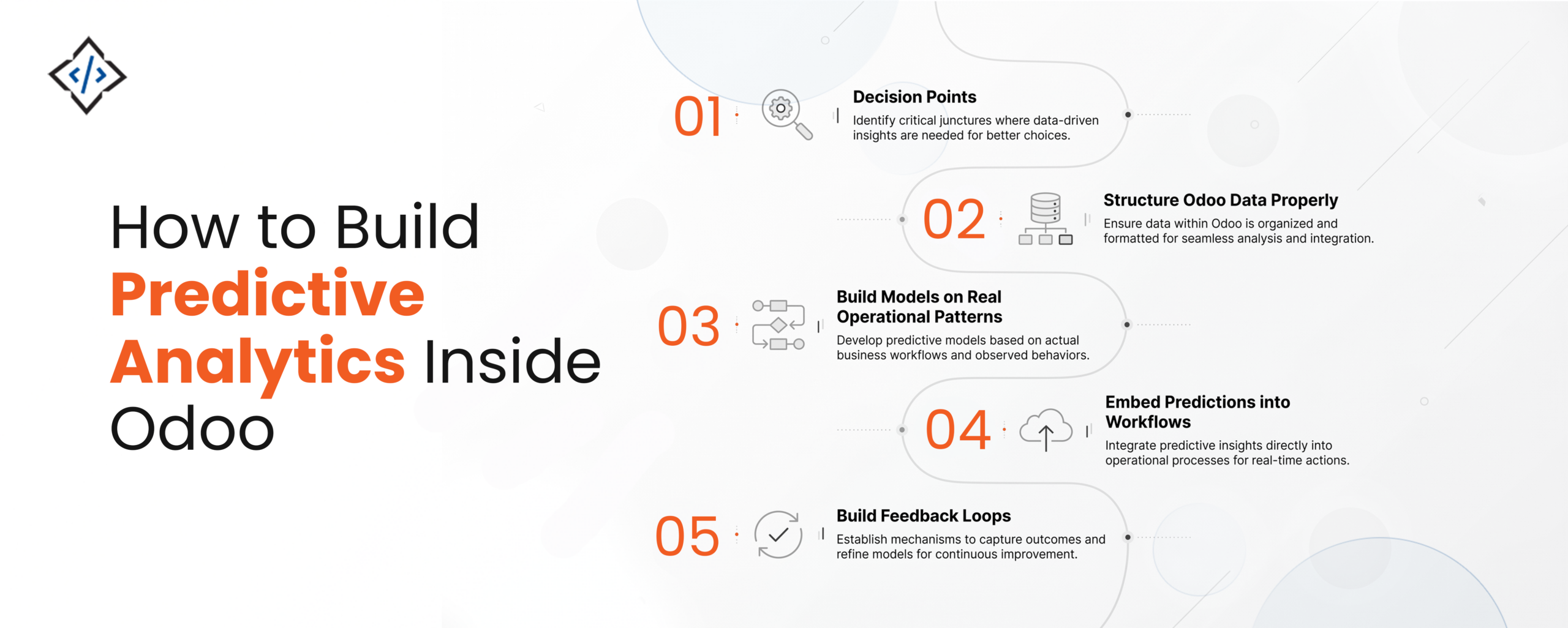
The sequence that works follows a clear order.
CodeTrade builds predictive analytics solutions inside Odoo, focused on three things:
CodeTrade builds predictive analytics directly inside Odoo, with a focus on making sure the output actually changes how the team operates day to day.
What that looks like in practice:
The team using Odoo does not need to understand the models behind it. They just need the right information to show up at the right point in their workflow, in a way that tells them what to do next.
That is what CodeTrade builds toward.
Reporting tells you what happened. Predictive analysis prepares you for what is coming.
The predictive analytics market is growing at 22.5% annually, driven by one consistent force, and that is, businesses that act on forecasts outperform those that react to outcomes. The competitive edge is no longer having more data. It is knowing what happens next and having a system that acts on it before you have to.
 Hardik Soni
 Chand Prakash
 Hardik Soni
 Hardik Soni
 Chand Prakash