





AI
 Chand Prakash
06 August 2026
Chand Prakash
06 August 2026
Why US Enterprises Invest in Generative AI Development Services?
Chand Prakash

Enterprise learning infrastructure demands systems built through specialized AI development services rather than basic content hosting. Evaluating predictive analytics in modern digital learning requires examining daily administrative workflows. The global AI in education market size will grow from $11.4 billion in 2026 to $57.2 billion by 2033. A Grand View Research study highlights this trajectory. This financial shift redefines institutional procurement priorities.
Technical leaders look beyond open-source flexibility to find solutions supporting conversational tutors at scale. Organizations track how AI in Learning Management Systems evaluates individual performance metrics. Selecting the best LMS for AI learning establishes the foundation for long-term corporate training efficiency.
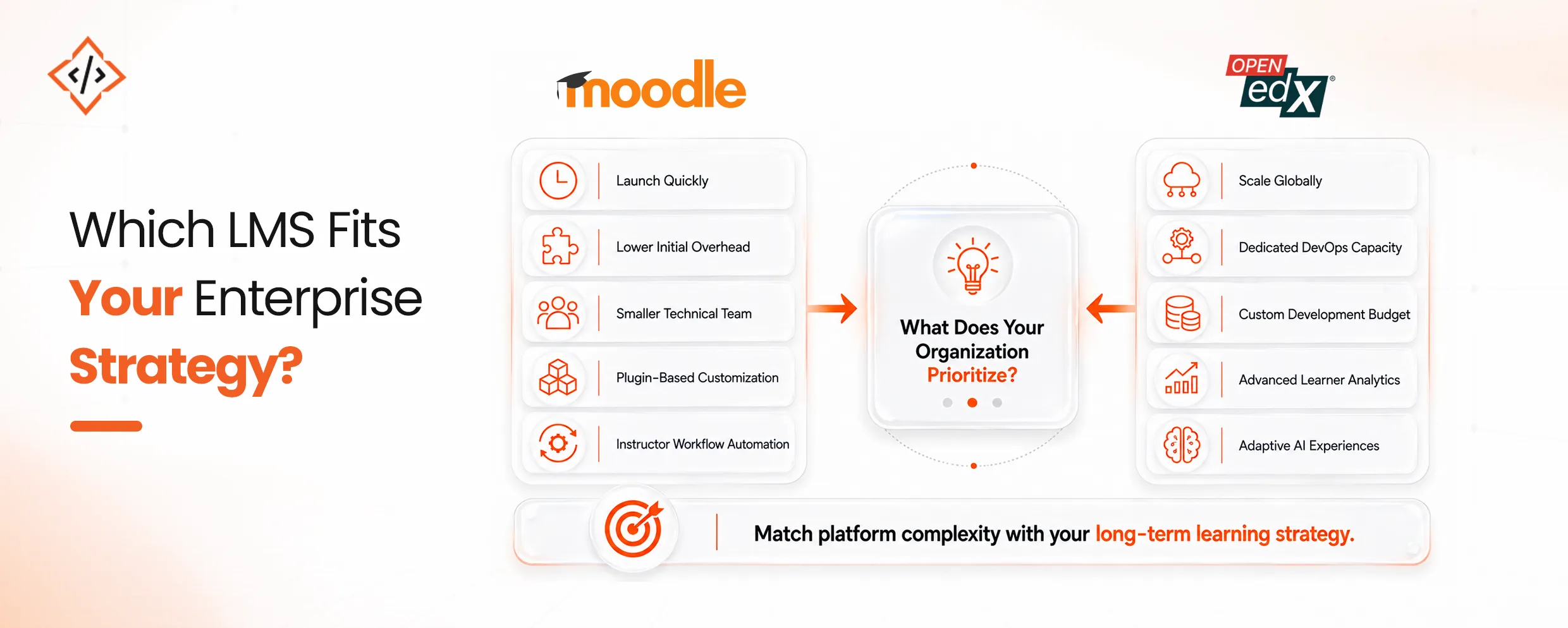
Open edX utilizes AI primarily for massive scalability and complex learner data analysis. Moodle focuses on embedding AI tools into daily instructor workflows for immediate content generation and flexible grading. An objective Open edX vs Moodle comparison reveals distinct architectural goals.
Moodle embeds machine learning directly into course administration tasks. Moodle AI features reduce authoring time by up to 60 percent through automated content generation plugins. Instructors utilize automated grading systems for open-ended essays and programming tasks.
Conversational chatbots use Retrieval-Augmented Generation to answer specific learner inquiries autonomously. A McKinsey & Company report states generative tools automate up to 70 percent of routine administrative duties. This capability makes Moodle highly practical for universities seeking localized workflow efficiency.
Open edX handles large datasets across extensive enterprise networks. Open edX AI frameworks deliver intelligent content recommendations that monitor continuous user behavior. Open edX identifies knowledge gaps and adjusts course paths automatically. Predictive analytics flag at-risk learners weeks before traditional testing cycles begin.
Deploying Open edX + AI Tutors leverages natural language processing to provide real-time learner engagement. Organizations building an AI-powered LMS often require this level of deep data processing. Evaluating Open edX vs Moodle 2026 options reveals that architectural scale dictates long-term value.
Moodle uses a modular, plugin-based architecture for flexible and straightforward deployments. Open edX relies on a microservices architecture designed for deep customization and massive concurrent user scaling.
A proper Open edX vs Moodle comparison requires analyzing these foundational structural layers. Technical teams evaluating an enterprise LMS comparison must understand how these frameworks support long-term digital growth.
Moodle relies on a modular framework that allows system administrators to integrate external add-ons efficiently. This customization suits organizations requiring rapid rollout cycles and continuous updates. This setup functions like a pre-built house with many available interior additions.
Administrators rely on targeted Moodle development and specific plugins to handle unique course requirements without rewriting core code. A Business Research Insights report indicates 48 percent of enterprises encounter integration challenges between learning platforms and legacy databases. This data makes a flexible modular setup practical for mid-sized firms avoiding extensive code rewrites. This structure supports standard corporate training LMS needs while keeping initial setup costs manageable.
Open edX employs a distributed microservices framework to handle immense processing loads. Organizations seeking an eLearning platform with AI often choose this approach for heavy data traffic. This infrastructure functions like a custom-built stadium designed to support massive crowds simultaneously. Each component operates independently to ensure system stability during peak usage hours.
Universities and global corporations rely on specialized Open edX development services to build scalable digital campuses. Enterprise teams often collaborate with an experienced Open edX partner to configure these complex environments. Choosing the best LMS for AI learning depends heavily on whether the underlying system can sustain intensive adaptive algorithms.
Evaluating primary system features highlights clear architectural differences between these two platforms for enterprise scale and continuous intelligence integration.
| Feature | Open edX | Moodle |
|---|---|---|
| Integration Architecture | Relies on REST APIs and microservices for high-concurrency enterprise ecosystems. | Uses a modular architecture to connect third-party educational tools through standard protocols. |
| Customization Method | Requires dedicated Open edX development services for deep code modifications and custom extensions. | Relies on accessible Moodle customization options through extensive plugin directories and themes. |
| Target Audience & Scale | Tailored for large-scale MOOCs, global institutions, and high-volume corporate training LMS platforms. | Designed as a versatile LMS for universities and enterprises needing adaptable course management. |
| AI Integration Focus | Focuses on scalable learner data processing, real-time virtual tutoring, and adaptive feedback loops. | Focuses on instructor workflow automation, AI-driven content generation, and automated essay grading. |
| Analytics & Data Processing | Provides deep behavioral data tracking across massive datasets to power an AI-driven learning platform. | Delivers built-in learning analytics and predictive models to identify at-risk student engagement. |
| Administration & Workflow | Offers a structured, course-centric interface optimized for self-paced and cohort-based learning. | Features a flexible, block-based layout with drag-and-drop tools for non-technical educators. |
| Deployment Overhead | Demands dedicated cloud infrastructure, DevOps expertise, and ongoing technical maintenance. | Allows straightforward installation on standard web hosting setups with minimal initial infrastructure costs. |
Large corporations driving digital transformation initiatives generally favor Open edX for its massive data capacity. Mid-sized enterprises often choose Moodle for rapid deployment and lower initial technical overhead. An objective Enterprise LMS comparison requires analyzing your specific organizational scale and technical maturity.
The corporate LMS market will grow from $15.02 billion in 2025 to $18.46 billion in 2026. A 2026 Grand View Research report notes the software segment commands over 67 percent of global revenue. This rapid financial expansion forces technical leaders to prioritize scalable systems.
Organizations must select an Adaptive learning platform capable of supporting thousands of concurrent users. Choosing Moodle vs Open edX for enterprises depends heavily on these projected growth trajectories.
An objective Online learning platform comparison helps clarify these strategic infrastructure investments. Companies need robust infrastructure that supports continuous workforce upskilling seamlessly.
Decision makers must evaluate total cost of ownership very carefully. Moodle customization appears highly cost-effective during the initial launch phase. Administrators can install standard plugins without needing advanced programming skills. This modular approach allows teams to launch basic courses quickly.
However, integrating complex cognitive capabilities often requires hiring dedicated developers later. Open edX implementation demands a much higher upfront technical investment. Building a custom Learning experience platform requires specialized Open edX development services. This foundational work ensures the system can handle extensive data processing safely. The architecture handles massive traffic surges without degrading user performance.
A trusted Open edX partner helps navigate these complex architectural requirements efficiently. Both systems serve as an excellent LMS for universities and enterprises. Leaders must simply match their technical budget with their long-term digital strategy.
Transitioning from strategic platform selection to long-term implementation requires looking beyond basic feature checklists. The future of corporate and academic training relies on platforms integrating secure AI models that process real-time learner data. Modern systems must adapt continuously rather than simply serving static video content.
Making an informed Open edX vs Moodle 2026 decision demands matching software flexibility with internal technical capacity. Enterprise leaders must evaluate their underlying data infrastructure before committing to a specific vendor deployment.
CodeTrade provides specialized Open edX development services to help organizations engineer scalable learning infrastructure. Technical teams build custom features that transform standard course portals into a high-performance Learning experience platform. Partnering with an experienced technical team ensures your digital learning ecosystem scales securely alongside evolving AI capabilities.
 Chand Prakash
 Chand Prakash
 Chand Prakash
 Chand Prakash
 Hardik Soni