







eCommerce
 Chand Prakash
11 September 2026
Chand Prakash
11 September 2026
How Should Mid-Market Businesses Choose Magento vs Shopify Plus for B2B?
 Chand Prakash

Adobe Commerce and Magento Open Source 2.4.5 and 2.4.6 stop receiving security patches on 11 August 2026, and no store can complete a safe upgrade in the days that remain. That is the honest position.
Anyone promising a compliant upgrade inside this week is proposing to skip the extension audit and the regression testing that make an upgrade survivable.
The deadline is not a switch-off, though. Stores on unsupported versions carry on exactly as before. The problem is narrower than a shutdown and worse: from 12 August, any newly disclosed vulnerability affecting those versions stays public and stays unpatched.
This post covers what actually changes and what the realistic options are with days left. It also covers how to protect a store in the gap before a properly executed upgrade.
Three distinct things end, and it helps to separate them.
What does not happen is equally worth stating plainly. The store does not stop working. Payments continue processing. Admin access continues. There is no license enforcement event and no forced shutdown.
| Feature | Open edX | Moodle |
|---|---|---|
| Integration Architecture | Relies on REST APIs and microservices for high-concurrency enterprise ecosystems. | Uses a modular architecture to connect third-party educational tools through standard protocols. |
| Customization Method | Requires dedicated Open edX development services for deep code modifications and custom extensions. | Relies on accessible Moodle customization options through extensive plugin directories and themes. |
| Target Audience & Scale | Tailored for large-scale MOOCs, global institutions, and high-volume corporate training LMS platforms. | Designed as a versatile LMS for universities and enterprises needing adaptable course management. |
| AI Integration Focus | Focuses on scalable learner data processing, real-time virtual tutoring, and adaptive feedback loops. | Focuses on instructor workflow automation, AI-driven content generation, and automated essay grading. |
| Analytics & Data Processing | Provides deep behavioral data tracking across massive datasets to power an AI-driven learning platform. | Delivers built-in learning analytics and predictive models to identify at-risk student engagement. |
| Administration & Workflow | Offers a structured, course-centric interface optimized for self-paced and cohort-based learning. | Features a flexible, block-based layout with drag-and-drop tools for non-technical educators. |
| Deployment Overhead | Demands dedicated cloud infrastructure, DevOps expertise, and ongoing technical maintenance. | Allows straightforward installation on standard web hosting setups with minimal initial infrastructure costs. |
Adobe supports upgrading directly from 2.4.5 or 2.4.6 to 2.4.8 without passing through 2.4.7. That direct path is what makes the work tractable rather than sequential.
The reasoning is uncomfortable, but it is not complicated.
Security advisories are public. When Adobe patches a vulnerability in supported versions, the advisory describes what was fixed and which versions were affected. That advisory is a map.
It tells anyone who reads it precisely which weakness exists in every store still running an unsupported version and that those stores will never be fixed.
So an unsupported eCommerce platform is not vaguely riskier than a patched one. It sits on a list, and the list is public.
The Magento 1 end-of-life provides the documented case. Support ended in June 2020, and over 7,500 stores were compromised in one coordinated campaign.
Attackers did not need novel research. They needed known vulnerabilities on systems that would never be patched.
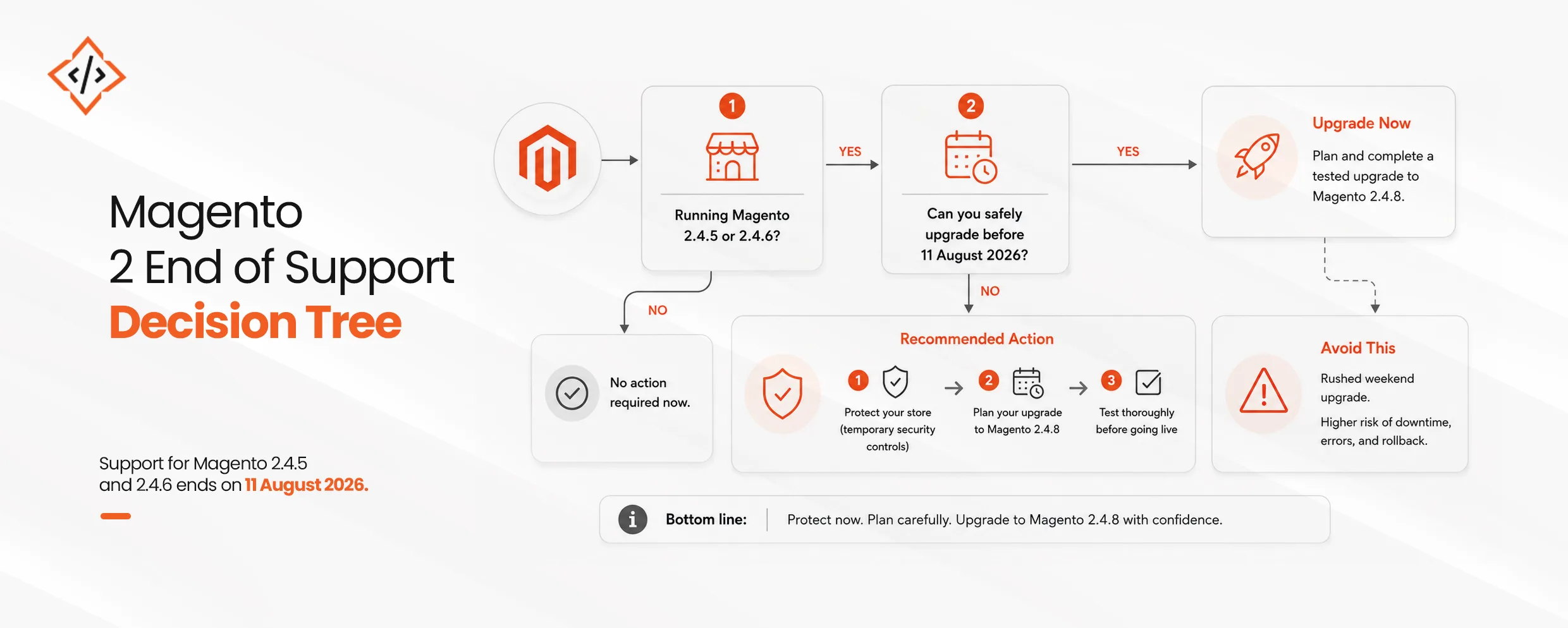
Five compensating controls, ordered by protection gained per hour spent. None of these replaces the upgrade. All of them reduce exposure during the gap.
bin/magento --version rather than trusting documentation or memory. Patch level matters, not just the minor version. A surprising number of stores discover they are on a different release than assumed.A sixth item is worth adding for anyone processing cards directly: talk to the acquirer. PCI DSS obligations do not pause because a vendor ended support, and running unsupported software with known vulnerabilities is a compliance question as much as a security one.
Realistic duration for a typical store is two to six weeks, driven almost entirely by extension count and customization depth rather than by catalogue size. The phases are well understood.
| Phase | What happens | Where projects stall |
|---|---|---|
| Extension and module audit | Inventory every third-party extension; check for a 2.4.8-compatible release. | An extension with no 2.4.8 version and no maintainer response |
| Custom code review | Deprecated APIs, removed methods, dependency conflicts | Customization written against undocumented behavior |
| PHP and dependency alignment | Match required PHP, Composer, search engine, and database versions. | Hosting that cannot supply the required PHP version |
| Staging upgrade | Full upgrade against a production data copy | First discovery of real breakage; expect this. |
| Regression and UAT | Checkout, payments, tax, shipping, integrations, reports | Payment and tax edge cases |
| Go-live | Maintenance window, cutover, verification | Insufficient rollback planning |
The pattern mirrors ERP upgrades closely, and so does the failure mode. As with the Odoo 18 to 19 upgrade, the work is set by custom code rather than by data volume. The cheapest phase is the inventory that most teams skip.
The extension audit deserves emphasis. A single abandoned extension with no compatible release forces a real decision: replace it, fork and port it, or rebuild the functionality. Discovering that in the staging phase rather than the audit phase is what turns a three-week project into a three-month one. Stores without in-house Magento capacity usually bring in Magento development services for the audit and the regression testing, because that is where the hours actually go.
For some merchants, yes. A forced upgrade is a legitimate trigger to ask whether Magento is still the right platform, and answering honestly is more useful than defaulting either way.
Stay on Magento and upgrade when the catalogue is large and complex, when B2B features such as company accounts, quotes, and shared catalogues are in use, when heavy customisation reflects genuine competitive advantage, or when an in-house or partner team already knows the platform.
Consider replatforming when the store is comparatively simple and the customisation was largely incidental, when the extension estate has become unmaintainable, when operating cost is disproportionate to revenue, or when no team with Magento depth is available at all.
One caution against deciding under deadline pressure: replatforming is slower than upgrading, not faster. A migration to another platform is a multi-month project involving data migration, SEO preservation, and integration rebuild. It is a reasonable strategy and a bad emergency response. Merchants weighing it should close the security gap with an upgrade first, then replatform on their own schedule.
Stores that already run Odoo for inventory, fulfilment, or accounting have a further option worth scoping: tightening that integration rather than changing commerce platform. The Magento to Odoo integration patterns matter more to total operating cost than the storefront version does.
Not an immediate incident, in most cases. That is precisely what makes inaction attractive and dangerous.
The realistic sequence is gradual. Week one passes without event. Then a vulnerability is disclosed and patched in supported versions, and the advisory tells attackers exactly what is available on unsupported ones. Automated scanning identifies vulnerable stores. Weeks or months later, a skimmer appears in checkout, or an admin account is used to place fraudulent orders, or customer data leaves quietly.
The cost then arrives in a bundle: incident response, forensics, card-brand penalties, notification obligations, and the reputational damage that follows a payment-data disclosure. Recovery costs more than the upgrade every time, and it turns up on the attacker’s schedule rather than yours.
The active Magento store count has already fallen substantially from its peak of roughly 162,000 in late 2021. Some of that decline is deliberate replatforming. Some store owners stopped maintaining their stores until something happened.
Adobe Commerce and Magento Open Source 2.4.5 and 2.4.6 lose security support on 11 August 2026. Stores keep trading afterward, so nothing appears to change. That appearance is the hazard, because published advisories turn unsupported versions into a list anyone can work through.
With days remaining, the honest advice is a two-track response. This week, deploy a WAF, lock down the admin surface, verify a real restore, and enable file integrity monitoring. Then schedule a properly tested upgrade to 2.4.8, which is supported through April 2028 and reachable directly from either version.
Do not attempt the whole upgrade before Tuesday. An untested upgrade that breaks checkout costs more in a single trading day than the scheduled project costs in total. Close the exposure this week. Do the upgrade properly after that.
 Chand Prakash
 Chand Prakash
 Chand Prakash
 Bhavesh Kachadiya
 Chand Prakash