






AI
 Chand Prakash
13 November 2026
What Is Customer Experience Automation (CXA)? A Complete Guide
 Chand Prakash

AI tools now sit inside almost every small business workflow, from sales emails and support chats to code reviews and hiring. The problem is that adoption usually comes first, and rules come later. Employees sign up for tools on their own, product teams add large language model features, and nobody keeps a full record of which tool touches which data.
AI Governance for Startups and SMBs fixes this gap. It gives a small team clear answers to simple questions. Which AI tools are approved? What data can go into them? Who checks AI output before it reaches a customer? Who is accountable when something goes wrong?
This guide explains AI governance in plain language. It covers the risks small businesses face, the core parts of a governance framework, the 2027 compliance deadlines, the frameworks worth following, and a 30-day plan to put everything in place. It also includes a one-page AI policy template that your team can adapt and use straight away.
AI governance is the system of policies, roles, and controls that guide how a company selects, builds, uses, and monitors AI. For a large enterprise, this often means a committee, a compliance team, and long audit cycles. For a startup or SMB, it should be much lighter.
In practice, AI governance for small businesses answers five practical questions:
Good governance does not slow a startup down. In fact, it often speeds up sales, because enterprise buyers and investors now ask about AI controls during security reviews and due diligence.
A startup that can show a clear AI policy and risk register answers those questions in minutes instead of weeks.
Small businesses adopt AI quickly, but their rules rarely keep pace.
A Goldman Sachs 10,000 Small Businesses survey from early 2026 found that 76% of small businesses are already using AI.
At the same time, Pax8’s Q2 2026 SMB AI Pulse Report found that only 23% of US small businesses have a documented AI policy, while many others rely on informal guidelines or verbal oversight.
The data risk is also higher in smaller companies.
According to PagerDuty’s 2026 Shadow AI Survey, 40% of workers at companies with fewer than 1,500 employees had entered customer data into public AI tools, compared with 27% at larger organizations. In other words, the teams with the fewest controls are the ones sharing the most sensitive data.
Three more pressures make 2027 an important year:
AI risk management for SMBs starts with knowing what can actually go wrong. The table below lists the risks small teams run into most often, along with a simple example and the governance control that reduces each one.
| Risk | Simple example | Governance control |
|---|---|---|
| Shadow AI and data leakage | An employee pastes a customer contract into a free chatbot | Approved tool list, data classification rules, blocked personal accounts |
| Hallucinated output | A support bot invents a refund policy | Human review for customer-facing replies until accuracy is tested |
| Bias in decisions | A screening tool ranks candidates unfairly | High-risk classification, bias testing, human sign-off |
| IP and copyright exposure | AI-generated images or code reused without checking terms | Usage rules for AI content, vendor terms review, pre-publish checks |
| Security attacks | Prompt injection makes a chatbot reveal internal data | OWASP LLM checks, secret scanning, least-privilege access |
| Agent errors | An AI agent issues a batch of wrong refunds | Spending limits, action logs, approval for irreversible actions |
| Vendor risk | A tool provider trains its model on your data | Vendor due diligence, data processing agreements, opt-out settings |
| Silent model drift | Output quality drops after a model update | Monitoring, version tracking, periodic re-testing |
Most of these risks have low-cost fixes.
As a result, a small team can cover the biggest gaps without buying new software or hiring a compliance officer.
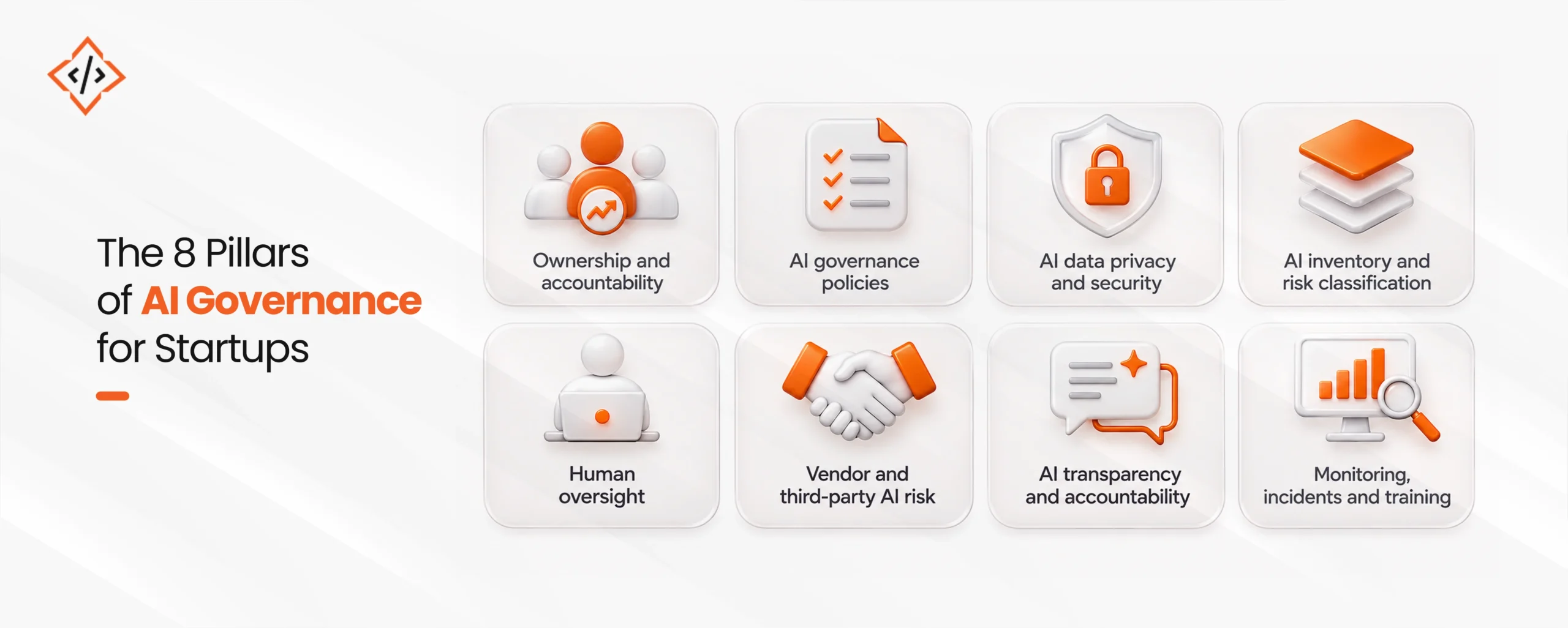
An AI governance framework for startups works best when it stays short and practical. The eight pillars below follow common AI governance best practices, scaled down for a team of five to 500 people.
Every AI program needs one named owner. In most startups, this is the CTO, COO, or a senior product leader. This person approves new tools, keeps the AI inventory current, and leads the response when something goes wrong.
AI governance policies turn intentions into everyday rules. A good policy is short enough that employees actually read it. One to two pages is usually enough for a small team.
AI data privacy and security controls decide which data can reach which tool. The simplest method is to classify company data into four levels and map each level to approved tools.
| Data level | Examples | Allowed AI use |
|---|---|---|
| Public | Website copy, published blogs | Any approved tool |
| Internal | Meeting notes, internal process docs | Approved business-plan tools only |
| Confidential | Source code, contracts, financials | Enterprise tools with no-training terms |
| Restricted | Customer personal data, health, or payment data | Only approved systems with contracts, encryption, and access logs |
In addition, check data retention settings, model training terms, and where data is processed for every tool that handles confidential or restricted data.
An AI inventory is a single list of every AI tool, model, and feature in use, including AI features hidden inside existing software such as CRM or help desk tools. A shared spreadsheet works well at first.
Human oversight means deciding in advance which AI outputs a person must approve. Consequently, mistakes get caught before they reach customers or affect people’s lives.
Most startups use AI built by someone else. Therefore, vendor checks are a core part of AI ethics and compliance. The vendor section later in this guide lists the exact questions to ask.
AI transparency and accountability mean customers know when they are dealing with AI and can reach a human when needed. A short label such as “This reply was drafted with AI and reviewed by our team” sets the right expectation without hurting the experience. Keep records of key AI decisions so you can explain them later.
Governance continues after launch. Track accuracy, complaints, costs, and unusual agent actions, and keep a one-page incident plan that explains how to pause an AI feature. Moreover, train staff on safe AI use. For companies within its scope, the EU AI Act has required AI literacy since February 2025.
An AI risk assessment framework does not need complex scoring. For most startups, three tiers are enough. Each tier comes with a fixed set of controls, so the team knows exactly what to do once a use case is classified.
| Risk tier | Typical SMB use cases | Required controls |
|---|---|---|
| Low | Brainstorming, internal drafts, meeting summaries | Approved tool, no confidential data, normal use |
| Medium | Customer emails, support chatbots, marketing content, AI product features | Human review or sampling, disclosure label, accuracy testing, logging |
| High | Hiring, credit, insurance, health, pricing, autonomous agents with money or data access | Documented risk review, bias testing, human approval, audit trail, owner sign-off, legal check |
To classify a use case, ask four questions:
If the answer to the first question is yes, treat the use case as high risk. If two or more of the other answers are yes, treat it as at least medium risk.
Generative AI governance needs extra attention because these tools create new content and, increasingly, take actions.
Large language models can sound confident while being wrong, and agents can repeat a mistake hundreds of times before anyone notices.
For generative AI tools, focus on these controls:
For AI agents, add limits on what the agent can do:
These controls work best when they are part of the product design, not added after launch. Experienced AI engineers can build approval gates, action limits, and logging into an agent from its first version.
Startups that fine-tune models or build AI features on their own data face a risk most SMB guides skip. If the team cannot show where training data came from and what rights it holds, the company may face claims under copyright law, privacy law, or customer contracts.
Startups building their own AI products should settle these records before training begins. Working with an AI development company that documents data sources and model versions as part of delivery makes later audits and buyer reviews much easier.
AI regulatory compliance depends on where your customers are and what your AI does. A startup does not need to master every law.
However, it should know which rules touch its use cases and when they start.
The EU AI Act entered into force in August 2024 and applies in phases. In 2026, the EU adopted the Digital Omnibus on AI, Regulation (EU) 2026/1744, which entered into force on 27 July 2026. It delayed the high-risk rules but left most other obligations in place.
| Obligation | Date it applies | What it means for a startup |
|---|---|---|
| Prohibited AI practices | 2 February 2025 | Banned uses, such as manipulative or social scoring systems, are already illegal |
| AI literacy | 2 February 2025 | Staff using AI need suitable training |
| General-purpose AI model rules | 2 August 2025 | Mainly affects model providers, but check your vendor's compliance |
| Transparency duties | 2 August 2026 | Tell users when they interact with AI, such as chatbots |
| AI-generated content marking | 2 December 2026 | Providers of generative systems must mark synthetic content |
| Stand-alone high-risk AI (Annex III) | 2 December 2027 | Hiring, credit scoring, education and similar uses need full compliance |
| High-risk AI in regulated products (Annex I) | 2 August 2028 | AI inside medical devices, machinery and similar products |
The EU AI Act can apply to companies outside Europe. If a US, Indian, or Middle Eastern startup places an AI system on the EU market, or its AI output is used in the EU, the rules may apply.
The US has no single federal AI law. Instead, existing laws still apply when AI is involved, and several states have passed their own AI rules.
Many startups serve customers in the GCC. Saudi Arabia’s SDAIA has published AI Ethics Principles, and the UAE has issued national AI guidance and data protection rules.
In addition, data protection laws in most regions already cover personal data used by AI tools. As a result, a single governance program built on NIST and ISO 42001 usually covers the shared core of these rules.
You do not need to adopt every framework. Instead, pick one base layer and add others when customers or regulators require them.
The table after the two main frameworks also covers the EU AI Act tiers, OECD AI Principles, OWASP LLM Top 10, and Singapore’s agentic AI guidance.
The NIST AI Risk Management Framework is free and built around four functions: Govern, Map, Measure, and Manage. Its Generative AI Profile (NIST AI 600-1) adds risks such as hallucinations, data leakage, and harmful content. For most startups, this is the best place to begin.
How to start: Pick your two or three most important AI use cases, then record the owner, risks, and controls for each one under the four functions.
ISO/IEC 42001 is the international standard for an AI management system. Unlike NIST, it can be certified by an accredited body. It suits startups selling AI products to banks, hospitals, and large enterprises.
How to start: Run a gap assessment against the standard and its Annex A controls, and seek certification only when buyers ask for it.
| Framework | What it gives you | Cost and effort | Best fit |
|---|---|---|---|
| NIST AI RMF | Risk structure and generative AI risk list | Free, low to medium | Every startup as a base layer |
| ISO/IEC 42001 | Certifiable AI management system | Paid audit, medium to high | B2B startups selling to enterprises |
| EU AI Act tiers | Legal risk classification | Low to high, by risk | Anyone with EU users |
| OECD AI Principles | Values for responsible AI for startups | Free, low | Early-stage teams |
| OWASP LLM Top 10 | Security checks for LLM features | Free, low to medium | Products with LLM or agent features |
| Singapore framework | Guardrails for autonomous agents | Free, low to medium | Startups shipping AI agents |
AI risk changes with the industry. As a result, the framework to start with also changes. The table below shows common high-risk AI uses by sector and where to focus first.
| Industry | Common high-risk AI use | Start with | Add later |
|---|---|---|---|
| Healthcare and healthtech | Clinical support tools, patient chatbots, medical coding | NIST AI RMF, HIPAA safeguards | ISO 42001 for hospital buyers, OWASP checks for health data leaks |
| Fintech and banking | Credit scoring, fraud detection, KYC checks | NIST AI RMF, fair lending checks | EU AI Act high-risk controls, ISO 42001 for bank partners |
| Insurance | Underwriting, pricing, claims triage | NIST AI RMF, bias testing | EU AI Act controls for life and health pricing |
| HR tech and recruiting | Resume screening, candidate ranking | Bias testing, human sign-off | EU AI Act high-risk controls, regular bias audits |
| B2B SaaS | AI features and agents inside the product | NIST AI RMF, OWASP LLM Top 10 | ISO 42001 for enterprise deals, agent guardrails |
| E-commerce and retail | Recommendations, dynamic pricing, support bots | OECD principles, disclosure labels | EU transparency duties for chatbots and AI content |
| EdTech | Grading, proctoring, admissions | Human review of scores | EU AI Act high-risk controls for education |
| Logistics and manufacturing | Forecasting, route planning, maintenance | NIST basics | OWASP checks once agents touch operations |
Governance should match the size and risk of the business.
A five-person team with no customer data does not need the same program as a 200-person fintech. The stages below help you decide how far to go right now.
| Stage | Typical situation | Governance level |
|---|---|---|
| Early stage | Small team, internal AI use only, no regulated data, no EU users | AI inventory, one owner, one-page policy, approved tool list |
| Growth stage | Customer-facing AI, first enterprise deals, some personal data | Add risk tiers, human review rules, vendor checks, incident plans, and NIST mapping |
| Scale stage | Regulated data, EU customers, AI agents, enterprise contracts | Add formal risk assessments, audit trails, bias testing, and ISO 42001 gap assessment or certification |
A useful rule is to move up a stage when a trigger appears.
Common triggers include the first enterprise security questionnaire, the first EU customer, the first use of AI in hiring or credit decisions, or the first AI agent that can act without approval.
Deciding which stage applies is the first real decision in AI governance for startups and SMBs. If the answer is unclear, AI consulting services can map your use cases, risk tiers, and frameworks to the right stage.
AI governance implementation fails most often because nobody owns it. A small team can fix this with a simple ownership model.
| Task | Founder or CEO | AI owner (CTO or COO) | Team leads | All employees |
|---|---|---|---|---|
| Approve AI policy | Approves | Drafts | Review | Read and follow |
| Approve new AI tools | Informed | Decides | Request | Request |
| Keep AI inventory | Informed | Owns | Update for their team | Report new tools |
| High-risk reviews | Signs off | Leads | Join | None |
| Incident response | Informed | Leads | Support | Report issues |
| Training | Supports | Plans | Run sessions | Complete |
Before approving any AI tool for confidential or customer data, ask the vendor these questions:
Small teams do not need an expensive governance platform on day one. Most of the early work runs on tools the business already pays for. The table shows what each governance task needs at each stage.
| Governance task | Low-cost starting option | When to upgrade |
|---|---|---|
| AI inventory and risk register | Shared spreadsheet | When tools pass a few dozen or audits begin |
| Blocking unapproved tools | SSO, browser, and network controls are already in place | When shadow AI keeps returning |
| Data protection | Business or enterprise AI plans with no-training terms | When restricted data enters AI workflows |
| LLM security testing | OWASP LLM Top 10 checklist in code reviews | Before high-risk or agent releases |
| Monitoring and logs | Application logs and simple dashboards | When AI agents act on money or customer records |
| Certification | ISO 42001 gap assessment done in-house | When enterprise buyers make it a contract term |
The main cost in the early stage is time. Expect the AI owner to spend a few hours a week during setup, then a short monthly review after that.
Governance only helps in a security review or due diligence when you can prove it. Keep these records in one shared folder so you can answer questions quickly:
The plan below helps a startup move from scattered AI use to a working governance system in four weeks. Each week has one clear goal.
| Week | Goal | Key actions | Output |
|---|---|---|---|
| Week 1 (days 1 to 7) | Find all AI use | Survey teams, check expense reports and SSO logs, list AI features in existing software | AI inventory |
| Week 2 (days 8 to 14) | Assign ownership and rate risk | Name the AI owner, classify each use case as low, medium, or high risk | Risk register |
| Week 3 (days 15 to 21) | Set rules and train | Publish a one-page AI policy, and run a 30-minute training with real examples | Approved policy and trained team |
| Week 4 (days 22 to 30) | Make it routine | Set review dates, write an incident plan, run a short practice exercise | Review calendar and incident plan |
After 30 days, review the inventory monthly and the policy every quarter. Moreover, add NIST or ISO 42001 controls step by step as the company grows.
The template below gives your team a starting point. Copy it, replace the bracketed text, and keep it to one page.
| Section | What to write |
|---|---|
| Purpose | This policy explains how [Company] staff may use AI tools safely and responsibly. |
| AI owner | [Name, role] approves AI tools and answers AI questions. |
| Approved tools | [Tool, plan type, allowed data level] for each approved tool. |
| Prohibited uses | No customer personal data, source code, or financial records in unapproved tools. No AI-only hiring or credit decisions. |
| Human review | All customer-facing AI output is reviewed before sending until accuracy is proven. |
| Disclosure | Customers are told when they are chatting with AI or receiving AI-drafted content. |
| New tools | Request new tools from the AI owner before signing up. |
| Incidents | Report AI mistakes or data exposure to [contact] within 24 hours. |
| Review date | This policy is reviewed every [three] months. |
You cannot manage what you do not measure. The following simple metrics show whether governance is working:
AI Governance for Startups and SMBs is about control, not paperwork. A short policy, a named owner, a live AI inventory and clear review rules cover most of the risk a small team faces.
Starting now also prepares the business for the EU AI Act high-risk dates in December 2027 and August 2028, and it makes enterprise security reviews far easier.
The smartest approach is to build governance into AI products from the start.
With 180+ engineers and 10+ years of experience, CodeTrade helps startups design human review, access limits, and audit trails into every AI feature, so their products stay compliant as they scale.
 Chand Prakash
 Chand Prakash
 Chand Prakash
 Chand Prakash
 Chand Prakash