





AI
eCommerce
 Chand Prakash
02 November 2026
Agentic Commerce for Fashion Ecommerce: How Brands Can Prepare for AI-Driven Shopping
 Chand Prakash

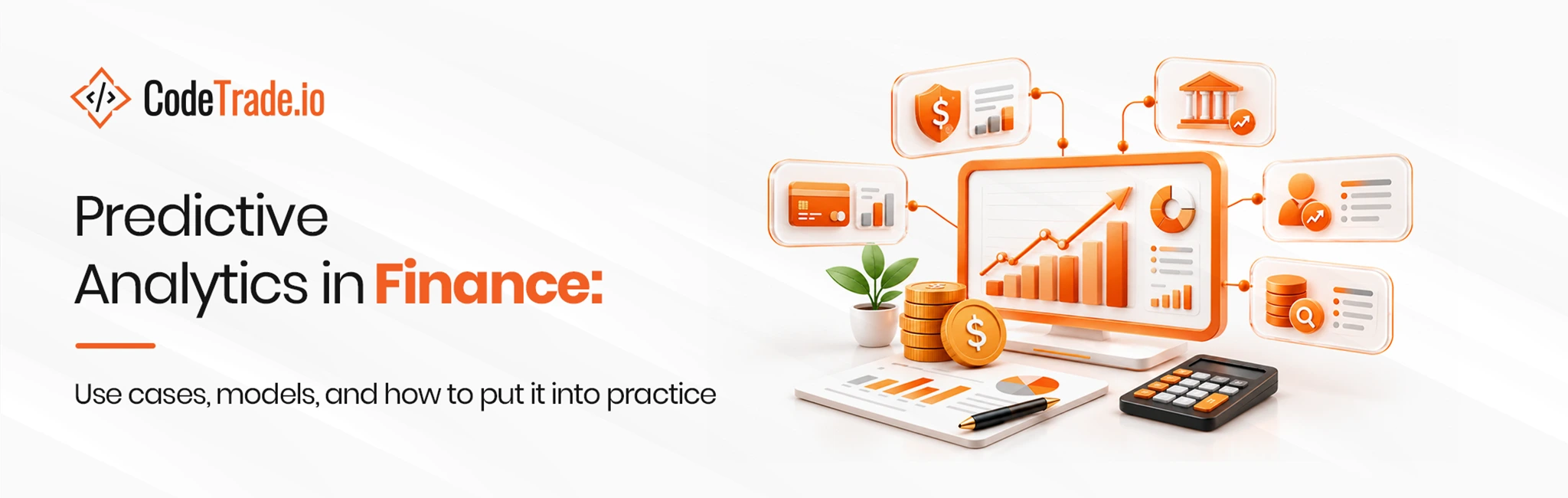
Finance teams make forward-looking calls all day. A credit officer decides whether to approve a loan. A fraud analyst decides which alerts to check first. A treasury team decides how much cash to keep on hand next month. Most of these calls still rely on fixed rules, spreadsheets, and experience.
Predictive analytics in finance gives those teams a better starting point: a data-based estimate of what is likely to happen. This guide is written for finance, risk, and data leaders at banks, lenders, fintechs, and corporate finance teams. It covers where predictive models pay off, which models suit which problems, what regulators now expect, and how to get a first model into production.
Predictive analytics in finance is the use of historical and real-time financial data, statistics, and machine learning to estimate future outcomes. Typical predictions include whether a borrower will default, whether a payment is fraudulent, how much cash a business will need, and which customers are likely to leave.
It differs from traditional reporting in one simple way. Reports explain what already happened. Predictive models estimate what is likely to happen next, along with a level of confidence, so teams can act earlier.
It also differs from generative AI. Generative AI writes text or summarizes documents. Predictive analytics produces a score, a probability, or a forecast. The two often work together, for example, when a language model explains a risk score to an analyst in plain words.
Machine learning in finance is the engine behind most modern predictive models. It finds patterns across many variables at once, which fixed rules cannot do. Still, many finance teams get strong results from well-built statistical models.
The most common use cases are fraud detection, credit risk, collections, cash flow forecasting, customer churn, and investment risk. They share one trait: a clear decision that improves when you know what is likely to happen.
| Use case | What the model predicts | Main data needed | Good first project? |
|---|---|---|---|
| Financial fraud detection | Whether a payment or account action is fraudulent | Transactions, device and login data, confirmed fraud cases | Yes, if fraud labels are reliable |
| Credit risk and default | The chance a borrower misses payments | Credit history, income, repayment records | Yes, with strong explainability |
| Collections | Which overdue accounts are most likely to pay, and when | Payment history, contact history | Yes, quick to measure |
| Cash flow forecasting | Cash in and out over the coming weeks | Invoices, payments, ERP, and bank data | Yes, for corporate finance teams |
| Customer churn | Which customers are likely to close accounts | Balances, activity, complaints | Often |
| Anti-money laundering | Which alerts carry the highest risk | Transactions, customer profiles, case outcomes | Later, as it needs strict controls |
| Investment risk | How a portfolio may react to market moves | Market prices, holdings, economic data | Later, as it is hard to validate |
Banks usually start with fraud and credit risk, because losses are visible and data already exists. A fraud model scores each payment in real time and sends only the riskiest ones to analysts. Financial risk prediction for lending works the same way, ranking applicants by their likely chance of default.
Corporate finance teams often start with cash flow. A model learns how quickly each customer really pays, how seasonal sales behave, and how spending changes. Instead of one fixed number, it gives a likely range, so the treasury team can plan for both good and bad weeks.
Investment teams use predictive models mainly to understand risk, such as how much a portfolio could lose in a market drop. Predicting returns is much harder, because markets change and models that look good on past data often fail on new data.
Teams that want a structured way to choose and build these use cases often bring in predictive analytics services to assess data readiness before any model is built.
The best model depends on two questions: how costly is a wrong prediction, and will someone need to explain the result? In regulated decisions such as lending, an explainable model is often the right choice even if a complex one scores slightly higher in testing.
| Model type | Best for | Strength | Watch out for |
|---|---|---|---|
| Logistic regression and scorecards | Credit scoring, loan approvals | Easy to explain to customers and regulators | Misses complex patterns |
| Gradient boosting (XGBoost, LightGBM) | Fraud detection, credit risk, churn | Strong accuracy on tabular financial data | Needs explanation tools such as SHAP |
| Time series (ARIMA, Prophet) | Cash flow, revenue, and deposit forecasts | Handles trends and seasons well | Struggles when patterns change suddenly |
| Neural networks | Large transaction histories, text, complex fraud rings | Finds patterns other models miss | Harder to explain and validate |
| Clustering | Customer segments, unusual account behavior | Finds groups without labeled data | Results need human review |
| Monte Carlo simulation | Stress tests, liquidity, and portfolio risk | Shows a range of possible outcomes | Only as good as its assumptions |
For credit risk, many lenders start with logistic regression or a scorecard because they can show applicants and regulators why a decision was made. Gradient boosting often improves accuracy, and tools like SHAP can show which factors drove each score.
For fraud, gradient boosting is a common first choice, since it handles many signals at once, such as amount, device, location, and payee history. Graph-based models help when fraud spreads across linked accounts.
Predictive financial modeling is not only about choosing an algorithm. Most of the effort goes into preparing data, choosing the right features, and testing on later data the model has never seen. Teams without in-house data scientists often rely on machine learning development services for this stage, then train internal staff to run the model.
You need enough history to show the pattern you want to predict, plus clear labels for the outcome. For fraud, that means confirmed fraud cases. For credit risk, it means loans that were repaid or defaulted. For cash flow, it means at least two years of payments and invoices to capture seasons.
Good finance data analytics starts with a few checks:
There is no single accuracy figure, because it depends on your data, your use case, and how stable the conditions are. What matters is measuring the right thing for each problem:
| Use case | What to measure | Why |
|---|---|---|
| Fraud detection | Share of fraud caught and share of good payments blocked | Fraud is rare, so overall accuracy is misleading |
| Credit risk | How well scores rank good and bad borrowers and default rate by score band | Lenders need reliable ranking, not a yes or no. |
| Cash flow forecasting | Average forecast error against actual cash | Shows how close forecasts land week to week |
A simple example shows why plain accuracy can mislead. If 1 in 1,000 payments is fraud, a model that approves everything is 99.9% accurate and catches nothing.
The most reliable test is to compare a new model against your current method on recent data it has not seen. If it beats the current approach consistently over several months, it is ready for a controlled launch.
Predictive analytics in financial services is now covered by AI-specific rules in several regions, on top of existing data protection and model risk standards. The main ones to know in 2026:
| Region | Rule or guidance | What it means |
|---|---|---|
| European Union | EU AI Act, as amended by the Digital Omnibus on AI | Creditworthiness assessment of individuals is high-risk. Obligations apply from December 2, 2027. |
| United States | Federal Reserve SR 26-2, issued April 2026 | Replaces SR 11-7 with a risk-based approach to model risk management |
| United Arab Emirates | CBUAE Guidance Note on AI and ML, February 2026 | Sets expectations on governance, fairness, transparency, and human oversight for licensed financial institutions |
| Qatar | Qatar Central Bank AI Guideline, 2024 | Sets AI governance expectations for licensed financial institutions |
The Digital Omnibus on AI entered into force on July 27, 2026. It moved high-risk obligations for Annex III systems, including credit scoring, from August 2, 2026 to December 2, 2027. AI used mainly to detect financial fraud is excluded from the credit-scoring category. Life and health insurance pricing and risk assessment remain high-risk.
The later date is time to prepare, not a pause. High-risk systems will need documented data quality, risk management, record-keeping, and human oversight.
The Central Bank of the UAE’s guidance note builds on its existing Model Management Standards. It expects board accountability, fairness checks, human oversight, and clear customer redress. Responsibility also stays with the institution when it uses an outside vendor, so contracts and monitoring matter.
Across all regions, the common thread is explainability. Tools such as SHAP show which factors pushed a score up or down. Keep a record of model versions, data sources, approvals, and performance checks so your team can answer an auditor’s questions quickly.
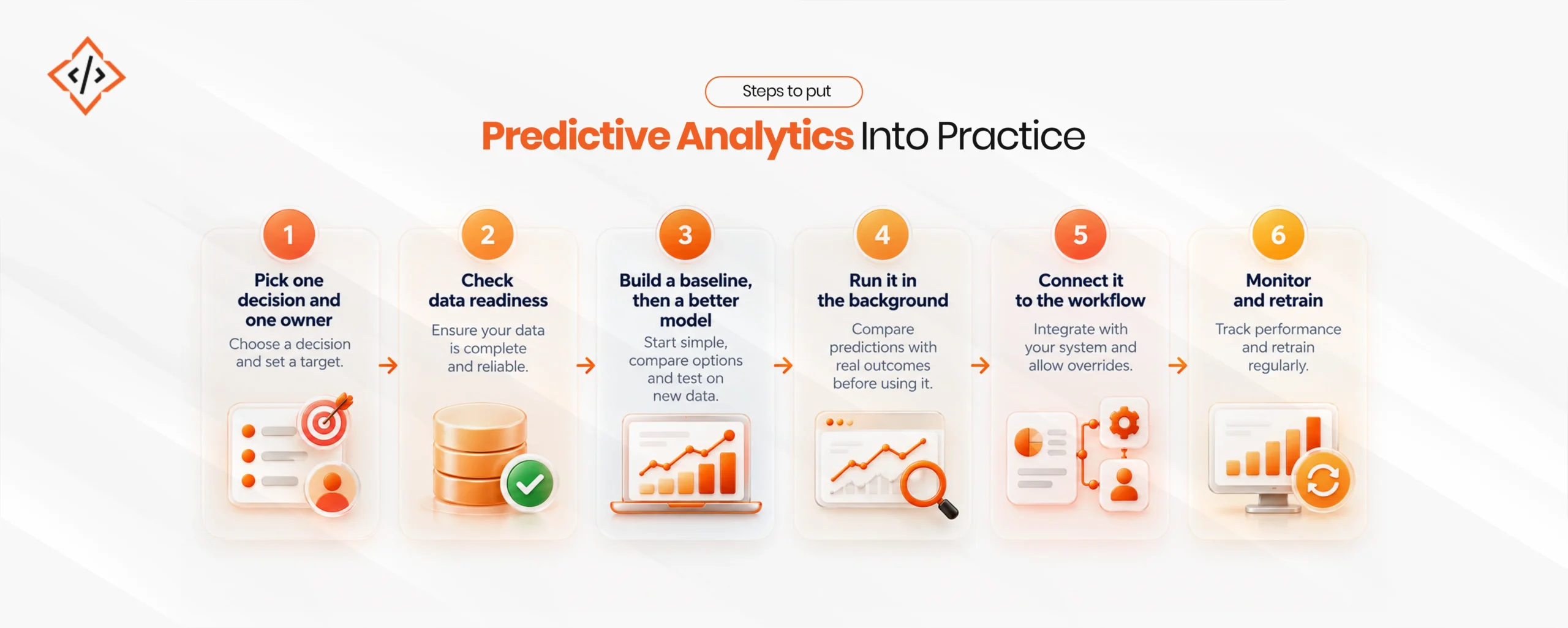
Start with one decision, prove the value against your current method, and only then scale. The six steps below work for most banks, lenders, and corporate finance teams.
Choose a single decision the model will support, such as which fraud alerts to review first. Name a business owner who will act on the results and set a target, for example, fewer false alerts without missing more fraud.
Confirm that the history, labels, and data quality are good enough. If not, fix the data first. A model built on weak data creates false confidence.
Start with a simple model and compare stronger options against it. Test on recent data the model has never seen, and measure the cost of wrong predictions, not only accuracy.
Run the model alongside your current process without changing decisions. Compare its predictions with real outcomes for several weeks before you let it influence anything.
Connect the model to the system where the decision happens, such as the payment platform, loan system, or planning tool. Give staff a simple way to override the model and record why. Keep the old process ready as a fallback.
Customer behavior, fraud tactics, and interest rates change, so models lose accuracy over time. Track performance on a dashboard, review high-risk models more often, and retrain on a set schedule or when results slip.
To scale beyond the first model, connect predictive scores to automated steps across teams. AI development services can help link models to approvals, alerts, and reporting, so AI in financial analytics becomes part of daily work rather than a separate dashboard.
Cost depends far more on data readiness and integration than on the model itself. A cash flow forecast built on clean ERP data costs much less than a real-time fraud system connected to a payment platform.
The main cost drivers are:
Ask any provider to break the estimate into these parts. A single lump-sum quote makes it hard to see where the risk sits.
| Option | Best when | Trade-off |
|---|---|---|
| Build in-house | You have data engineers, ML engineers, and model risk staff, and the model is a competitive advantage | Slow to start if the team is not already in place |
| Buy a tool | The use case is standard, such as card fraud, and a vendor has data you cannot access | Less control and harder-to-explain decisions |
| Hire a partner | You know the problem but lack the team to build, launch, and monitor | Needs strong knowledge transfer so you are not dependent |
Many firms combine the options. They buy a standard fraud tool, then work with a partner to build custom models for credit, collections, or forecasting and connect everything to their systems.
When choosing a partner, look for real finance project experience, a clear plan for monitoring after launch, documentation your auditors can use, and a commitment to train your team.
Predictive analytics in finance works when it is tied to one clear decision, built on trusted data and monitored after launch. Fraud alerts, credit risk, collections, and cash flow forecasting are the most practical places to start, because the results are easy to measure.
Regulators in the EU, the US, and the GCC now expect clear governance, explainable decisions, and human oversight. Building those into the first model saves rework later and makes it easier to scale across the business.
 Chand Prakash
 Chand Prakash

 Hardik Soni
 Chand Prakash
 Chand Prakash