






LMS Development
 Chand Prakash
05 October 2026
Chand Prakash
05 October 2026
FERPA-Compliant LMS: What US Universities Need
 Chand Prakash
Key Takeaways:
US institutions adopting Open edX for universities are actively migrating away from rented, monolithic learning platforms toward owned digital infrastructure. The traditional per-user licensing model actively penalizes institutions for expanding their enrollment reach. This penalty is especially harsh as schools pivot toward high-volume, non-degree certificates.
According to Gartner, global enterprise IT spending in education and government is forecast to hit $861.4 billion in 2026. This massive financial shift forces CIOs to rethink their long-term budgets. Technical decision-makers must prioritize platforms offering a predictable total cost of ownership over restrictive SaaS subscriptions.
Fully evaluating the custom LMS development cost for higher education is no longer an optional exercise. It remains a necessary step for sustainable campus growth. Investing in Open edX development for universities treats the learning platform as a customizable asset rather than a perpetually leased utility.
Building a custom LMS for universities allows institutions to maintain full data ownership and scale user bases without financial penalties. Commercial platforms force academic departments to adapt grading rubrics and administrative workflows to rigid vendor software. Specialized LMS development services solve this problem by aligning the platform with unique institutional needs.
Universities handle sensitive student records, intellectual property, and proprietary research datasets every single day. Custom higher education LMS development ensures all academic records remain securely stored on private institutional servers or dedicated cloud instances. Complete codebase ownership eliminates unexpected vendor price hikes, forced system updates, and sudden platform deprecation. It also gives compliance officers direct control over federal audit trails and retention schedules without relying on external software patches.
Off-the-shelf SaaS systems frequently throttle bandwidth or suffer downtime during high-concurrency campus events. A custom learning management system handles massive traffic spikes during semester registration windows and final exam weeks without latency. Internal IT teams can configure auto-scaling cloud servers to distribute computing resources dynamically across diverse departments during peak assessment cycles.
Modern higher ed LMS solutions must exchange information with existing campus databases smoothly. Purpose-built platforms connect directly with core Student Information Systems such as Ellucian Banner and Workday. This direct integration removes data silos between admissions, financial aid, and academic departments. It gives university leadership a unified view of overall institutional operations.
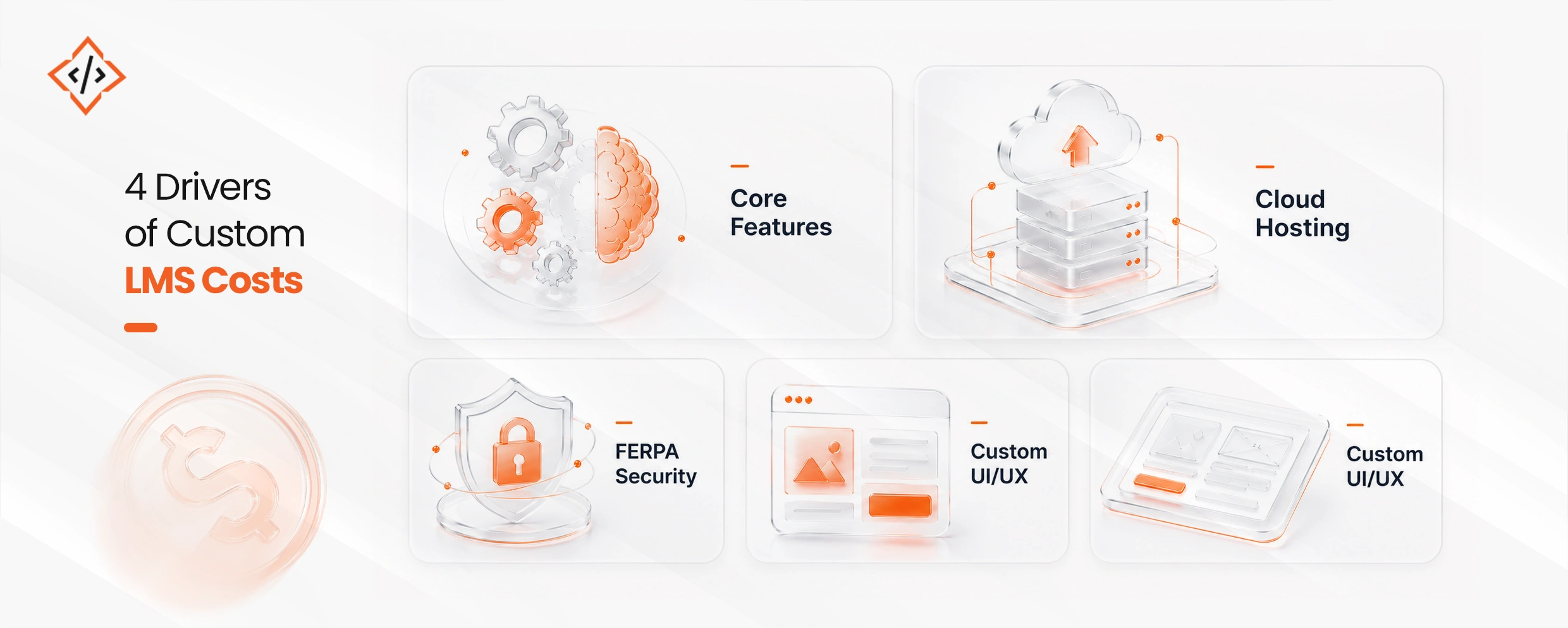
The LMS software development cost fluctuates based on the depth of custom workflows, API integrations, and security infrastructure required. A custom learning management system requires strategic architectural investments to guarantee long-term stability and high performance.
Commercial software lacks the specialized logic required for university platforms. Adding these advanced features directly impacts the total custom LMS development cost.
Server architecture dictates both initial setup fees and ongoing maintenance budgets. This scalable digital infrastructure is essential for continuous university operations. According to Coherent Market Insights, the cloud-based LMS segment holds an estimated 77% market share in 2026.
Protecting sensitive academic data requires significant baseline security investments. Meeting strict US federal education regulations is a non-negotiable expense during LMS development for universities.
A modern university platform must serve thousands of unique students and faculty members daily. Designing accessible interfaces for diverse student bodies requires significant research and testing hours.
A standard custom LMS cost ranges from $50,000 to over $300,000, which universities should budget across phased deployment stages.
| Platform Parameter | Basic MVP Platform | Mid Tier Systems | Enterprise Level LMS |
|---|---|---|---|
| Estimated Investment | $50,000 to $80,000 | $80,000 to $150,000 | $150,000 to $300,000+ |
| Target Institutional Use | Small private colleges validating new online degree programs | Mid-sized universities expanding established hybrid learning departments | Massive state university networks managing multi-campus operations |
| Core Learning Features | Standard course catalogs, basic media playback, and simple quizzes | Interactive course modules, discussion forums, and certification engines | Native mobile applications, live video hosting, and adaptive testing |
| User Access & Permissions | Standard email authentication and basic administrative consoles | Granular role-based permissions for instructors and department leads | Campus-wide Single Sign-On (SSO) with central identity syncing |
| Analytics & Reporting | Basic course completion tracking and user login records | Detailed progress tracking, gradebooks, and custom report exports | Predictive retention analytics and institutional compliance reporting |
| Campus System Integration | Manual CSV data imports for student enrollment rosters | Standard API connections for payment processing and campus libraries | Deep bi-directional sync with legacy SIS (Banner, Workday) and HR tools |
| Infrastructure & Architecture | Single-instance cloud deployment with standard bandwidth | Load-balanced cloud setup with automated backup protocols | Multi-tenant, auto-scaling architecture built for high-concurrency exams |
Deploying Open edX reduces initial LMS implementation cost by providing a pre-built architecture instead of engineering platforms entirely from scratch.
| Development Parameter | Scratch LMS Development | Open edX Custom Implementation | Cost Reduction Impact |
|---|---|---|---|
| Core Architecture Setup | Requires 400+ engineering hours to build base frameworks ($35,000 to $60,000) | Uses pre-tested, enterprise-grade core engine out of the box ($5,000 to $10,000) | Saves up to $50,000 on backend framework development |
| Course Authoring Studio | Custom-building interactive block editors and syllabus managers ($20,000 to $40,000) | Pre-configured Open edX Studio with drag-and-drop course tools ($3,000 to $6,000) | Eliminates 80% of content management coding hours |
| Learner Dashboards | Engineering custom user portals, enrollment views, and tracking ($15,000 to $25,000) | Ready-to-use learner dashboards with automated progress tracking ($2,000 to $4,000) | Reduces frontend development costs by roughly $18,000 |
| Platform Licensing Fees | Proprietary code eliminates SaaS fees but incurs huge initial development costs | Zero software licensing fees due to the open-source MIT/AGPL model | Reallocates $30,000+ annually from SaaS licenses to custom builds |
| Specialized Feature Customization | Teams spend 70% of the budget on standard table-stakes features | Teams focus 80% of billed hours strictly on proprietary campus tools | Delivers custom grading logic at half the engineering expense |
| Assessment & Grading Logic | Building complex calculation engines and rubric structures ($18,000 to $30,000) | Pre-built assessment engines adapted to departmental grading scales ($4,000 to $8,000) | Cuts assessment module delivery time by 60% |
| Total Baseline Delivery Cost | $120,000 to $250,000+ for a standard baseline functional product | $45,000 to $95,000 for a fully configured, customized platform | Lowers initial deployment expenditure by 40% to 60% |
Managing the overall custom LMS cost comes down to careful feature prioritization and selecting the right foundational architecture early. Although the upfront investment is substantial, owning your intellectual property removes restrictive per-student SaaS licensing fees for good. This financial freedom makes custom platforms the most sustainable option for expanding institutions. Academic leaders should audit their current software constraints today to establish a clear digital roadmap for 2026.
Making this technical transition requires moving past guesswork and building with strategic engineering discipline. Integrating modern AI development services with campus infrastructure ensures every development dollar delivers measurable operational value.
CodeTrade engineers scalable higher ed LMS solutions tailored to complex university workflows and strict compliance standards. The engineering team specializes in custom Open edX deployments, legacy SIS integrations, and secure cloud architectures. Partnering with CodeTrade ensures your institution launches a dependable learning platform built to support decades of academic growth.
 Chand Prakash
 Chand Prakash
 Chand Prakash