






AI
 Chand Prakash
18 August 2026
Chand Prakash
18 August 2026
Why Your Business Needs A Custom AI Development Company USA For True Automation?
 Chand Prakash

Artificial intelligence in ecommerce directly serves as a core revenue driver rather than just an experimental feature. Modern AI-powered ecommerce tools continuously observe consumer behavior and process transaction data instantly. Intelligent systems make precise operational adjustments at a scale human teams cannot match.
A 2025 McKinsey report states that 89% of retail companies currently use or test AI to maintain a competitive edge. Integrating AI for online retailers helps companies optimize pricing, personalize product recommendations, and forecast demand accurately. Shifting from manual oversight to ecommerce automation with AI ensures businesses capture lost sales and reduce expensive errors.
Intelligent E-Commerce solutions directly resolve operational issues like cart abandonment, poor stock visibility, and low conversion rates. Ultimately, investing in AI ecommerce solutions enables pragmatic retail leaders to scale operations efficiently and secure measurable financial returns.
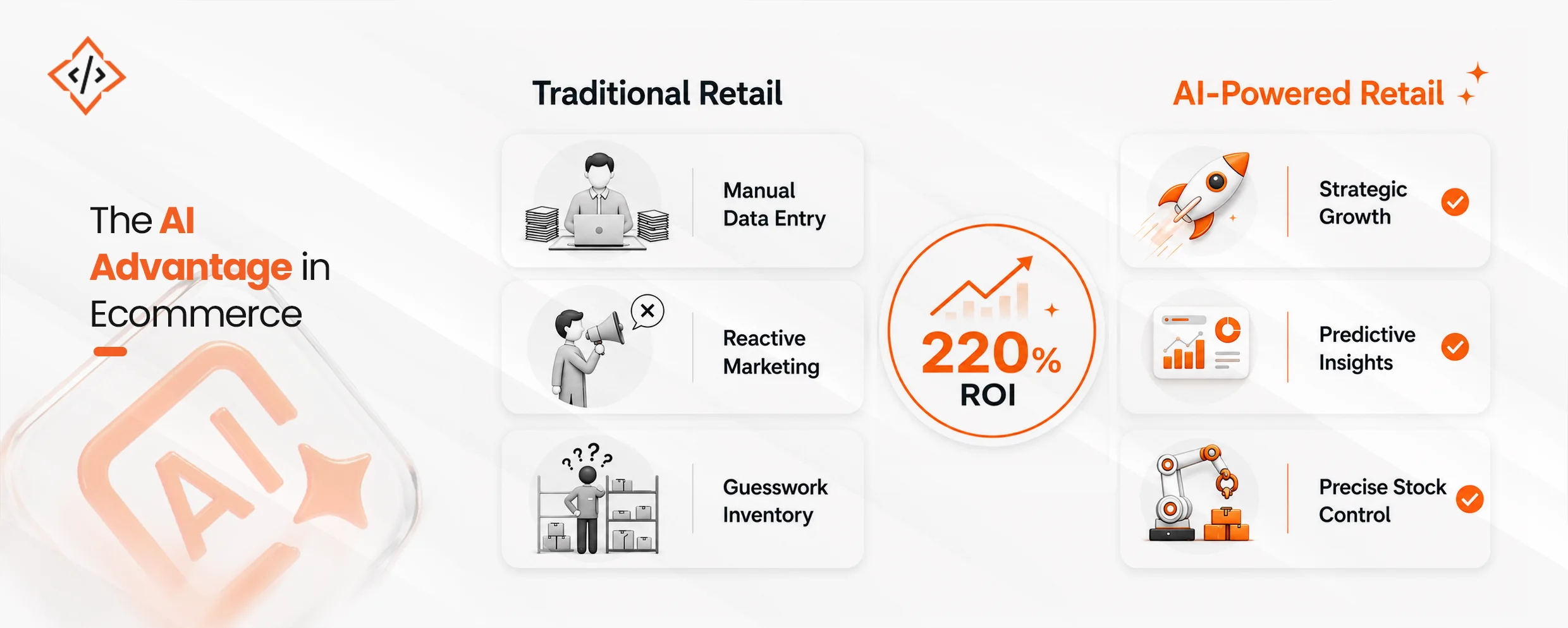
Retailers invest in AI for ecommerce because it produces a measurable financial return. Pragmatic business owners use these intelligent tools to resolve major operational bottlenecks instead of treating them as experiments. AI for online retailers shifts the focus from manual data entry directly to strategic growth.
These intelligent systems constantly analyze vast amounts of data to identify hidden consumer purchasing patterns. Consequently, teams spend less time on repetitive tasks and more time executing high-level growth strategies.
The financial incentive to adopt these technologies is substantial. According to a 2026 industry analysis by The Thinking Company, AI investments in retail and ecommerce deliver an average 220% ROI, representing the highest return of any business sector. This massive value creation stems from improving workflow efficiency and directly increasing daily sales volume through targeted personalization and demand optimization.
The shift toward AI-powered ecommerce provides several specific operational advantages:
Artificial intelligence in ecommerce removes friction from the buying journey while tightening backend operations. Retailers recognize that modern ecommerce AI solutions provide a clear path to sustained profitability. By relying on data-driven insights, online brands can successfully adapt to changing market conditions.
They consistently outpace competitors by responding quickly to emerging consumer demands. Eliminating manual friction from backend operations makes the entire organization highly adaptable.
Backed by expert AI consulting services, personalization engines analyze past purchases and browsing history to display exactly what each customer wants to buy. Modern artificial intelligence in ecommerce replaces generic store layouts with dynamic digital storefronts tailored to individual shopping habits. By interpreting user intent in real time, these platforms remove hesitation from the purchasing journey and increase conversion rates.
When shoppers see suitable items, right when they need them, average order value can rise and customer satisfaction follows . Tailored product recommendations curb choice paralysis , basically by hiding irrelevant inventory and pushing the final decision forward .
Key benefits of tailored recommendation engines include:
Implementing dynamic pricing models allows retailers to adjust price points automatically based on live market conditions. Advanced AI algorithms monitor supply levels, consumer demand, and competitor pricing shifts in real time. This automated pricing strategy ensures online stores remain competitive during peak traffic periods while safeguarding baseline profit margins.
Core advantages of automated pricing systems include:
Deploying these AI ecommerce solutions creates a smooth buying experience that consistently drives repeat sales. Retailers gain a reliable framework to maximize yield per visitor across every product category.
An AI chatbot for ecommerce handles customer inquiries instantly to prevent frustrated buyers from abandoning their shopping carts. These intelligent systems interact dynamically with users to remove friction that typically derails a digital purchase. A 2026 Gartner report projects massive growth for this specific technology. By 2028, at least 70% of customers will use conversational AI interfaces to initiate their customer service journeys.
By utilizing AI development services, retailers integrate these smart solutions to provide immediate answers and maintain vital purchasing momentum.
Bots effortlessly manage routine requests like returns, order tracking, and basic product questions without any human intervention. This setup fundamentally transforms how retail support centers operate daily.
Advanced bots act as dedicated virtual shopping assistants that actively curate the digital buying experience. These tools ask customers specific questions to understand their exact preferences and budget constraints.
Stockouts lead directly to immediate lost sales and frustrate ready buyers. AI inventory management solves this expensive problem by predicting exactly what will sell. A 2026 Gartner report projects that enterprise spending on AI-powered supply chain management software will reach $53 billion by 2030.
Retail leaders are aggressively adopting these intelligent agents to automate routine replenishment workflows and prevent expensive out-of-stock events. Consequently, precision algorithms reduce lost sales by ensuring popular products remain readily available.
Machine learning constantly evaluates past performance to accurately map future buying patterns. It analyzes historical sales data alongside shifting market trends and complex seasonal changes. This deep analysis allows retailers to anticipate market needs long before human analysts spot underlying trends.
Applying AI for online retailers helps companies strategically eliminate expensive dead stock holding costs. Retailers capture maximum revenue by ensuring highly requested products remain available during peak shopping periods. The technology efficiently transforms raw data into actionable procurement strategies.
Automated systems maintain optimal warehouse levels without requiring constant manual oversight from procurement teams. The platform automatically orders new inventory when stock quantities dip below a specific calculated threshold. AI-powered ecommerce tools track live stock movements across multiple global fulfillment centers simultaneously to maintain perfect balance.
This constant monitoring ensures your business only invests capital in products with a high probability of selling. Intelligent logistics connect unexpected consumer demand directly to supplier readiness without causing awkward fulfillment gaps.
Ecommerce automation with AI eliminates friction points in the buying process directly. This technology makes it significantly easier for customers to complete a transaction. By removing unnecessary barriers, retailers capture sales that would otherwise bounce.
Intelligent systems constantly monitor user behavior to identify exactly where shoppers abandon their carts. The software analyzes drop-off points during checkout and automatically simplifies the required steps. For example, it might dynamically reduce form fields for returning visitors. These ecommerce AI solutions tailor payment flow based on real-time user hesitation. This proactive approach ensures a smoother path to purchase for every visitor.
Shoppers can easily upload images to find similar products hidden deep within a retailer’s catalog. This visual discovery method completely bypasses traditional text search limitations. Often, customers struggle to describe a specific pattern or style using words alone. Visual search matches their exact buying intent by analyzing the uploaded picture directly. Implementing this specific artificial intelligence in ecommerce directly increases the likelihood of a sale.
Streamlining checkout flows and matching precise visual intent represent a critical shift in modern retail strategy. Implementing these intelligent tools transforms passive storefronts into highly proactive digital sales environments. They constantly adapt to real-time consumer behaviors to guarantee a frictionless path to purchase.
The future of retail belongs to brands that use artificial intelligence to anticipate customer needs before they arise. Companies must adopt AI in online retail to build resilient and highly profitable operations. Moving beyond manual processes allows your business to thrive despite constantly changing market conditions.
CodeTrade specializes in building custom AI for ecommerce platforms tailored to complex enterprise requirements. Our engineering teams design and deploy sophisticated ecommerce AI solutions that directly resolve specific operational bottlenecks. Our custom AI software development ensures your intelligent infrastructure integrates flawlessly and scales securely to support continuous revenue growth.
 Chand Prakash
 Chand Prakash
 Chand Prakash
 Chand Prakash
 Chand Prakash