






Enterprise Application
.NET Development
 Bhavesh Kachadiya
14 August 2026
Bhavesh Kachadiya
14 August 2026
.NET Framework to .NET 10 Migration: A Practical Playbook
 Bhavesh Kachadiya
Odoo partner tier is the first thing most buyers look at and one of the least informative things available.
Gold, Silver, Ready. Those tiers track commercial performance, meaning how much Odoo the firm sells, how many certifications the staff hold. That’s a real signal about a business being established. It says nothing about whether the team assigned to you has carried a customized estate through a version upgrade, which is the thing that decides what your Odoo costs over five years.
Buying from the US or EU makes this harder, because the usual informal checks are unavailable. You can’t drop into the office, you don’t share a professional network with their previous clients, and time zones make casual conversation expensive.
So you verify artifacts instead of impressions. This covers what to verify, what tier does and doesn’t tell you, and the terms to fix before the first invoice. If you’re buying in the UAE specifically, the Dubai partner selection guide covers the local considerations this post deliberately leaves out.
Worth being precise, because the tiers are widely misread.
Odoo’s partner program grades firms on commercial metrics: revenue contribution, user counts sold, certified staff. Higher tiers indicate a larger, more established Odoo practice, and that genuinely correlates with survival, process maturity, and a bench deep enough to absorb someone leaving.
What it doesn’t measure is delivery outcome on projects like yours. There’s no quality gate on implementations, no audit of whether customization was written against supported extension points, no check on whether last year’s clients could still upgrade.
Which produces a specific trap. A large firm with a strong tier can assign you a junior team while the senior people work the accounts that earned the tier. The tier is a property of the firm. Your project is staffed by individuals.
Use tier as a filter for firm stability, then evaluate the team you’d actually get.
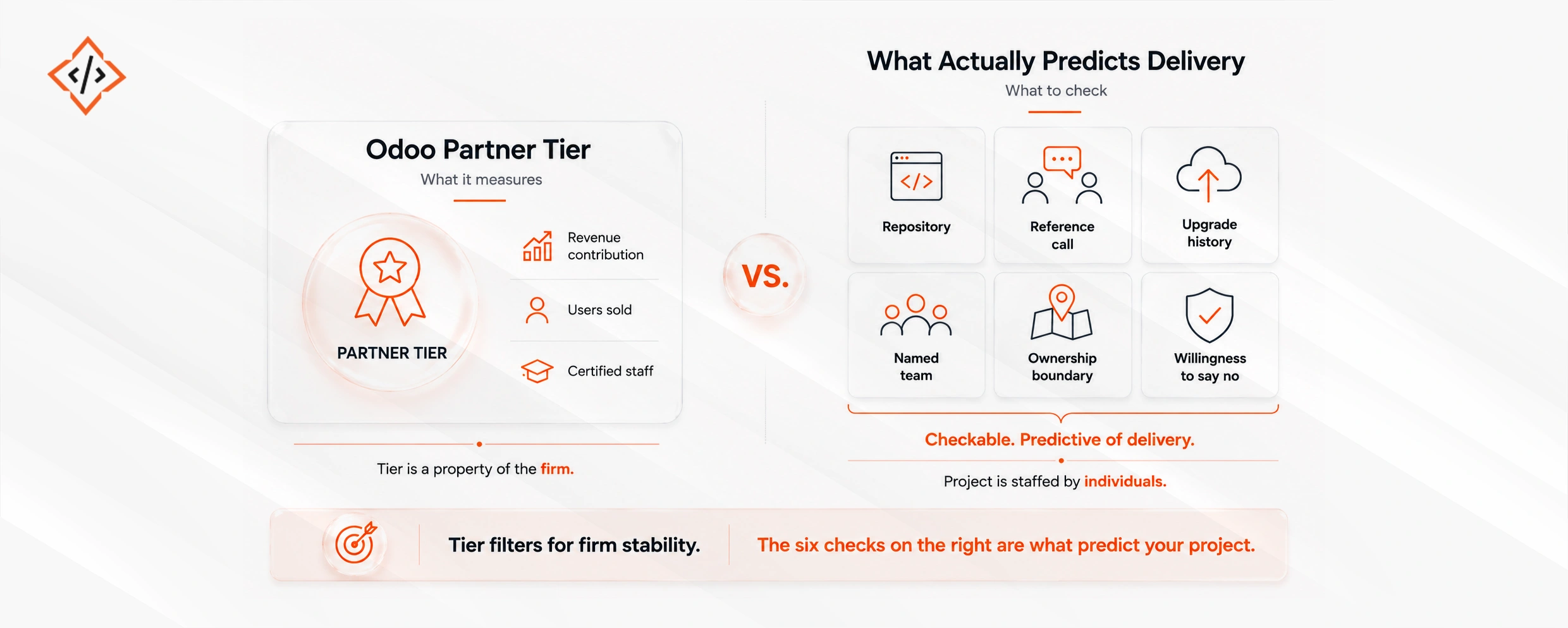
All six are checkable from another continent. That’s the point.
Ask to see code from a comparable engagement, with the client’s permission. You’re looking for whether customization extends Odoo or overrides it, and whether anyone wrote down why.
You don’t need to read Python to assess this. Ask them to walk you through one custom module and explain what would happen to it at the next major version. A partner who’s thought about that answers immediately.
Not a logo on a slide. A named person at a client, on a call, without the partner present.
Ask that reference two questions: what went worse than expected, and what would you do differently. References who only have praise were selected for it. The useful ones describe a real problem and how it got handled.
Ask which clients they’ve carried across a major Odoo version, and what broke. This is the single most informative question in Odoo procurement, and it’s the one that separates implementation shops from partners who live with what they build.
A firm that has only ever implemented and handed over has never faced the consequences of its own architectural decisions.
The people in the pitch should be the people on the project. Ask for names, get the commitment in the contract, and require notice before changes.
This matters more on ERP than elsewhere, because accumulated understanding of your processes is the actual asset you’re buying. Rotate the team and you buy discovery twice.
Who owns configuration decisions, who owns process design, who owns the data model, who signs off the chart of accounts. Ambiguity here surfaces during user acceptance testing as a defect when it’s really an unmade decision.
The strongest signal, and the easiest to test. Describe a requirement you suspect is unnecessary and see whether they sell it to you or question it.
A partner who agrees to everything in the sales process will agree to everything in delivery, and you’ll pay to build things you didn’t need.
If you’re in the UAE and want someone in the room, hire locally. Proximity is worth real money on ERP, and we’d be the wrong shape for you.
If your requirements are close to standard Odoo and you have an internal person who’s implemented before, buy Odoo direct and skip a partner. You’ll get further on configuration than most people expect.
And if you want the cheapest quote, we won’t be it and you shouldn’t pick on that basis anyway. The variance between a good Odoo implementation and a bad one is far larger than the variance between quotes, and the cheap ones recover margin in change requests.
Six questions. The answers separate partners fast.
Buying offshore or nearshore is normal and works well. What changes is the evidence you rely on.
| What you’d normally do | What to do instead |
|---|---|
| Meet the team in person | Video call with each named individual, not just the account lead |
| Judge the office and culture | Judge the repository, documentation, and commit history |
| Rely on local reputation | Rely on references you call yourself, unaccompanied |
| Resolve issues by dropping in | Written escalation path with named owners and response times |
| Assume shared working hours | Agreed overlap window, in the contract |
One thing worth insisting on regardless of geography: a paid discovery phase with a defined deliverable, before the implementation contract. It costs a fraction of the project, produces the process documentation you need either way, and tells you how the partner actually works before you’re committed. If they resist scoping discovery separately, that’s information.
Four, and they’re cheap now and expensive later.
These mirror the terms in Hire Odoo Developer , which covers the adjacent problem of building a team rather than selecting a firm.
I’ve given you six checkable signals, and I want to name the one I can’t operationalize.
What I actually want to know about a partner is how they behave when a project goes wrong. Not whether it goes wrong, because on ERP something always does. How they behave: whether they surface a problem early or manage it quietly until it’s undeniable, whether they absorb a mistake that was theirs, whether the senior person shows up when it matters.
None of my six checks touch that. References get close and they’re selected, and even honest references mostly describe outcomes rather than conduct. The upgrade-history question is a proxy, because a partner who stayed through upgrades has probably stayed through problems.
The best I’ve found is to ask directly: “Tell me about a project that went badly and what you did.” Then listen for whether they describe their own error or the client’s. Partners who narrate a difficult project entirely as the client’s fault are telling you what your postmortem will sound like.
That’s a soft test, and it’s the one I weight most, which is uncomfortable to admit in a post arguing for checkable evidence.
Partner tier measures commercial volume, not delivery quality. Use it to filter for a firm that will still exist in three years, then evaluate the team you’d actually be assigned.
Then verify artifacts rather than impressions, because buying at a distance removes the informal checks you’d otherwise rely on. A repository you can see, a reference you call yourself, an upgrade history with specifics, a named team, a written ownership boundary, and demonstrated willingness to say no.
Insist on paid discovery with a defined deliverable before the implementation contract. It’s the cheapest way to learn how a partner works while you can still change your mind.
And get four terms in writing before the first invoice: client-owned repository, upgrade-path commitment, documentation as a deliverable, named team with substitution notice.

 Bhavesh Kachadiya
 Chand Prakash
 Chand Prakash
 Hardik Soni
 Hardik Soni