Odoo Development, Enterprise Application 14 September 2026Why Do ERPNext Implementation Projects Stall and How Can You Avoid It?
Key Takeaways:
- ERPNext implementation delays usually come from unresolved process decisions and poor data rather than software limitations.
- ERPNext configuration should follow a clear dependency order because later phases rely on decisions made earlier.
- Data migration needs its own timeline, with source data cleaned and reconciled before final import.
- ERPNext customization should begin only after teams test the standard flow and confirm what the system cannot handle natively.
- Full production data should be used during cutover rehearsals to expose timing, reconciliation, and volume-related issues before go-live.
- Post-go-live support should be planned for the first four weeks because that period often determines user adoption and process stability.
Introduction
Most ERP projects do not slow down because the software is difficult to configure. They slow down when teams must agree on processes that were never clearly defined before. During an ERPNext implementation, those gaps quickly become visible. Finance may describe one approval flow, while operations follow another in daily work.
Returns may move between warehouses without a fixed rule. Old ledger accounts may remain active even though nobody knows why they exist. ERPNext configuration forces these choices into a single operating model, so unresolved decisions soon create rework. That rework adds time, raises ERPNext implementation cost, and delays testing or migration.
A practical ERPNext implementation guide should therefore begin with process decisions before configuration or customization starts. An ERP Migration Checklist also helps structure data preparation because poor records can block every phase that follows. Clear ownership, clean source data, and the right phase order help teams avoid repeated work and reach go-live with fewer surprises.
What Is the Right Phase Order for ERPNext Implementation?
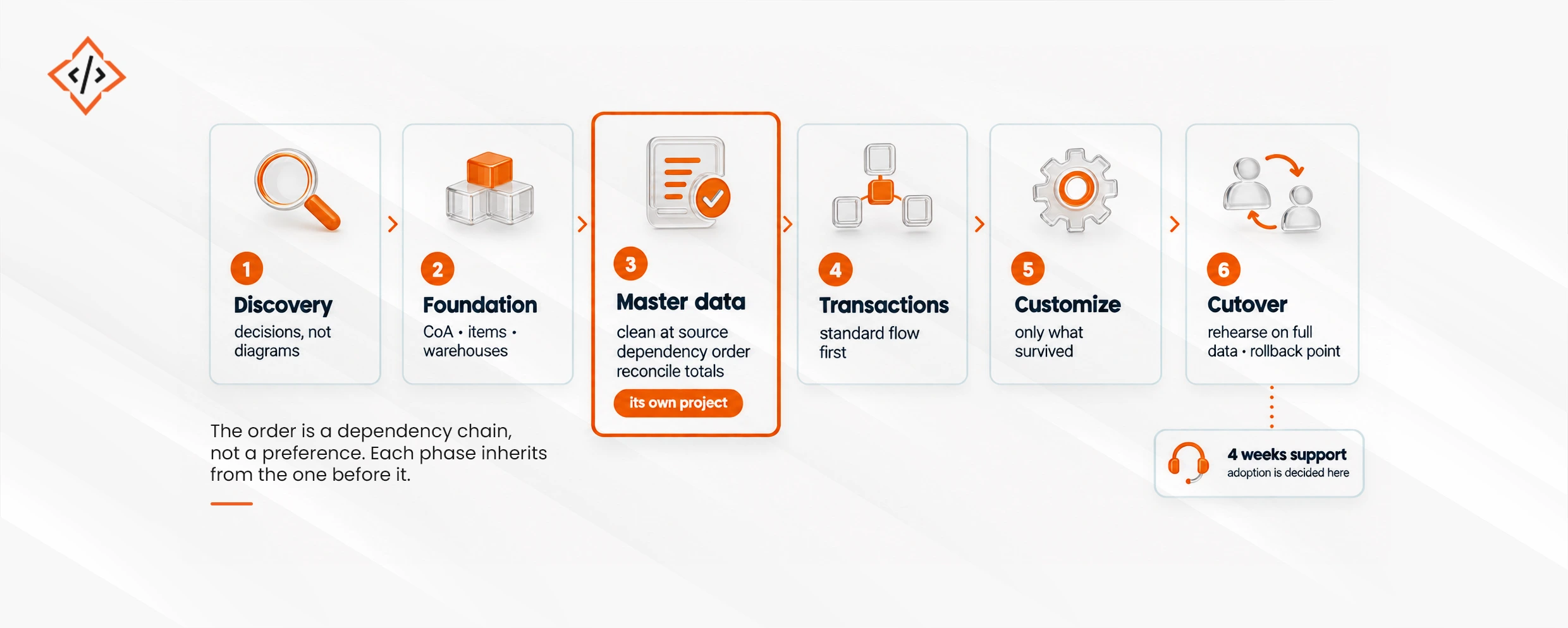
A successful ERPNext implementation depends on completing each phase in the right order because every stage builds on earlier decisions. Six phases. The order is not a preference. It is a dependency graph, and changing that order creates rework.
- Process discovery and decisions. Document how the business actually runs, including the exceptions people rarely mention because “that’s just how we do it.” The output is decisions, not diagrams.
- Foundation configuration. Company, chart of accounts, tax setup, item master structure, warehouses, naming series. Everything downstream inherits from these, which makes changing them later expensive rather than annoying.
- Master data migration. Customers, suppliers, items, opening balances. This is its own project, covered below.
- Transactional configuration. Sales, purchase, stock, manufacturing, and the workflows connecting them. Configure against the standard flow first.
- Customization. Only what survives contact with the standard flow. Reports, custom fields, custom apps, integrations.
- Cutover and go-live. Rehearsal against full data, then the real thing, followed by four weeks of intensive support.

Phase three is drawn to scale. It is the project inside the project.
Why Does ERPNext Data Migration Need Its Own Project?
Most ERP implementations underestimate data migration. ERPNext does not change that.
The reason is simple. ERPNext data migration exposes data quality issues that often went unnoticed before. Duplicate customers may have slightly different names. Items may have no unit of measure. Opening balances may not reconcile. A supplier record may contain three addresses with no clear indication of which one is current.
These issues are easy to miss while the data sits in spreadsheets or an old system. During migration, they can block imports completely.
Four practices make this manageable.
- Migrate in dependency order. Items come before stock, customers before sales history, and accounts before opening balances. The order is fixed, and getting it wrong means re-importing.
- Clean before you import, not after. Importing poor-quality data and fixing it in ERPNext takes longer than cleaning the source. It also introduces errors into a system users are beginning to trust.
- Decide what not to migrate. Ten years of closed transactions rarely justify the import cost. Opening balances plus a defined history window cover most operational needs. The old system can remain readable for the rest.
- Reconcile before sign-off. Compare totals in ERPNext with totals in the source for each account and warehouse. If the numbers do not match on migration day, they will not match after go-live. Finance will usually find the difference first.
What Should You Decide Before ERPNext Configuration Begins?
These decisions shape the data model, which makes them expensive to revisit once ERPNext configuration begins.
- Chart of accounts structure. Do not simply copy the old one. Build a structure that matches how you report, agreeing with whoever signs the statements.
- Item and variant strategy. Whether size and color are variants or separate items determines how stock, pricing, and reporting behave. Getting it wrong can require a re-import.
- Warehouse and stock hierarchy. Define physical locations, virtual warehouses, and how transit and returns should be represented.
- Naming series. It may seem minor, but it appears on every document you issue. Changing it later leaves two conventions in the same ledger.
- Who approves what, including the exceptions. Document informal authority as well, because it often surfaces during user acceptance testing as a defect when it is not one.
When Is an ERPNext Implementation Partner Not Necessary?
If your processes are close to standard and you have strong technical capability in-house, an internal ERPNext implementation may be practical. ERPNext documentation is detailed, the community is active, and hands-on configuration can help the internal team understand the system more deeply.
If the chart of accounts or approval rules are still unresolved, delay the project. These are business decisions that ERPNext implementation services can help structure, but they still need clear internal ownership. Paying a partner while finance and operations debate basic process rules adds cost without moving the implementation forward.
ERPNext should also not be used to fix an undefined or broken process. The system will formalize the process it is given, including its weaknesses. Resolve the process first, then configure ERPNext around the agreed operating model.

If your internal team can handle part of the implementation, CodeTrade can help identify where specialist support will actually reduce risk. Talk to the CodeTrade team to assess your migration, configuration, and cutover needs before committing to unnecessary scope.

When Should ERPNext Customization Begin?
The requirement list at kickoff is usually longer than the requirement list at go-live, and that difference often represents real savings.
Run the standard flow first. Show users the default sales order, the default approval, and the default report. A meaningful share of “we need X” becomes “we used X because the old system could not do Y,” while ERPNext already supports Y natively.
What survives that review is a genuine requirement and worth building properly on the Frappe Framework instead of working around.
Two disciplines help keep ERPNext customization from becoming technical debt.
- Prefer custom fields and custom apps over core modification. The framework provides proper extension points. Use them, and future upgrades remain easier to manage.
- Write down which business process each customization serves, and who owns it. Maintain that map as you go. It makes the next upgrade easier to estimate, and rebuilding it later is rarely practical.
How Should You Plan Cutover During ERPNext Implementation?
A successful ERPNext implementation needs a controlled cutover plan because go-live risks continue well beyond the migration itself. Two things decide whether go-live is calm.
- Rehearse against full production data. Not a sample. Import volume, opening balance reconciliation, and any recompute step scale with row count. A rehearsal on trimmed data tells you very little about the actual duration. The same trap catches Odoo upgrades, described in the Odoo 18 to 19 upgrade guide.
- Define the rollback point. Decide the exact time and condition for abandoning the cutover and returning to the old system. Agree on it in advance, in writing, with someone who has the authority to make the call. Making that decision at 3am can turn a difficult cutover into a worse one.
Then budget the four weeks after go-live properly. That period is often heavier than the configuration phase, and it is where adoption is decided. Expect a support queue, process gaps that testing missed, and at least one person who prefers the old system. Staff for this period rather than treating it as contingency.
How Much Historical Data Should ERPNext Migration Services Move?
Migrating a limited window of transactional history is often more practical than moving everything. Opening balances plus one or two years of history can reduce ERPNext implementation cost without affecting most daily operations. The trade-off is that older records must remain accessible elsewhere.
The reasoning is straightforward. Historical transactions increase migration volume, slow cutover rehearsals, and are rarely used in day-to-day work. A sales invoice from several years ago may never be opened again. Keeping the old system available in read-only mode can cover those occasional needs.
The risk appears later. Read-only access may disappear when licenses expire, servers are retired, or the people who understand the old system leave. Records that seemed safely stored can then become difficult to retrieve during an audit, dispute, or compliance review.
ERPNext migration services should account for that risk before data is excluded. A full export to a data warehouse or structured archive adds work, but it provides a more reliable fallback. The practical approach is to define the migration window, confirm where older records will be stored, and assign clear ownership for that archive.
Conclusion
Projects usually stall when teams postpone the decisions that shape data, workflows, approvals, and ownership. A successful ERPNext implementation starts by settling those choices before configuration moves too far. Clean source data also matters because weak records create delays during migration and reconciliation.
ERPNext configuration should follow a clear dependency order so later work does not have to be rebuilt. ERPNext customization should come only after teams test the standard flow and confirm what truly needs changing. Cutover also deserves a full rehearsal with production data, not a reduced sample. Clear rollback rules help teams respond quickly if the go-live window starts to slip.
ERPNext migration services can reduce risk, but internal ownership still matters throughout the project. The four weeks after launch should be included in ERPNext Implementation Services, not treated as optional support. When these steps are handled in sequence, teams reduce rework, control ERPNext implementation cost, and reach go-live with fewer surprises.
See how prepared your business is for ERPNext implementation and where delays are most likely to appear before go-live. Talk to the CodeTrade team to build a practical plan for data migration, configuration, customization, and cutover with fewer surprises.
FAQs
It tracks process complexity and data quality rather than user count. A business running close to standard processes with clean master data moves quickly. Unusual processes, poor data, or unresolved internal disagreement about how things work extend it substantially, and the software is rarely the constraint.
Data migration and process decisions. Migration surfaces data quality problems nobody was measuring, and configuration forces a business to state how it actually operates, which is where the disagreements appear.
Last, and less than you planned. Run the standard flow first and a meaningful share of the requirement list dissolves, because many requirements exist to work around limitations in the old system. Build what survives that filter using the framework's extension points rather than modifying core.
Opening balances plus a defined window, usually one or two years, rather than everything. Older history rarely gets queried in the ERP. Decide explicitly where the remaining archive lives and who owns it, because "the old system stays available" tends to hold for about eighteen months.
Four weeks of intensive support, staffed deliberately rather than treated as contingency. That period is heavier than configuration and it's where adoption is decided, because process gaps that survived testing surface as soon as real volume hits the system.
Hardik Sonii is the CEO and Sales Director at CodeTrade's official Odoo Partner operation in Dubai. He works across Odoo, AI/ML, Python, Django, and e-commerce, and has spent years helping businesses in the Middle East adopt technology that fits their scale and industry requirements.







 Hardik Soni
14 September 2026
Hardik Soni
14 September 2026 Hardik Soni

 Bhavesh Kachadiya
 Chand Prakash