






Web Development
eCommerce
 Chand Prakash
17 August 2026
Chand Prakash
17 August 2026
Magento Security Hardening for Stores Past End of Life
 Chand Prakash
Revenue does not dictate the outcome of the Adobe Commerce vs Magento Open Source debate. Catalog size remains equally irrelevant to this technical evaluation. Framing this platform choice as a simple size question produces bad financial outcomes in both directions. Plenty of high-revenue stores run exceptionally well on the Magento ecommerce platform.
Many smaller stores genuinely need the paid edition because specific Adobe Commerce features sit exclusively there. The real decision depends entirely on requiring native Magento B2B ecommerce capabilities or advanced merchandising tools. Requiring a managed cloud platform with guaranteed support also heavily influences this final choice. These three distinct feature groups carry very different technical weight.
This guide explains exact platform boundaries and how to calculate your true Adobe Commerce vs Magento Open Source cost. You will discover specific scenarios where the free edition remains the perfect architectural fit when planning Magento development services.
Evaluating specific functional differences reveals three distinct capability groups that justify investing in the enterprise edition for your business.
Built-in features include company accounts with multiple buyers, shared catalogs, and customer-specific price lists. Native quote negotiation workflows, requisition lists, and purchase order payments are also included.
This group decides the platform edition more often than any other factor. Approximating these tools on Open Source requires assembling several extensions or building custom code. Both routes tend to cost more than the license over a few years.
Treat these native Adobe Commerce B2B features as close to a hard requirement for commercial operations. The operational detail is documented across standard Magento B2B features.
Capabilities include customer segmentation, dynamic content targeting, and automated visual merchandising rules. Teams also gain related-product rules alongside content staging with preview for scheduled campaign changes.
These Adobe Commerce features are genuinely useful for merchandising-led retailers who update site presentations frequently. They remain much less useful for catalog-driven or wholesale sellers where site presentation changes rarely. Consequently, this specific feature group is the one most often paid for and least used.
The offering provides managed cloud hosting, a supported deployment pipeline, performance tooling, and guaranteed support response commitments.
The support entitlement is easy to undervalue until an operational crisis occurs. During events like the Adobe Commerce 2.4.6 End of Support, this vendor relationship mattered directly for security decisions. It eliminated the risky need to rely on community forums during critical platform updates.
| Capability | Magento Open Source | Adobe Commerce |
|---|---|---|
| Catalog, attributes, configurable products | Full | Full |
| Multi-store, multi-currency, multi-language | Full | Full |
| Cart price rules, catalog price rules | Full | Full |
| Checkout, payments, shipping | Full | Full |
| Full-page cache, indexing, search | Full | Full plus tooling |
| REST and GraphQL APIs | Full | Full |
| Company accounts and roles | Extension or custom build | Native |
| Shared catalogs and price lists | Extension or custom build | Native |
| Quote request and negotiation | Extension or custom build | Native |
| Customer segmentation | Extension | Native |
| Content staging and preview | Extension | Native |
| Visual merchandiser | Extension | Native |
| Managed cloud infrastructure | Self-arranged | Included |
| Vendor support entitlement | None | Included |
| License cost | None | Annual |
The first six rows matter most in this Magento Open Source comparison. Core commerce capability remains identical across both editions. Technical decision-makers must focus on functional differences rather than assuming arbitrary platform tiers.
Evaluating Adobe Commerce vs Magento reveals specific operational scenarios where the free open source platform remains perfectly suitable. Four specific operational cases remain far more common than standard vendor marketing material typically suggests.
One specific financial argument requires extreme care. Choosing the free edition purely to avoid licensing fees creates a dangerous false saving. Complex hosting, security patching, and performance upgrades never disappear. These critical technical tasks simply become strict internal engineering obligations. The open source edition carries zero royalties. However it rarely guarantees a lower Adobe Commerce vs Magento Open Source cost overall.
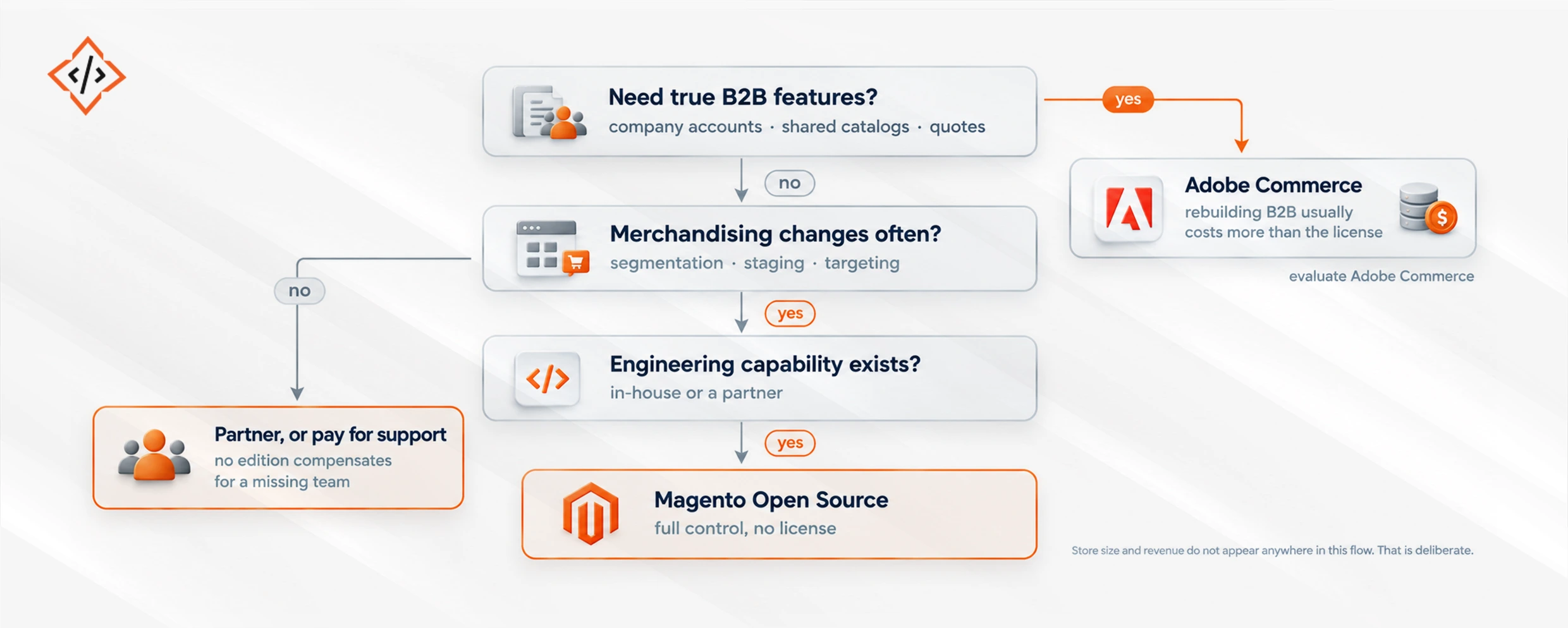
Three precise operational questions decide the final platform edition. Total company revenue is never one of them.
Do not evaluate your Adobe Commerce vs Magento Open Source cost as license fees against zero. Most merchants only see this highly flawed initial comparison.
Start by counting the official Adobe Commerce pricing. Then subtract everything the native enterprise platform replaces completely. This includes separate hosting arrangements and third-party extensions. You must also deduct standard external support costs. The final net figure sits significantly lower than the initial headline price.
Evaluating Magento Open Source pricing requires calculating self-managed hosting and essential infrastructure expenses. You must include third-party extensions required to approximate paid features. Then calculate the required engineering time to integrate and maintain those modules. Finally, add the external support arrangement replacing the official vendor entitlement.
That final engineering line decides most genuine architectural cases. Assembling multiple extensions to mimic native modules demands extensive integration work. It introduces severe compatibility risks during every system upgrade. Merchants also face the constant possibility that independent vendors abandon their modules entirely. This matches the exact pattern described in the recent upgrade guide. Every single extension represents a complex future upgrade decision.
This general financial shape holds fairly reliably across operations. Open Source usually wins on total cost for B2C retail lacking heavy merchandising needs. Adobe Commerce usually wins for genuine commercial operations. This happens once custom extension assembly and continuous maintenance are priced honestly.
Choosing Magento Open Source specifically to avoid licensing fees requires dedicated internal technical management. Do not hire CodeTrade to build the system without having internal staff to run it. Development agencies deliver working stores but leave an immense operating burden behind. The platform becomes completely unpatched within eighteen months without proper internal engineering support.
Finance teams often suggest dropping to the free version to save money while utilizing native Adobe Commerce B2B features properly. Ask CodeTrade to price the complete technical replacement before committing to any strict architectural changes. Retaining the enterprise license often remains the cheapest operational option. Professional development agencies prefer explaining this reality rather than building unstable custom replacements.
Organizations needing daily platform operation rather than new development require a managed hosting partner. Development agencies provide entirely different services at completely different price points.
Migrating between editions remains completely possible in both directions without requiring a total reinstall.
Moving from Open Source to the Adobe Commerce ecommerce platform represents the more common and straightforward direction. Both systems share a core data model. Catalogs, customer accounts, and historical order data carry over directly without loss. The primary technical work involves reconciling third-party extensions that duplicate native enterprise features. Teams must also migrate custom B2B implementations directly onto native modules. This project constitutes a structured data and process migration rather than an abrupt platform switch.
Switching from Adobe Commerce to the free edition happens primarily to eliminate recurring licensing expenses. The core challenge involves replacing native enterprise features before the official license lapses. A store using company accounts and shared catalogs must deploy working extension replacements first. Underestimating this deployment sequence causes these migration projects to fail badly.
Plan system upgrades and edition migrations as two entirely separate projects in either scenario. Combining them forces two sets of technical unknowns to interact simultaneously. That mistake makes root cause diagnosis and system troubleshooting considerably harder.
The cost comparison outlined above intentionally excludes exact figures. This represents a practical limitation rather than mere editorial caution. Adobe never publishes official Adobe Commerce pricing as a fixed number. Final costs are negotiated directly based on specific requirements. Rates vary significantly by revenue band and distinct deal terms. The figures circulating online usually come from unsubstantiated repetition.
Any total cost model inherently contains a completely blank variable. The entire financial comparison turns heavily on that exact missing number. This means the fundamental shape of this architectural advice remains completely stable. However the exact financial crossover point remains entirely fluid.
The custom extension assembly route absolutely gets expensive. Determining when that route stops being expensive requires actual quote data. This Adobe Commerce vs Magento Open Source cost crossover lands differently for every merchant. Acquiring a real vendor quote provides the only definitive financial answer.
Stating this reality honestly is better than publishing deceptively precise models. True technical transparency requires acknowledging these strict pricing limitations upfront.
Resolving the Adobe Commerce vs Magento Open Source decision comes down to three precise operational questions. Does your store require native B2B functionality? Does merchandising change often enough to justify dynamic segmentation and staging? Most importantly, does your team possess the technical capability to manage the infrastructure?
Native Adobe Commerce B2B features justify the enterprise tier more than anything else. Approximating company accounts and custom quote workflows through third-party extensions costs more over time. This fragile patchwork also adds severe upgrade risks with every new release. Conversely, advanced merchandising tools represent the capability group most frequently purchased yet least used.
The Magento ecommerce platform remains a complete robust system, not an incomplete trial. It serves standard B2C retail operations exceptionally well whenever businesses hire Magento developers for dedicated technical management. Neither software edition compensates for an absent technical team. Choosing the free edition purely to evade license fees without operational resources guarantees failure.
 Chand Prakash
 Chand Prakash
 Kush Trivedi
 Kush Trivedi