







Odoo Development
 Hardik Soni
18 August 2026
Hardik Soni
18 August 2026
Top 6 Odoo Development Companies in the UAE
 Hardik Soni
Enterprise ERP APIs are built for desktop clients on highly reliable networks.
Calling these endpoints directly from a mobile device creates a slow and fragile experience. A direct connection also exposes financial data during standard Flutter ERP integration.
Mobile clients on unstable connections simply cannot handle granular data models efficiently. The structural fix for this mismatch in Flutter app development is never just a faster application.
You need a dedicated backend-for-frontend service for proper Flutter Odoo integration.
This thin intermediary layer composes complex backend records into simple screen-shaped responses. It also keeps authoritative credentials safely off the public internet during ERP mobile app development.
This guide explains how to structure that secure middleware layer correctly. You will learn how to handle offline ledger mutations without corrupting your core system of record.
Connecting a backend directly to a mobile interface creates immediate architectural friction during any Flutter ERP API integration.
There are four distinct structural mismatches. None of these issues represent a criticism of the ERP itself.
Security adds another critical dimension during Flutter enterprise app development.
Exposing an ERP directly to the public internet widens your attack surface significantly. This exposes the core system holding your sensitive financial data.
That severe risk alone completely justifies building a secure intermediary layer.
A proper backend-for-frontend completely transforms how your mobile application communicates with your core systems during Flutter ERP integration.
This thin service sits directly between the application and the ERP. The mobile development team must own this layer completely. It handles six critical responsibilities.
In Flutter app development for enterprise, applications need exactly one request per screen where practical. An order detail endpoint must return all joined data needed for rendering.
The service only returns specific fields the application uses. It never sends the massive datasets the backend actually holds.
The service issues and refreshes tokens for the application. It holds ERP credentials securely server-side. The mobile application never possesses these sensitive credentials.
Reference information like product lists and pricing changes very slowly. Fetching this data repeatedly becomes highly expensive during Odoo mobile app development.
The service accepts an offline mutation and validates its precise shape. It enforces idempotency before applying changes to the ERP asynchronously.
Asking what changed since a specific timestamp makes offline synchronization tractable in Odoo development. Without this feature, every sync becomes a heavy full refresh.
That last responsibility deserves major emphasis. Design this delta endpoint very early in your project.
Retrofitting change tracking onto an existing framework is considerably harder than building it initially.
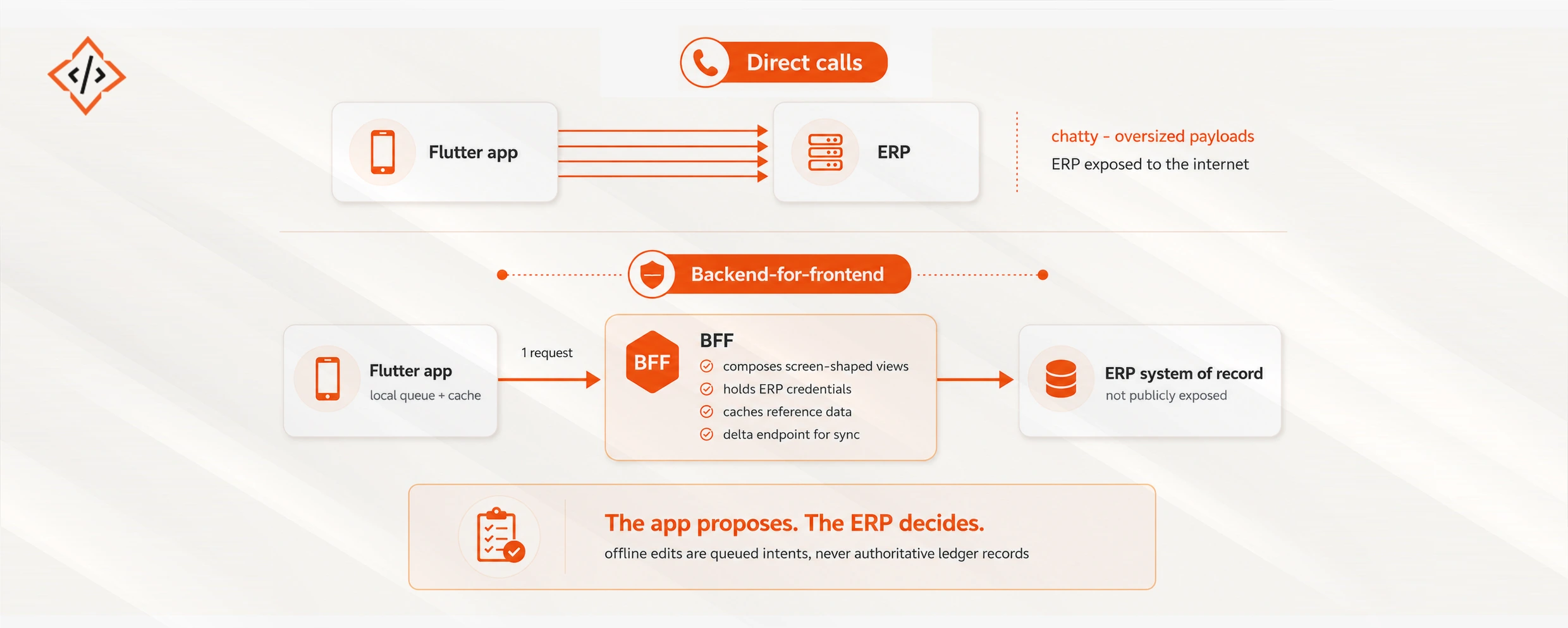
This architecture guarantees one request per screen. It keeps credentials held safely server-side. It provides the exact delta endpoint that makes offline synchronization possible.
Handle offline work carefully during Flutter ERP integration. The system of record is a financial ledger. A corrupted ledger creates a serious business problem rather than a simple technical bug.
The governing principle remains strict. The mobile application proposes changes, and the backend ERP decides. An offline edit represents a queued intent rather than an established fact. The user views this optimistically. The ERP confirms or rejects it when connectivity returns.
Cache reference data locally.
This includes products, prices, customers, and locations. Refresh this information through the delta endpoint to keep caching safe.
Store assigned work on the device. This covers specific orders, tasks, or inspections the user needs today. Fetch this data during the synchronization process.
Maintain a mutation queue. This holds the pending actions of the user. Each action must carry a unique idempotency key and an explicit state.
Never store anything authoritative during Flutter Odoo app development.
Stock levels, credit limits, and posted balances represent absolute ERP truth. Display these strictly as fetched values with a visible timestamp.
Never present locally computed figures. Showing users a calculated stock number creates false promises the warehouse cannot keep.
Each queued item requires an idempotency key.
Generate this key on the device at creation time rather than send time. This single detail makes network retries completely safe.
An application might send data, lose connection before the response, and resend. The server recognizes the existing key and prevents duplicate records.
Assign an explicit state to each queued item. These states mean pending, sending, confirmed, or rejected. Show rejected items to the user with a clear reason. A silently dropped mutation remains far worse than a highly visible failure.
Decide these rules per object in writing before beginning implementation.
Using a last-write-wins approach works for a free-text note. It remains completely unacceptable for a quantity on any financial document.
| Object | Reasonable rule |
|---|---|
| Free-text note or comment | Last write wins, or append both |
| Task or job status | Server wins if already progressed beyond the offline state |
| Quantity on a document | Reject and surface to the user, never merge silently |
| New record created offline | Accept, deduplicated by idempotency key |
| Price or discount | Server always wins, never accept a client-side price |
That last row matters immensely from a commercial perspective. A client-supplied price ultimately becomes a client-supplied discount.
Do not buy offline synchronization if your users always remain on stable building Wi-Fi.
This feature represents the most expensive investment during Flutter ERP app development. You would be paying for a complex subsystem that never actually activates.
A solid loading state and sensible network retry handling will cover your needs completely.
Avoid building a backend-for-frontend layer purely out of habit if your system already features a proper mobile-shaped API.
Experienced teams providing Flutter ERP integration services will recognize this redundancy immediately. A direct connection works perfectly when the backend already serves mobile data efficiently.
Pause the project completely if nobody internal owns the core ERP data model. An Odoo mobile application built without strict data governance produces silent errors.
Someone must know exactly what happens to specific fields during order confirmation. Missing this expertise creates fundamental application flaws that nobody catches until financial reconciliation.
Establishing strict architectural boundaries ensures your system remains completely stable and scalable during complex Odoo mobile app development.
Four specific rules keep this integration highly maintainable over time.
For Odoo specifically, the BFF typically talks to the external API and composes across models rather than exposing them individually.
On the app side, this fits the layering in Flutter enterprise architecture, with the BFF client in core/network behind repository interfaces.
Understanding these common failure points helps technical leaders avoid expensive mistakes during any complex Flutter ERP integration project.
There are five recurring failures alongside specific prevention strategies for each case.
Optimistic UI on ledger data creates significant architectural discomfort.
The governing principle states that the application proposes and the backend decides.
This approach remains structurally clean. Following this strictly creates usability issues during Flutter ERP app development. Field engineers recording completed jobs offline see pending badges for hours.
They might wait until the next morning for network signal. This delivers a worse experience than traditional paper forms. Field workers will quickly report this daily frustration.
The alternative involves showing the change as complete and quietly reconciling later. This works perfectly until the core enterprise system rejects the data. Users then falsely believe a job is closed when it remains open.
A common compromise shows the task as done with a subtle unsynced marker.
The application then makes any subsequent rejection highly visible. This remains an imperfect solution during complex Flutter Odoo integration.
Making markers too subtle means users completely ignore them. This outcome is arguably worse than choosing either strict extreme.
Offline honesty and offline usability constantly pull against each other. The financial ledger fundamentally only cares about absolute data integrity.
A mobile application built by a Flutter app development company in USA must never call an enterprise backend directly.
The core data shapes simply do not match. Complex APIs remain too granular and chatty for mobile networks.
A dedicated backend-for-frontend resolves this friction during Flutter ERP Integration. This middleware layer secures credentials safely on the server. It also keeps your core financial system completely off the public internet.
Handling offline work requires strict data governance during Odoo mobile app development. The mobile client only proposes changes while the core ledger decides.
You must queue offline mutations using device-generated idempotency keys. Never treat locally cached stock or pricing as absolute truth. Document your conflict rules for every single object before writing code. A basic override rule works fine for simple text comments.
Applying that same rule to financial quantities creates a severe defect. Proper architectural planning prevents these expensive reconciliation failures during Flutter enterprise app development.
 Hardik Soni
 Hardik Soni
 Hardik Soni
 Hardik Soni
 Abhishek Karad