







Mobile App Development
 Chand Prakash
30 September 2026
Chand Prakash
30 September 2026
How Should You Approach Flutter Performance Testing on Mid Range Devices?
 Chand Prakash

“Build once instead of twice” remains the standard industry pitch. It is actually the wrong reason to migrate your applications. Whether evaluating alternatives like React Native app development or sticking to native code, the real pain of maintaining separate codebases is feature divergence. A critical fix often lands on one platform but completely misses the other.
Two product backlogs drift apart while QA teams spend hours reconciling subtle differences. Teams seeking mobile app modernization usually want to escape this specific maintenance nightmare. They are not simply chasing raw speed during a native to flutter migration. These distinct goals demand completely different strategic plans and concrete success metrics.
This comprehensive guide explores how to execute an incremental transition successfully. It covers exactly how to sequence screens during Flutter app development. The guide also details when leaving your current architecture alone remains the smartest choice.
Identifying the right operational conditions ensures your native to flutter migration delivers measurable return on technical investment quickly. Four specific conditions determine technical readiness. Having two or more present makes a strong case for Flutter migration services.
The counter-case against undertaking custom Flutter app development remains equally clear and appears further below.
The add-to-app capability allows the framework to run directly inside an existing native application. The native application remains the host while Flutter renders specific screens or complete user flows. A successful native to flutter migration follows this exact technical sequence.
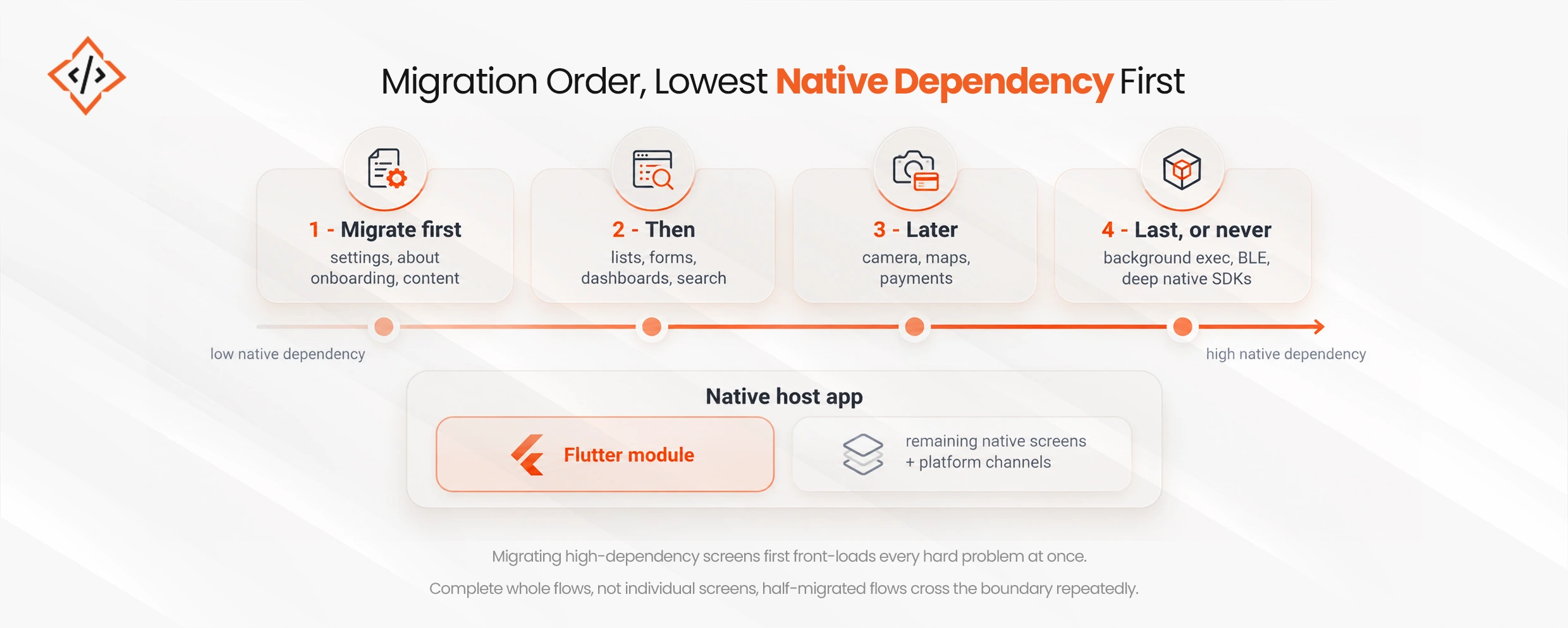
Order your process by native dependency. The host inverts only after Flutter owns the majority of application screens completely.
Evaluating real operational expenses remains critical to calculating your overall Flutter app development cost before committing technical resources.
| Cost | Detail |
|---|---|
| Binary size | Two runtimes coexist in one application, creating a meaningful and permanent size increase while both runtimes remain active. |
| Boundary maintenance | Every platform channel requires code to write, test, and synchronize across two separate native implementations. |
| Navigation friction | Screen transitions between native views and Flutter screens demand meticulous engineering to feel completely natural. |
| State duplication | Authentication state, active user sessions, and dynamic feature flags require seamless sharing rather than separate duplication. |
| Dual skill sets required | Engineering teams require strong Dart proficiency alongside ongoing Swift and Kotlin expertise throughout the transition. |
A complete rewrite appears faster to plan but remains considerably riskier to deliver. Incremental native to flutter migration wins for three specific reasons.
There remains one honest case for a complete rewrite. The existing applications are small and genuinely poor. Nobody wants to preserve their current behavior. The argument for keeping them completely disappears in this scenario.
Do not migrate if both your iOS and Android app development workflows are well maintained and ship simultaneously. Teams completely fluent in Swift and Kotlin should avoid unnecessary transitions. Undertaking Flutter migration services solves a non-existent problem while wasting valuable technical budget.
Never start this architectural shift midway through a heavy feature quarter. The transition competes directly for the same engineering resources. Running both efforts at full intensity guarantees slow migrations and delayed features. Wait for a natural schedule gap.
Avoid migrating if core application value lives in background locations or specialist hardware SDKs. The project will consist mostly of writing complex platform channels. This expensive approach to custom Flutter app development leaves organizations in a worse technical position.
Always order your migration by native dependency starting with the lowest first. Migrating complex screens initially front-loads difficult problems into phases where engineering teams know the least.
This exact sequence appears in the previous diagram demonstrating a very simple technical principle. Early mobile app modernization efforts exist purely to build confidence and prove underlying infrastructure. A basic settings screen failing only costs your team one week. A core payments flow failing costs an entire quarter and destroys essential project political support.
Sequencing a native to flutter migration by business priority rather than technical dependency creates severe architectural bottlenecks.
This approach initially seems highly defensible. Stakeholders often want critical checkout flows unified first because divergence bugs remain highly visible. Starting there forces teams to touch payment SDKs alongside analytics layers and deep links simultaneously. This requires building the entire platform channel layer under intense deadline pressure while learning add-to-app mechanics.
The project eventually ships but takes twice the initially estimated time, unexpectedly inflating your overall Flutter app development cost. Channel interfaces written under severe pressure usually require multiple complete rewrites over the following six months.
The correct approach mandates migrating basic settings first even when stakeholders demand core features. Teams then use the proven channel layer to execute complex checkouts properly during enterprise Flutter development. The business receives their desired feature slightly later but in significantly better technical shape. Discussing this strategic sequence upfront remains absolutely essential.
Knowing exactly when to avoid a native to flutter migration protects your technical budget from completely unnecessary expenses. We identify four specific cases where recommending against a framework transition remains much more useful than suggesting it.
A fifth critical consideration involves transition timing rather than technical suitability. You must never execute migrations during heavy feature delivery cycles.
Complex migration projects drift without explicit technical measures, and the most useful metrics avoid counting basic code lines.
Publish these exact metrics to project stakeholders every month. This transparency keeps multi-quarter Flutter application development fully funded. It makes an honest pause possible if numbers stagnate.
A successful native to flutter migration requires solving actual feature divergence rather than simply chasing raw development speed. Executing an incremental transition protects your existing revenue streams while allowing engineering teams to ship continuously.
Always sequence your Flutter application development by technical dependency instead of pure business priority. This cautious approach builds essential team confidence and establishes reliable platform channels without creating deadline panic for teams accustomed to traditional iOS app development services.
You must calculate your true Flutter app development cost by honestly factoring in ongoing dual skill requirements. Remember that deep native integrations might completely disqualify your current architecture from mobile app modernization entirely. Track your cross-platform defect rates carefully to ensure the transition actually delivers expected maintenance relief.
Transparent monthly reporting keeps these complex projects funded while proving the long-term value of your strategy. Making these pragmatic architectural choices ensures your enterprise Flutter development remains completely stable and structurally sound.
 Chand Prakash
 Chand Prakash
 Chand Prakash
 Abhishek Karad
 Abhishek Karad