





Odoo Development
eCommerce
 Hardik Soni
29 October 2026
Odoo WooCommerce connector: how to connect, sync, and automate your store (2026 guide)
 Hardik Soni

The most expensive ERP mistake involves paying developers to rebuild native system features from scratch. Companies often hire Odoo engineers who possess strong Python skills but lack functional configuration knowledge.
These teams might spend weeks hardcoding complex manufacturing workflows that the platform already handles natively. This custom code inevitably breaks during the next major upgrade and requires complete deletion. This costly failure happens because businesses treat the developer title as a single uniform job.
A successful project actually requires four distinct engineering roles handling configuration alongside custom module creation and deployment. Before you hire experienced Odoo developers, you must understand exactly which specific technical capability your project demands.
Complementing your standard Odoo implementation cost guide, this comprehensive guide details how to test specific skills and structure safe delivery models effectively. It also covers the essential contract terms required to protect your entire Odoo implementation team.
Understanding these four distinct technical profiles ensures you build a highly capable and dedicated Odoo development team efficiently. Four specific roles cover almost every successful Odoo engagement completely. Small software programs might combine these functional responsibilities. Large enterprise implementations separate them strictly.
This role translates complex business processes directly into native Odoo configuration. They own the critical chart of accounts setup alongside warehouse routing and approval hierarchies. They decide exactly what requires configuration rather than custom coding. This critical expertise prevents the most expensive technical mistakes entirely.
These Odoo customization experts write specific custom modules using Python against the native ORM. They strictly manage model inheritance alongside computed fields and complex record rules. They also handle QWeb reports and the modern OWL front end. This role determines whether your custom architecture survives future system upgrades safely.
Specialized Odoo integration developers connect your ERP to external platforms seamlessly. This includes payment gateways alongside external warehouse systems, banking portals, and modern AI services. They manage critical queue design alongside reliable failure handling protocols. Most production incidents within mature estates originate across these external connections.
This technical position owns system deployment alongside strict upgrade tooling and secure backup protocols. They guarantee environment parity and optimize overall application performance continually. This role remains absolutely mandatory for any self-hosted enterprise architecture. You quickly notice their absence when routine system upgrades consume excessive operational hours.
This comprehensive skill matrix outlines the exact technical requirements needed when you hire experienced Odoo developers for enterprise projects.
| Capability | Functional consultant | Framework developer | Integration engineer | DevOps |
|---|---|---|---|---|
| Odoo configuration depth | Essential | Working | Working | Basic |
| Python and Odoo ORM | Basic | Essential | Essential | Working |
| Model inheritance and record rules | Working | Essential | Working | – |
| QWeb / OWL front end | – | Essential | Basic | – |
| Accounting and localization | Essential | Working | Basic | – |
| Manufacturing / inventory logic | Essential | Working | Working | – |
| External API and queue design | Basic | Working | Essential | Working |
| OpenUpgrade and migration scripts | Working | Essential | Basic | Essential |
| Docker, CI, environment parity | – | Working | Working | Essential |
| Performance profiling and indexing | – | Working | Working | Essential |
| Data migration and reconciliation | Essential | Essential | Working | Working |
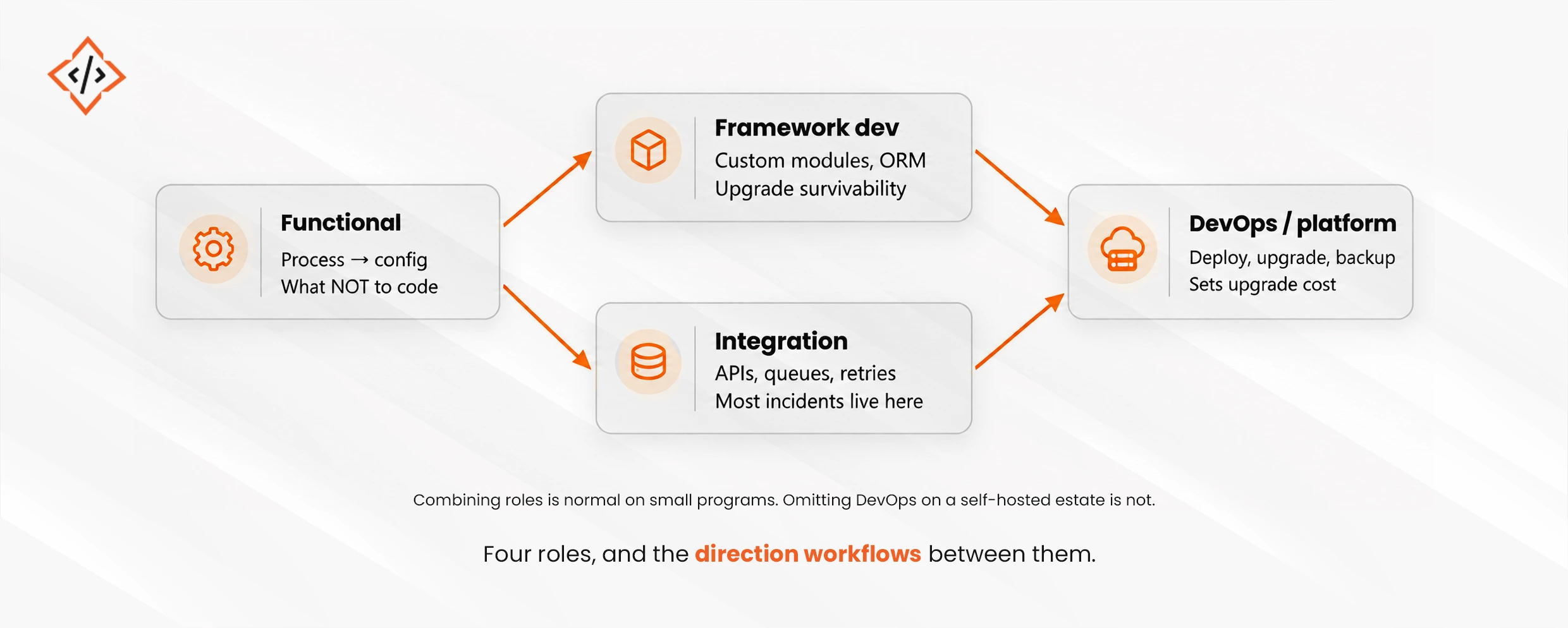
These four technical roles define the complete workflow required to deploy enterprise systems successfully.
Selecting the correct operational delivery framework matters significantly more than individual developer seniority during complex enterprise software engagements. Choosing the proper delivery framework shapes project outcomes more than individual seniority levels. Each framework possesses specific stages where it succeeds or fails completely.
| Model | Works well when | Fails when | Who carries risk |
|---|---|---|---|
| Fixed-bid project | Scope is genuinely known and stable, a discrete module or integration | Requirements are still being discovered, ERP first phases | Vendor, which rewards scope defense over outcome |
| Dedicated team | Multi-phase program, scope evolves, knowledge must accumulate | Work is a one-off with a hard end date | Shared, with you owning direction |
| In-house build | Odoo is core to the product and permanent | Odoo is infrastructure, or the local hiring market is thin | You, entirely |
| Hybrid | Core team in-house, specialist capability contracted for migration or AI work | Ownership boundaries left undefined | Split, and it must be documented |
Two crucial factors require attention regarding enterprise deployments specifically. Fixed-bid contracts perform poorly during initial phases because critical requirements emerge during active configuration.
The Panorama industry data on failure causes reflects this reality perfectly. Inadequate change management and poor data migration represent severe discovery problems. A restrictive contract that punishes this natural discovery process makes outcomes worse.
A dedicated Odoo development team works effectively because system knowledge compounds continuously. An engineer who migrated your chart of accounts previously brings immense value during subsequent phases. That accumulated system context represents the actual valuable product you purchase.
Most Odoo interviews strictly test basic memory recall. Effective technical screens must test reasoning regarding upgrade costs and data integrity. These specific areas represent where companies spend the most money. When you hire dedicated Odoo developers, testing their structural reasoning remains critical.
The strongest performance predictor remains practical migration experience across major version boundaries. This specific skill dictates whether custom architecture becomes expensive technical debt. No amount of simple greenfield development teaches this critical foresight.
Reading the native source code represents the second strongest predictor. Professionals who habitually read core modules produce architecture that survives upgrades safely. You must verify these specific habits when seeking Odoo engineers for hire.
Businesses needing a single small module built to an existing specification should hire a freelancer if internal maintenance exists. A dedicated Odoo development team represents the wrong structure for minor tasks. This approach creates expensive coordination costs that companies simply do not need.
Stable and well-configured estates without pending change requests require no immediate technical hires. These environments often need only a basic support retainer rather than active development. Recognizing this operational reality saves organizations an entire year of technical budget.
Organizations specifically needing a functional consultant to fix a chart of accounts must state that requirement clearly. Professional agencies will staff that exact role efficiently. A complete Odoo implementation team remains entirely unnecessary for isolated accounting configuration tasks. Vendors pushing four-person engineering pods for simple configuration fixes are selling the wrong solution entirely.
A realistic onboarding timeline for a dedicated Odoo development team takes six weeks to reach full productivity. Attempting to compress this schedule never works effectively. Delayed knowledge transfer always occurs later and costs businesses significantly more money.
| Phase | Duration | What must be true at the end |
|---|---|---|
| Environment and access | Days 1 to 3 | Local and staging running, repository access granted, restore from production backup verified |
| Codebase and process discovery | Week 1 to 2 | Custom module inventory documented, customization-to-process map produced, upgrade history understood |
| First supervised delivery | Week 2 to 3 | One small, low-risk change shipped through the full pipeline including review and deploy |
| Independent delivery | Week 4 to 6 | Team taking scoped work with normal review, escalation paths established |
| Steady state | Week 6+ | Team contributing to roadmap decisions, not just executing tickets |
When you hire Odoo developers, the most valuable onboarding artifact remains a comprehensive customization-to-process map. This critical document links every custom module to specific business processes and their owners. Most enterprise Odoo estates lack this essential documentation completely. Producing it usually uncovers outdated modules that nobody actively uses anymore.
These specific contract terms decide exactly how much operational leverage your business keeps. All four remain easy to agree upon before technical work begins. They become extremely expensive to negotiate later.
Organizations planning upcoming version upgrades should read the comprehensive Odoo migration checklist first to guarantee structural readiness before advancing further.
Many organizations screen Odoo candidates based purely on framework knowledge and Python depth. Both metrics are easily measurable within an hour. They often feel like the exact skills required when you hire Odoo developers.
These represent the wrong screening metrics entirely. The resulting failure only appears during the first major system upgrade. A genuinely strong software engineer lacking migration experience writes good code blindly. They possess no instinct regarding which custom modules are structurally load-bearing. Businesses rarely discover this critical flaw during month two. The disaster strikes during month fourteen when upgrading versions. Suddenly nobody can predict exactly what custom architecture will break.
Migration reasoning must always precede basic framework depth during every technical interview. This means deliberately turning down candidates who appear as stronger Python programmers. This uncomfortable decision remains absolutely correct for long-term project stability. The ultimate cost of poor architectural decisions lands entirely on the business. Proper screening protects the enterprise when seeking Odoo engineers for hire.
An ongoing industry debate requires careful consideration rather than pretending the issue is fully resolved. The native Odoo upgrade service has improved significantly. It now handles light customization that previously required manual OpenUpgrade scripting. This technological trend suggests that basic migration skills might matter less over time.
However, heavily customized estates are precisely where native services struggle the most. Furthermore, the rapid annual release cadence continually generates new complex technical boundaries.
Expert migration reasoning remains highly valuable for complex enterprise architectures. Organizations must prioritize this exact capability when they hire Odoo migration developers. The absolute necessity of these specific technical skills over the next five years remains uncertain.
Hiring Odoo engineers successfully requires treating the technical role as a plural set of capabilities. Whether utilizing a Community to Enterprise decision guide or internal assessments, your enterprise must carefully identify which specific expertise the current project phase actually demands. Always screen candidates rigorously for complex migration reasoning rather than basic module memorization.
You must also select an operational delivery model that perfectly matches your true scope stability. Every dedicated Odoo development team needs strict written agreements regarding repository custody and code ownership. Securing a firm upgrade-path commitment from your vendor prevents massive unbudgeted costs later. Proper documentation must always remain a mandatory deliverable when you hire Odoo developers.
These critical contract terms cost nothing to establish before actual technical work begins. The most successful organizations treat their Odoo implementation team as a compounding technical asset. Companies that fail typically view these crucial technical positions merely as temporary seats to fill.
 Hardik Soni
 Hardik Soni

 Chand Prakash
 Chand Prakash
 Hardik Soni