






AI
Education & eLearning
 Chand Prakash
22 September 2026
Chand Prakash
22 September 2026
Future of Generative AI in Education: Use Cases and Trends
 Chand Prakash
Traditional learning management frameworks often hit a wall when scaling personalized Open edX corporate training AI architectures for diverse global cohorts. Integrating AI in Open edX transforms this static model into an active, context-aware digital ecosystem.
Modern enterprise platforms must address structural learner dropouts by delivering immediate, automated feedback directly within the learning workflow. Achieving this requires an agile software layer that supports customized AI course creation without increasing manual developer workloads.
The open-source architecture of the platform serves as a stable foundation for a premium AI-powered LMS. According to a 2026 Forbes workforce analysis, 44 percent of organizations now fund advanced enterprise AI learning solutions. Executing a secure Open edX AI integration allows technical infrastructure teams to scale global training environments efficiently. This guide breaks down the underlying logic required to deploy a reliable Open edX AI tutor system.
It outlines the specific steps for establishing Open edX adaptive learning paths and managing generative content pipelines safely.
Connecting intelligence directly to native database parameters distinguishes local platform execution from using disconnected generative tools.
Standard Open edX development natively supports structured hierarchies, complex grading problems, user tracking parameters, and extensibility through platform APIs. Deploying AI in Open edX becomes genuinely valuable when it directly builds upon these existing core backend architectures.
Instead of functioning as an isolated plugin, a native Open edX AI integration directly reads the platform database state to inform its execution.
Integrating localized models lets the infrastructure serve learners, instructors, and system administrators through different operational pipelines. Learners receive immediate context-aware assignment guidance without leaving the active problem workspace.
Instructors gain Open edX AI analytics predictive insights to refine poorly performing grading modules. Concurrently, a unified AI learning platform allows system administrators to automate compliance reporting workflows efficiently.
When evaluating Open edX vs moodle AI systems, the primary goal remains creating defensible educational value over launching hollow marketing features. According to a 2026 Grand View Research study, the global AI in education sector reached $11.4 billion, driven heavily by demand for scalable platform personalization.
Deeply embedding an AI Tutor Open edX module optimizes true learning outcomes, increases content production speed, and reduces manual system oversight.
Embedding active intelligence directly into the learning timeline changes virtual coaching from a generic search tool into a context-driven academic asset.
Learners frequently drop out of complex courses when they experience long delays in receiving technical or academic assistance. Implementing an AI Tutor Open edX environment resolves this issue by providing immediate feedback right inside the active workspace. This real-time interaction powered by an Open edX AI tutor ensures that users resolve conceptual misunderstandings immediately without waiting for instructor replies.
When analyzing an Open edX AI higher ed vs corporate infrastructure setup, digital learning frameworks must anchor model responses to institutional databases rather than general web memories. According to a 2026 Grand View Research study, the subject-specific tutoring sector commands 49 percent of the global automated tutoring market.
Grounding the platform ensures that the system references only approved course textbooks, files, and lectures to maintain perfect alignment with learning outcomes.
Intelligent systems must recognize their own operational boundaries to prevent misinformation and secure total platform trust. When a user query involves high-stakes evaluation metrics or falls below specified confidence parameters, the system automatically stops automated output. The platform then routes that specific discussion to a human teaching assistant to preserve structural platform governance.
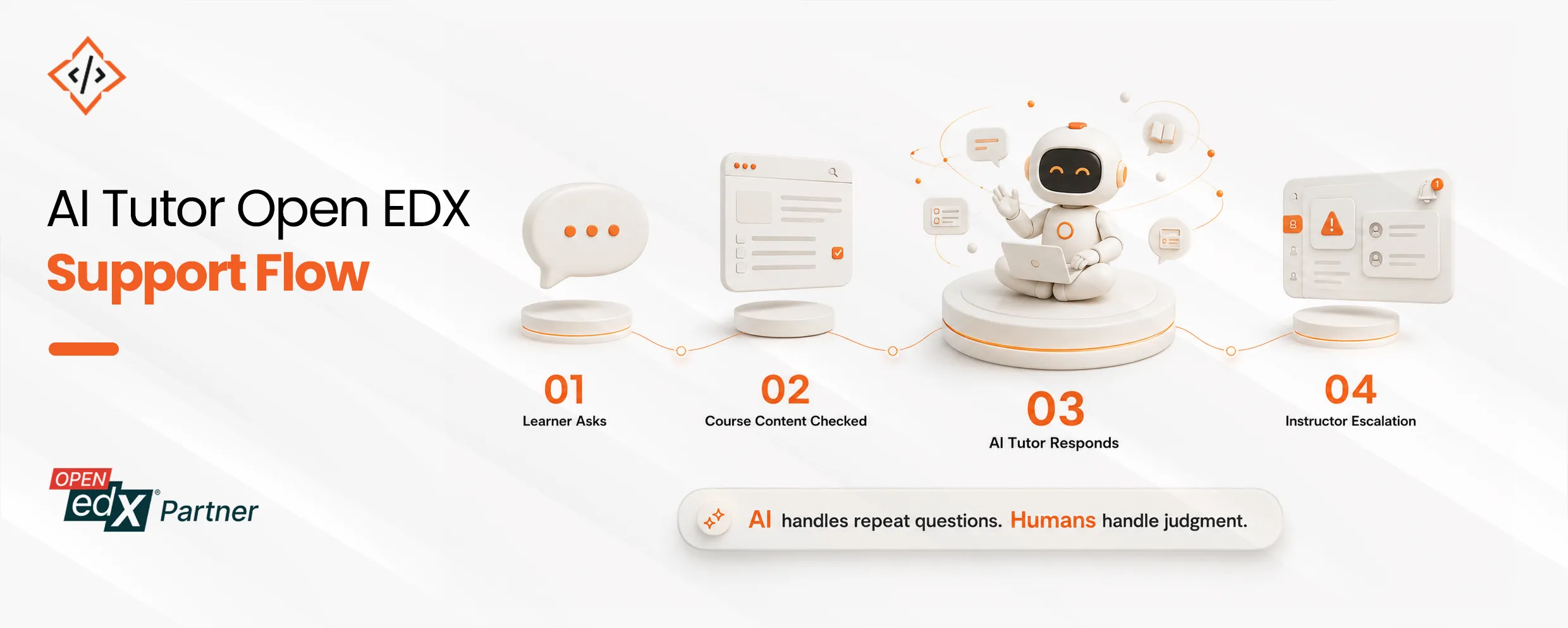
Analyzing live user data streams allows your educational platform to instantly modify course pathways without requiring structural developer updates.
A functional open-source infrastructure must capture immediate user performance metrics directly from the core event bus. Deploying customized Open edX AI agents ensures the platform tracks specific telemetry parameters including quiz scores and individual assignment attempts.
Furthermore, recording exact incorrect answers and active forum participation data provides the platform backend with the contextual intelligence required to assess actual subject mastery.
Instead of keeping every student on a rigid, uniform track, automated course logic sets up distinct next steps for individual users. Learners demonstrating immediate mastery bypass introductory blocks to interact with complex advanced lessons directly.
Conversely, users experiencing clear performance friction automatically receive simpler conceptual explanations or targeted practice modules to resolve foundational learning gaps before moving forward.
Analyzing student progress in real time gives administrators and instructors a clear path to discover educational risks early. Targeting an active Open edX AI skills gap workforce strategy optimizes baseline corporate certification programs and employee onboarding workflows.
Integrating automated development modules within your existing educational infrastructure drastically cuts down manual instructional design timelines.
Instructional teams can instantly convert unorganized training manuals, engineering documentation, and product guides into structured modules. Utilizing a native Open edX AI course creator engine allows instructional teams to establish clear lesson hierarchies automatically.
Developing robust evaluation materials usually demands significant manual labor. Dedicated AI course creation tools solve this by drafting extensive question banks, answer explanations, practice tests, and scenario-based assessments directly mapped to curriculum parameters.
Long-form educational assets can be repositioned into compact learning blocks without losing core informational depth. Advanced infrastructure extracts essential concepts to form microlearning lessons, text summaries, active discussion prompts, and targeted revision notes.
Automating the initial drafting workflow must never result in immediate production deployment without strict human supervision. Subject matter experts and instructional designers must systematically review every generated asset to verify factual accuracy, linguistic tone, and learning outcomes across all enterprise AI learning solutions.
Achieving a stable infrastructural architecture requires moving far beyond simple chatbot plugins to unify data layers and validation loops completely.
A professional machine intelligence layer needs absolute access to all core operational parameters across your open-source learning ecosystem. The system architecture must read verified educational content, live learner progress matrices, specific assessment rules, structural user role permissions, and active platform event buses. Unifying these variables guarantees that automated modules process instructions within the correct institutional boundaries.
Retrieval-augmented generation functions as a foundational security architecture that forces models to verify information using trusted internal databases before producing outputs. Configuring an Open edX ChatGPT Xblock RAG framework runs local semantic searches across uploaded documentation instead of public model memories.
According to a 2026 Gartner enterprise software report, integration layer connectivity remains the single biggest factor deciding whether advanced model deployments succeed or fail. Utilizing this technical approach ensures that responses remain factually precise, current, and tightly aligned with learning goals.
Deploying custom XBlocks allows technical teams to embed interactive intelligent components straight into the native course delivery interface. These distinct structural plug-ins place virtual tutors, automated practice assistants, direct essay feedback utilities, or adaptive exercises right inside standard student dashboards. This integration method prevents external application switching and maintains user immersion.
Comprehensive platform governance demands robust oversight portals for instructors and core system administrators to track model behavior continuously. High-level infrastructure must provide real-time dashboard analytics, automated content review queues, strict token utilization monitoring, and clear human escalation rules.
Maintaining absolute instructor visibility over system decisions secures organizational compliance and trust across your global educational framework.
Establishing rigorous internal governance structures protects institutional credibility and prevents computational failures across complex distributed infrastructure networks.
Sovereign structural execution requires implementing containerized security perimeters around sensitive student and administrative data catalogs. System architects must deploy isolated multi-tenant databases, comprehensive row-level access controls, and explicit model usage policies. Maintaining strict Open edX AI data privacy compliance protects infrastructure records from leaking into public commercial modeling streams.
Mitigating generation deviations relies on implementing strict verification mechanisms rather than relying on ungrounded model outputs. A February 2026 Coursera global institutional study revealed that 56 percent of educators believe their organizations remain entirely unprepared to manage baseline model governance.
To counter this, engineering teams tracking overall Open edX AI implementation cost metrics must lock down validation frameworks, enforce rigid confidence thresholds, and embed manual instructor review queues.
Preventing systematic academic plagiarism demands a structural redesign of linear evaluation mechanisms within your online framework. If students rely entirely on unverified automated tools to generate assignment text, traditional grading metrics lose institutional meaning.
Platforms must incorporate secure open edx adaptive assessment ai layers alongside advanced Open edX AI proctoring tools and multi-session telemetry to protect structural credential verification.
Every automated output requires continuous checking to guarantee absolute digital accessibility, linguistic fairness, and objective content generation. Algorithmic patterns can inadvertently reinforce cultural disparities if training weights remain skewed toward specific geographical demographics.
Instructors must evaluate automated recommendations regularly to confirm that regional learner cohorts experience balanced, compliant, and highly ethical training pathways.
Treating advanced engineering components as a unified platform strategy yields far higher institutional value than deploying minor detached tools. Developing a truly intelligent enterprise infrastructure relies on implementing controlled, modular use cases before introducing wide platform modifications.
Initiating a pilot program for automated content creation or targeted certification tracking lets teams validate system dependencies safely. Successfully maintaining these multi-agent ecosystems demands deep architectural expertise across data modeling, secure pipeline orchestration, and custom platform modifications.
Designing secure software architectures requires continuous post-launch monitoring to protect data privacy and maintain student assessment validity. As an experienced Open edX AI development company, CodeTrade builds resilient open-source code extensions and tailored infrastructure modules optimized explicitly for highly integrated educational frameworks.
 Chand Prakash
 Chand Prakash
 Chand Prakash
 Chand Prakash
 Chand Prakash