






AI
 Chand Prakash
23 October 2026
Chand Prakash
23 October 2026
AI in DevOps: how to automate software testing, deployment, and monitoring
 Chand Prakash
The cost to build an AI app in 2026 scales with integration requirements. Final deployment budgets shift based on the specific software systems chosen for connectivity. A simple chatbot development cost demands a moderate budget.
An enterprise AI application cost requires a much larger capital investment. This expense includes data preparation and model selection alongside system integrations and secure infrastructure testing. Companies are aggressively increasing tech budgets. In fact, they are also much more careful about where that money goes.
According to Gartner worldwide AI spending is expected to reach $2.59 trillion in 2026. In light of, this growing investment, strict cost planning and utilizing MVP development services now matter more than basic experimentation. Technical decision makers need accurate metrics to evaluate engineering frameworks. They must weigh infrastructure overhead against expected outcomes.
This guide gives technology leaders the exact metrics required to accurately scope and budget their upcoming engineering projects.
AI app development cost structures vary significantly based on project complexity and the underlying technical architecture in 2026.
The table below outlines the estimated budget requirements across different application types:
| Project Type | Planning Cost Range (2026) |
|---|---|
| AI Chatbot Development Cost | $15,000 to $60,000 |
| AI Mobile App Development Cost | $40,000 to $150,000 |
| Machine Learning App Development Cost | $50,000 to $200,000 |
| Generative AI App Development Cost | $60,000 to $250,000 |
| AI Automation Software Cost | $70,000 to $250,000 |
| AI Agent Development Cost | $80,000 to $300,000+ |
| Enterprise AI Application Cost | $150,000 to $500,000+ |
Note:
Analyzing the baseline AI Cost provides realistic planning ranges rather than fixed contract quotes. In fact, final software development costs depend heavily on data engineering complexity and compliance audits. For this reason, engineering teams must evaluate individual infrastructure demands before finalizing their capital allocation plans.
The total budget varies depending entirely on your technical foundation, operational data quality, and chosen application deployment architecture.
Using a standard API drastically reduces the overall AI software development cost. Building a custom model requires expensive proprietary engineering. Fine-tuning models or using retrieval-augmented generation adds technical complexity. Computer vision and multi-model systems demand extensive design, leading enterprises to hire AI ML developers for optimization phases.
Clean and structured data directly lowers the AI implementation cost. In contrast, messy datasets inflate engineering budgets significantly. Consequently, teams must label and validate fragmented information before models produce reliable results. According to Gartner, 60% of AI projects lacking prepared data will be abandoned through 2026. Therefore, engaging professional AI consulting services to build solid data infrastructure prevents these expensive delays.
Applications cost more when they execute decisions across multiple steps rather than just generating a basic response. For instance, automation and approval flows require advanced decision logic. Similarly, claims processing and scheduling algorithms demand extensive testing. Consequently, this operational complexity directly impacts the final AI solution development cost.
Connecting existing corporate systems directly increases the custom AI app development cost. Connecting internal systems like CRMs or ERP gateways requires secure custom middleware. E-commerce platforms, analytics tools, and HR software demand stable API endpoints to prevent operational data drift. Customer support and warehouse integrations require rigorous ongoing performance testing.
Strict compliance mandates naturally require a larger upfront capital investment. Regulated fields like healthcare, finance, and insurance demand advanced data protection frameworks. Engineering teams must implement complete audit trails and role-based access control layers. Legal, HR, and logistics systems demand data encryption and transparent explainability frameworks.
Specific project types dictate capital deployment metrics since different technical architectures require unique engineering resources and integration timelines.
The table below provides a detailed breakdown of pricing benchmarks, typical enterprise use cases, and primary budget variables for 2026 engineering plans:
| AI Application Type | Estimated Budget Range | Core Use Cases | Primary Cost Drivers |
|---|---|---|---|
| AI Chatbot Apps | $15,000 to $60,000 | Customer support, sales qualification, HR assistants, internal knowledge management, service desk automation. | Capital requirements remain lower when utilizing limited corporate knowledge bases, defined workflows, and standard third-party LLM APIs. Consequently, this architecture optimizes the baseline AI chatbot development cost. |
| AI Mobile Apps | $40,000 to $150,000 | Recommendation engines, voice search, smart notifications, visual search, personalization, user behavior prediction. | Budgets scale because mobile deployments require native front-end builds, back-end logic integrations, app store readiness, and device-level performance optimization. These requirements govern the AI mobile app development cost. |
| Machine Learning Apps | $50,000 to $200,000 | Demand forecasting, fraud detection, dynamic pricing engines, risk scoring, anomaly detection, predictive maintenance. | These applications depend entirely on historical data quality. Intensive model training, data validation, and iterative accuracy testing dictate the final machine learning app development cost. |
| Generative AI Apps | $60,000 to $250,000 | Document automation, proposal generation, enterprise search, RAG assistants, legal drafting, report creation. | Expenses rise when systems require complex data retrieval pipelines. Prompt governance, safety guardrails, output validation, and private knowledge access layers increase the generative AI app development cost. |
| AI Agent Systems | $80,000 to $300,000+ | Autonomous task planning, multi-tool execution, database record updates, automated workflow triggers, exception escalation. | Independent systems cost more because they require advanced cognitive memory. Complex tool connectivity, multi-step reasoning flows, approval logic, and failure controls increase the AI agent development cost. |
| Enterprise AI Apps | $150,000 to $500,000+ | Multi-user corporate platforms, private cloud deployment, ERP integration, governance dashboards, audit logs, role-based access. | High-tier investments address rigorous enterprise security protocols. Compliance audits, massive internal system integrations, architectural scalability, and long-term technical support define the total enterprise AI application cost. |
The total AI implementation cost extends far beyond the initial build because ongoing operational infrastructure requires continuous financial commitment.
Hosting models and storing massive datasets require constant cloud resources. Organizations continuously pay for specialized GPUs, vector databases, and scalable compute power. These fundamental requirements inflate the total AI solution development cost.
Generative applications create highly variable monthly expenses. Every user prompt, automated response, data retrieval step, and tool call adds direct usage fees. High query volumes naturally scale these operational bills higher over time.
Deploying models safely demands rigorous technical oversight. Teams must fund accuracy checks, hallucination tracking, output reviews, drift detection, and continuous feedback loops.
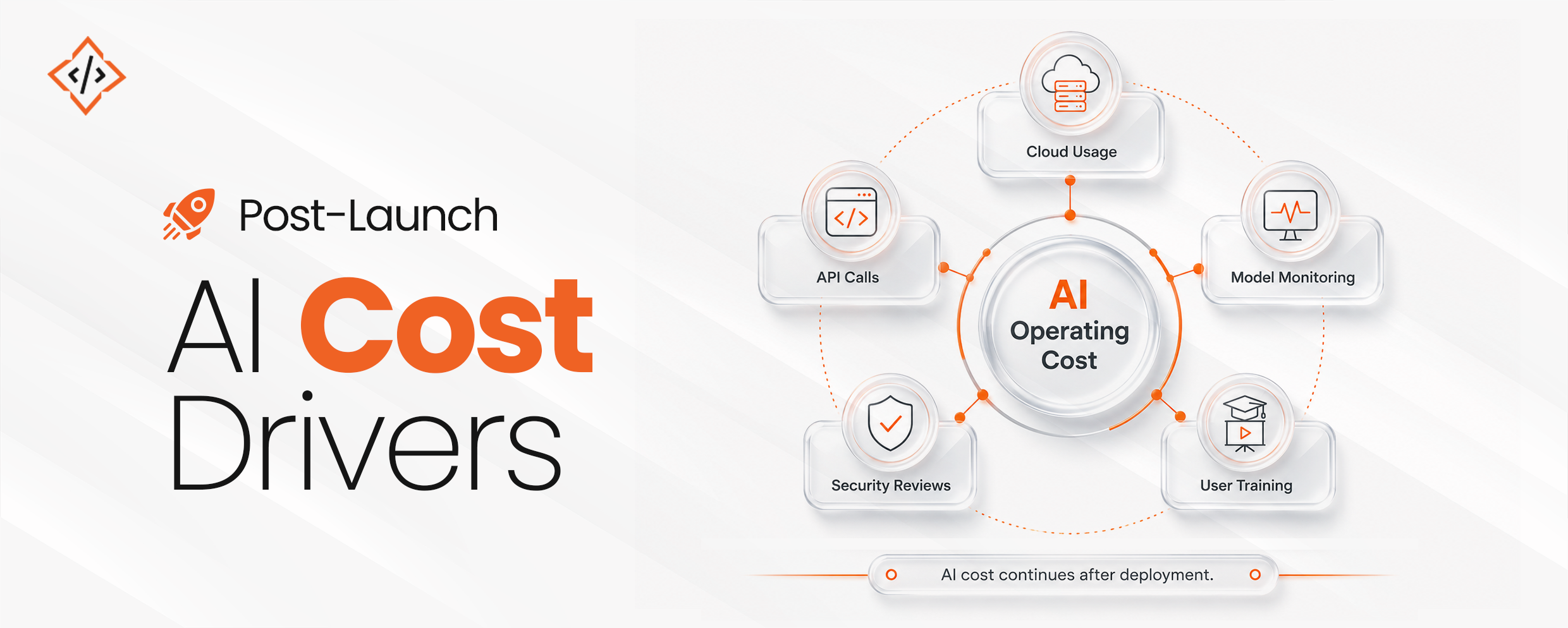
Corporate data protection requires regular capital allocation. In fact, according to an IDC report, worldwide AI infrastructure spending reached $318 billion in 2025. With this in mind, protecting these large investments requires data masking, penetration testing, encryption, and mandatory compliance audits.
Applications provide zero value without proper workforce adoption. Budgets must include comprehensive admin training, internal documentation, user onboarding, and dedicated support workflows.
Planning the final AI App Development Cost requires defining the specific enterprise business use case first. Technology leaders must carefully calculate costs across the model selection, data readiness, integration, and compliance layers. Securing reliable generative AI app development services prevents teams from treating these complex initiatives as a simple one-time software build.
In fact, the real budget includes post-launch model monitoring, algorithmic optimization, infrastructure maintenance, and workforce adoption. Therefore, establishing a clear architectural roadmap ensures predictable capital deployment across the entire technology lifecycle. Ultimately, this thorough scoping process prevents unexpected expenses during live production environments.
CodeTrade provides specialized AI app development services engineered for high-performance enterprise environments. Experienced technical teams construct accurate project roadmaps that align complex infrastructure requirements with defined capital budgets.
This strategic engineering approach optimizes the total custom AI app development cost structure before deployment. Enterprise leaders receive transparent milestone metrics to justify technology investments to executive boards.
 Chand Prakash
 Hardik Soni
 Chand Prakash
 Chand Prakash
 Chand Prakash