






AI
 Chand Prakash
23 October 2026
Chand Prakash
23 October 2026
AI in DevOps: how to automate software testing, deployment, and monitoring
 Chand Prakash

Business data is easier to capture today, but turning it into timely action remains a challenge for many businesses. Many companies already manage large volumes of information inside Odoo across sales, inventory, finance, and operations. Yet data alone does not improve performance unless it helps teams make timely decisions with the right context. This is where Odoo artificial intelligence is becoming increasingly important.
When intelligence is integrated into core ERP workflows, businesses can move beyond reporting and begin using data to predict outcomes, automate routine processes, and improve decision-making across departments. From forecasting inventory requirements to identifying process bottlenecks, AI in Odoo ERP is changing how teams work with greater speed, accuracy, and operational visibility.
According to McKinsey’s 2025 State of AI report, 78% of organizations reported using AI in at least one business function, up from 72% in early 2024. This growth reflects how AI is becoming part of everyday business operations rather than isolated experimentation. For businesses using Odoo, this marks a practical shift toward more intelligent and responsive ERP management.
Most businesses using Odoo already operate essential workflows through one ERP platform. Sales, purchasing, inventory, finance, and approvals all operate within the same ERP environment every day.
The pressure begins when decisions across these functions need to happen faster than teams can process them manually. Reports take time to review. Approvals slow down workflows. Operational decisions often depend on someone gathering information from multiple screens before taking action.
This is why Odoo artificial intelligence is becoming central to ERP strategy. It helps businesses reduce manual dependency by turning live ERP data into recommendations, predictions, and automated actions inside existing workflows.
Gartner predicts that by 2026, 40% of enterprise applications will feature task-specific AI agents, up from less than 5% in 2025. This reflects the growing shift toward AI-powered ERP systems that are built to support faster decisions, stronger operational visibility, and more intelligent business execution.
AI in Odoo ERP works inside everyday business processes and improves how teams plan, respond, and make operational decisions.
AI also helps businesses notice patterns across sales history, stock movement, and purchasing behavior before demand even starts to shift. This improves forecasting accuracy and supports better inventory planning with fewer manual reviews across teams.
Many routine tasks inside Odoo follow repeatable patterns that no longer need constant manual handling. Odoo automation tools help manage approvals, invoice processing, and task routing with greater speed and operational consistency.
Business data gets way more useful when it is presented in a way people can actually understand. The Odoo AI features help teams spot trends, condense reports, and detect unusual activity across the day-to-day operations.
Odoo artificial intelligence supports faster decisions by turning ERP data into practical recommendations inside active workflows. It helps teams identify risks early, evaluate next steps, and respond with better operational clarity.
The most practical Odoo AI use cases are creating measurable impact inside the workflows businesses rely on every day.
Sales teams use AI in Odoo ERP to prioritize leads, assess opportunity value, and improve revenue forecasting with stronger visibility. It gives teams earlier visibility into high-value opportunities and stronger context across the sales pipeline. As a result, teams spend less time reviewing pipelines and more time focusing on opportunities already in motion.
Inventory planning becomes more accurate when businesses can anticipate stock movement before demand changes. Odoo artificial intelligence supports stock prediction, replenishment timing, and warehouse planning using live operational data across supply chains.
For finance teams, Odoo AI features support invoice processing, help review expenses, and track cash flow with more consistent results. This gives better financial visibility while also reducing repetitive manual work across daily accounting workflows.
Customer support teams benefit from faster ticket routing, smarter response handling, and better access to customer context. These improvements help teams resolve requests faster while maintaining consistency across support operations.
Internal operations often see the widest impact through workflow automation, alerts, and process optimization across departments. Repetitive tasks such as approvals, status updates, and operational follow-ups can be handled faster when workflows are supported by intelligent automation inside the ERP system.
According to McKinsey’s 2025 Superagency in the Workplace report, 92% of companies plan to increase their AI investments over the next three years. Workflow efficiency remains one of the biggest priorities behind that investment. This reflects how Odoo business automation is becoming part of everyday operations across departments rather than a future-stage initiative.
Odoo artificial intelligence improves decision-making by helping teams act faster with better context inside everyday business workflows.
Teams often lose time waiting for reports, approvals, or those manual updates before they even act on operational issues. With AI in Odoo ERP, that lag gets cut down, because you get real-time guidance right inside the workflows where the choices are already happening, within the workflow where decisions are already being made.
Manual interpretation often creates inconsistencies when teams review large volumes of business data across departments. Odoo AI features improve accuracy by reducing errors and supporting decisions with clearer operational inputs.
Business decisions improve when teams work with shared visibility instead of disconnected reports across functions. AI creates a clearer operational view by connecting sales, finance, inventory, and workflow data in one place.
Planning becomes stronger when businesses can prepare before demand shifts or operational risks begin affecting performance. AI for business decision making supports forecasting, risk anticipation, and resource planning using live ERP data.
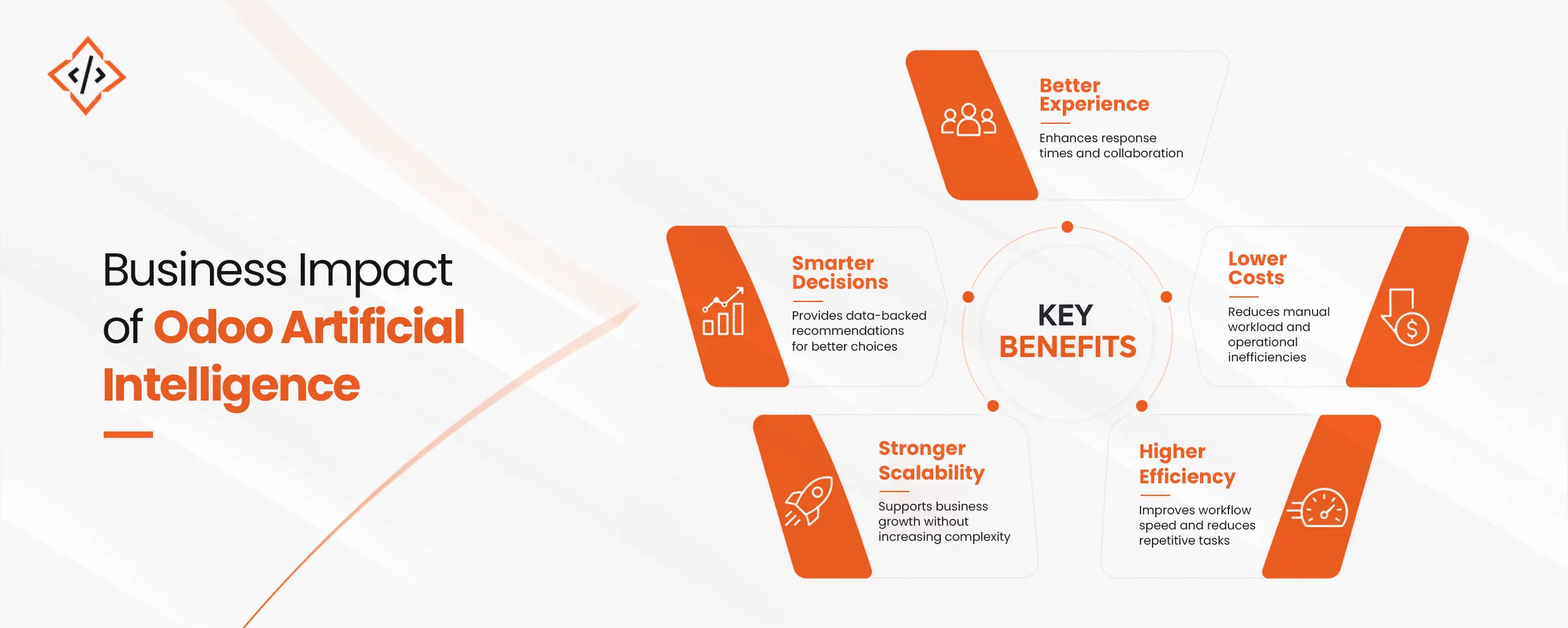
The value of Odoo artificial intelligence becomes most visible through measurable outcomes across daily operations, teams, and business performance.
One of the clearest Odoo AI benefits is reducing manual workload across repetitive business processes. Fewer manual interventions reduce delays, less rework, and a bunch of inefficiencies that just pile up over time and push operational costs higher.
Teams work faster when repetitive tasks are absorbed in the workflow itself instead of relying on repeated manual follow-ups. The Odoo automation tools help with speed, consistency, and an overall operational flow that moves between departments more smoothly.
Growth often increases operational pressure across systems, teams, and internal processes. Odoo business automation helps businesses scale while keeping workflows manageable and operational complexity under control.
Business decisions improve when teams can act on reliable information without waiting for manual analysis. AI for business decision making helps departments respond with better speed and stronger clarity.
Operational improvements also shape the experience for both teams and customers across the business. When responses become faster and collaboration improves, the service outcomes tend to be stronger and day-to-day coordination gets better too.
The success of Odoo artificial intelligence depends as much on preparation as it does on the technology itself.
AI performs best when business data is accurate, well-organized, and kept in a consistent way across the ERP system. Clean data gives Odoo development services the context needed to generate reliable outputs and relevant recommendations.
Not every workflow needs automation at the same stage of implementation. Businesses see stronger results when they begin with high-impact processes where time loss or manual dependency is highest.
Technology adoption becomes more effective when internal teams actually understand how the new workflows will fit into their everyday tasks and responsibilities. Getting users ready early, and shaping the processes ahead of time, helps reduce friction during implementation, throughout implementation.
Clear success metrics help businesses measure value beyond deployment and monitor progress over time. Defining ROI early creates stronger direction for AI in Odoo ERP and future operational planning.
Odoo artificial intelligence is already shifting how businesses use ERP day to day. It brings faster decision-making, stronger forecasting, and more practical automation into the kinds of workflows teams are already running inside Odoo.
From sales and inventory all the way to finance and internal operations, AI in Odoo ERP helps businesses operate with better visibility and respond with less delay. The value goes beyond automation alone. It also improves cross-department decision making by using live business data and operational context together.
For businesses already operating with Odoo, this creates a practical path toward more efficient and scalable operations without changing the ERP foundation already in place. As AI-powered ERP systems continue to evolve, Odoo will become an even more active part of how businesses plan, operate, and make decisions.
CodeTrade helps businesses bring Odoo artificial intelligence into practical business workflows with a clear implementation approach built around operational goals. Successful Odoo AI implementation starts with choosing the right business use cases, not applying AI everywhere at once. CodeTrade works closely with businesses that hire Odoo developer support to build scalable ERP solutions that create measurable value through intelligent automation and stronger decision support.

 Chand Prakash
 Hardik Soni
 Hardik Soni
 Hardik Soni
 Hardik Soni