






Odoo Development
ERP
 Hardik Soni
03 September 2026
Hardik Soni
03 September 2026
How Should Mid-Market Teams Plan an Odoo 18 to Odoo 19 Upgrade?
 Hardik Soni

Key Takeaways:
Achieving a successful ERP go-live represents only the baseline infrastructure stage of your enterprise digital deployment. True financial efficiency shifts entirely toward your long-term operational strategy and your system architecture management. Neglecting your recurring Odoo maintenance cost after deployment inevitably triggers application performance gaps and operational friction, especially for businesses relying on complex Odoo development services.
A 2025 research study on proactive maintenance strategies found that organizations implementing preventive and predictive maintenance approaches achieved a 30–50% reduction in unplanned downtime, alongside lower maintenance costs and improved operational efficiency (Research Study on Proactive Maintenance Strategies).
Consequently, managing your Odoo annual maintenance proactively mitigates compounding technical debt before it impacts your core data pipelines. Tracking your internal Odoo support cost, server infrastructure, and version migrations helps create a highly predictable technology budget that scales cleanly with corporate transaction volumes.
Your total Odoo maintenance cost depends directly on application customisation depth, infrastructure scale, and active user assignments. While the base enterprise license establishes a fixed price, your ongoing operational budget fluctuates based on custom database dependencies and resource allocation choices. Managing these variables prevents technical conflict during minor version updates.
Highly modified business modules require continuous developer validation to remain functional during core system updates. Excessive base software modification stretches your overall Odoo upgrade cost because custom scripts must be manually rewritten to match the latest database structures. Keeping system modifications minimal preserves standard application integrity and directly lowers recurring engineering fees, reducing dependency on long-term efforts to hire Odoo developer resources for frequent fixes.
Expanding data processing requirements dictate your long-term Odoo cloud hosting cost by driving server resource consumption. High transaction counts require dedicated memory allocation and ongoing disk space monitoring to eliminate latency during standard operating hours. Optimizing historical data storage constraints ensures optimal system performance without forcing expensive, premature hardware upgrades.
Employee access profiles determine internal support demands and training requirements after deploying the enterprise application. Misconfigured access permissions generate recurring technical helpdesk queries that expand your direct Odoo support cost over time. Auditing deployment seats regularly guarantees appropriate software licensing while streamlining the volume of operational maintenance requests.
Securing dedicated Odoo post-implementation support ensures that your business software functions reliably during peak transactional volumes. Moving beyond standard patch fixes allows your technical team to separate routine issue resolution from proactive database structural optimization. This structural division directly protects administrative workflows and controls software overheads.
Establishing structured communication tracks daily application bugs and operational user queries systematically. Quick resolution of functional friction points prevents minor system bottlenecks from disrupting core supply chain operations. Clean ticketing histories also reveal structural workflow errors that require permanent core code refinement.
Maintaining platform execution velocity requires continuous database maintenance and index optimization routines. Regular database cleanups prevent application slowdowns during high-volume accounting periods or complex inventory checks. Steady performance monitoring maintains rapid server response times without demanding expensive hardware capacity increases.
Clear service agreements define engineer availability timelines and technical issue escalation paths. Dependable expert response windows protect enterprise data pipelines during sudden database processing failures. Strategic operational partnerships turn your recurring Odoo annual maintenance into a structured framework for long-term digital growth.
Calculating your expected Odoo upgrade cost requires mapping your exact database dependencies before initiating the software migration. Stagnating on older software versions increases technical complexity, integration friction, and long-term application vulnerability.
A 2026 Gartner report estimates that organizations using structured approaches to manage infrastructure technical debt will report 50% fewer obsolete systems by 2028 compared to businesses that delay modernization initiatives (Source: Gartner Technical Debt Report).
Regular Odoo version updates help prevent escalating maintenance overhead, reduce dependency conflicts, and avoid costly cumulative architectural issues that can disrupt enterprise operations.
Standard database transition processes require cleaning historical ledger logs and matching fields to new core formats, as outlined in a structured Odoo development guide for safe migrations. Utilizing native script tools identifies configuration mismatch issues before moving production data.
App marketplace installations demand comprehensive validation to confirm compatibility with the incoming system version. Incompatible modules stall data structures and inflate your long-term cost of maintaining Odoo after go-live.
Custom programming adjustments dictate final engineering hours because depreciated scripts require complete rewrite processes. Standardizing custom applications ahead of time reduces manual developer intervention fees significantly.
Your primary infrastructure selection directly dictates the baseline Odoo cloud hosting cost. Choosing between dedicated environments or shared frameworks alters your compute pricing and database speed metrics. Balancing storage throughput with security configurations keeps your operational platform budget predictable.
Selecting the specialized Odoo.sh platform offers tailored runtime environments for standard applications. Conversely, deploying on private cloud models like AWS or Google Cloud demands direct memory allocation and disk I/O optimization management. Private instances require separate security firewall costs but grant deeper architectural control over enterprise configurations.
Preserving enterprise information requires systematic staging copy storage across external secondary server nodes. High frequency data replication schedules increase active cloud storage consumption metrics over time. These essential security processes prevent database corruption losses without adding manual database administrative burdens.
Operating across international boundaries requires strict adherence to local processing rules and sovereignty standards. Storing operational records within specific geographic boundaries forces targeted cloud server location choices. These localized resource adjustments influence your long-term cost of maintaining Odoo after go-live.
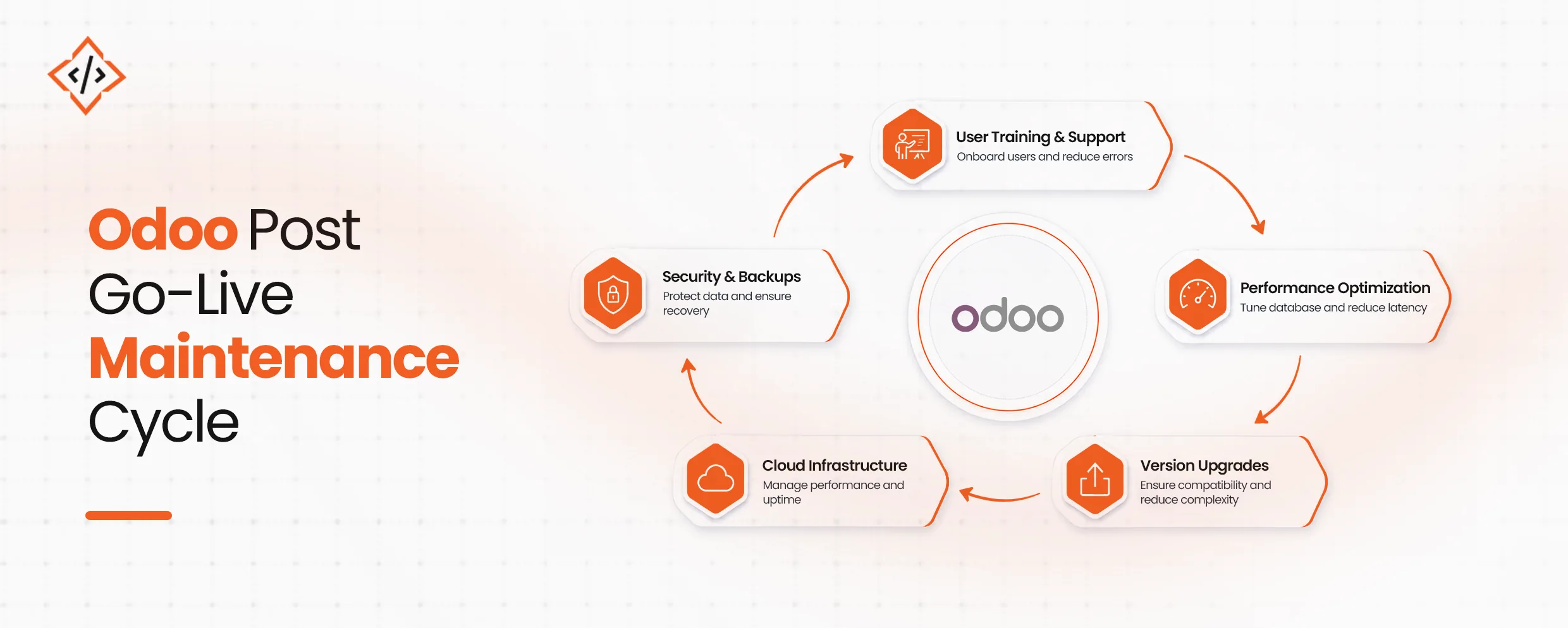
Allocating resources to your continuous Odoo training cost stabilizes company operating speed during staff transitions and system updates. Regular instruction stops processing mistakes that slow down logistics and financial balancing. Protecting team execution consistency keeps your overall software infrastructure running efficiently.
Employee turnover creates functional knowledge gaps that damage your ongoing data entry accuracy. Routine education programs ensure new staff members grasp corporate database structures without relying on expensive external developer assistance.
Modifying standard supply chains or manufacturing routines requires targeted user training to align software steps with real operational shifts. Proper guidance ensures departments execute administrative tasks correctly without creating system data errors.
Annual version upgrades modify standard interface designs and backend processing automation tools, making internal adoption easier when teams follow an updated Odoo 19 Guide. Targeted upskilling introduces these functional changes directly to your workforce to protect organizational output from sudden drop-offs.
Treating your final enterprise resource planning deployment budget as a continuous corporate asset protects database execution speed and minimizes hidden infrastructural liabilities. Proactive financial and operational monitoring transforms your recurring Odoo maintenance cost from an unpredictable system expense into a clear operational advantage.
Managing version migrations, technical helpdesk dependencies, and localized cloud infrastructure proactively shields your core workflows from sudden architectural downtime.
Partnering with an experienced technical specialist ensures your database modifications remain stable across future versions. CodeTrade provides certified enterprise support to manage your overall cost of maintaining Odoo after go-live with high precision.
The engineering team delivers dedicated database optimization, structured version upgrades, and functional training to keep your internal software layers closely aligned with long-term commercial scale metrics.
 Hardik Soni
 Chand Prakash
 Abhishek Karad
 Hardik Soni
 Hardik Soni