






Odoo Development
ERP
 Hardik Soni
03 September 2026
Hardik Soni
03 September 2026
How Should Mid-Market Teams Plan an Odoo 18 to Odoo 19 Upgrade?
 Hardik Soni
At some point, someone on your team stops fully trusting the ERP number. They do not announce it or escalate it. Instead, they quietly export the data to Excel, just to be sure. Over time, this behavior spreads. What began as a quick validation step slowly becomes standard practice across teams.
Meanwhile, the ERP continues to function on the surface. Orders are processed, reports are generated, and nothing appears technically broken. However, decisions start happening outside the system that was meant to run the business.
A Gartner research predicts that by 2027, more than 70% of recently implemented ERP initiatives will fail to fully meet their original business case goals, with as many as 25% failing catastrophically.
This blog helps you recognize these ERP failure warning signs early—before operational doubt turns into systemic ERP system failure. The first step is identifying the red flags that quietly indicate when an ERP has stopped supporting growth and started slowing it down.
Some warning signs are often dismissed as minor ERP red flags and rarely appear as sudden breakdowns. They show up in the daily choices, routines, and trade-offs teams make to keep things running.
When teams instinctively validate ERP data before acting on it, trust has already been eroded. Decisions are put off until someone else verifies accuracy, reports are exported, and numbers are reconciled externally. This behavior weakens the ERP’s role as a single source of truth. And, it gradually slows down decision-making across the organization.
Workarounds often begin as short-term fixes. A spreadsheet fills a reporting gap. Over time, these external tools become embedded in daily operations. The ERP shifts into a passive system of record rather than an operational backbone, signaling clear ERP red flags and early ERP system failure.
When minor updates such as changing an approval step or tweaking a pricing rule turn into multi-week projects, something’s off. At that point, the ERP isn’t supporting the business anymore. Rather, it is slowing it down. This mostly happens with legacy systems, where even small changes require raising vendor tickets, long lead times, and costs that feel wildly out of proportion.
Instead of the ERP adapting to business needs, teams adjust workflows to fit system constraints. Over time, processes start to follow what the ERP can handle instead of what the business actually needs. That shift slowly chips away at efficiency and creates operational friction that’s hard to undo.
A modern ERP should integrate seamlessly with other systems. When teams avoid touching integrations for fear of breaking the ERP, automation stalls. Manual handoffs increase, data flow slows, and ERP scalability problems begin to surface as the business grows more complex.
As operations scale, financial visibility should improve. When closing cycles stretch longer with growth, finance teams spend more time validating data than analyzing it. This often points to ERP performance issues and an inability to handle increased volume or reporting complexity.
Low adoption is one of the most telling ERP failure warning signs. The system starts to lose relevance when teams avoid the ERP, put off entering data, or only use it when they have to. Poor usability then leads to incomplete data. Later, inconsistent processes and declining trust across teams follow too!
Individually, these signs may feel tolerable. Collectively, they indicate that the ERP is no longer supporting the business the way it should.
In many organizations, the signs are visible long before action is taken, yet they’re often left unaddressed. More often than not, this comes down to the real fears and strategic trade-offs leaders face when reviewing enterprise systems.
ERP implementations demand substantial time, cost, and organizational investment. And once it is implemented, organizations tend to work around the system rather than challenge its long-term fit. This is called a sunk-cost effect, which makes ongoing inefficiencies feel less risky than revisiting a decision that once required months of coordination.
Additionally, ERP issues often emerge gradually. As mentioned earlier, systems continue to function, creating a false sense of stability. Workarounds appear manageable, external tools seem harmless, and delays are absorbed quietly by teams. Because the impact accumulates slowly, the urgency to switch ERP platforms rarely feels immediate.
There is also the fear of disruption. ERP migrations are widely known to be complex and operationally risky. So, even if leaders recognize the limits of legacy systems, the effort to change feels heavier than the cost of staying put. Over the time, this normalization allows ERP system failures to take root beneath the surface.
Understanding this hesitation is critical because the real cost is not just inefficiency; it is what prolonged inaction does to scalability, visibility, and growth.
Ignoring ERP failure warning signs often feels easier than dealing with them. At first, work continues, targets are met, and the system seems stable.
Over time, trust starts to fade. Decisions take longer because data needs extra checks. Planning becomes more cautious, and teams choose safety over speed. Growth slows because the system cannot support it the way it should.
Eventually, the ERP becomes something people work around instead of relying on it. By the time the impact is clear, dependencies are high, change feels harder, and the risk of acting seems bigger than it really is.
This pattern repeats and builds. The ERP becomes a problem that the organization works around instead of using. By the time leaders notice the damage, the system is deeply embedded with high dependencies, and it’s too late for a smooth transition.
And it is at that moment that the leaders realize that waiting just pushed the problem down the road.
When organizations reach this point and start looking for an alternative to their current ERP, they’re usually not looking for another long, complex replacement. Instead, they want flexibility and more control along with a system that can grow and change with the business. Industry research supports this shift. Panorama Consulting’s ERP Report found that flexibility, integration capability, and ease of change were among the top drivers for ERP replacement decisions. This was particularly relevant to mid-sized and growing organizations.
This is where Odoo stands out. It has a modular design that enables businesses to add anything they want, anytime and anywhere. And that is exactly what they want, instead of committing to a large system upfront. Moreover, this approach helps them prevent overbuilding during the initial period and later struggle to make things right!
Another critical factor is control. Traditional ERP systems often force businesses to follow fixed plans and rely heavily on vendors for changes. But Odoo works differently. It gives teams more control to adjust workflows, integrations, and reports based on how they actually operate. This is especially helpful for companies that are already facing ERP issues, because it helps the system support growth.
In a nutshell, Odoo is not meant to be a quick fix for ERP problems. It is the opposite! For companies that have outgrown inflexible, legacy ERP environments, Odoo is intended as a flexible foundation.
The practical value of Odoo becomes clearer when its design is mapped against the reasons ERP systems fail in the first place.
Businesses moving to Odoo typically see several changes take shape:
When combined with a structured Odoo ERP implementation, these shifts address the root causes behind ERP failure warning signs rather than just masking symptoms. This is also where well-executed Odoo development services play a crucial role, ensuring that the system is configured around business reality, not assumptions. But to begin with, you can also look at an Odoo development guide. It will help you make initial decisions with more clarity.
At this stage, the question naturally changes from “Is our ERP failing?” to “Are we ready to move forward in a controlled, strategic way?”
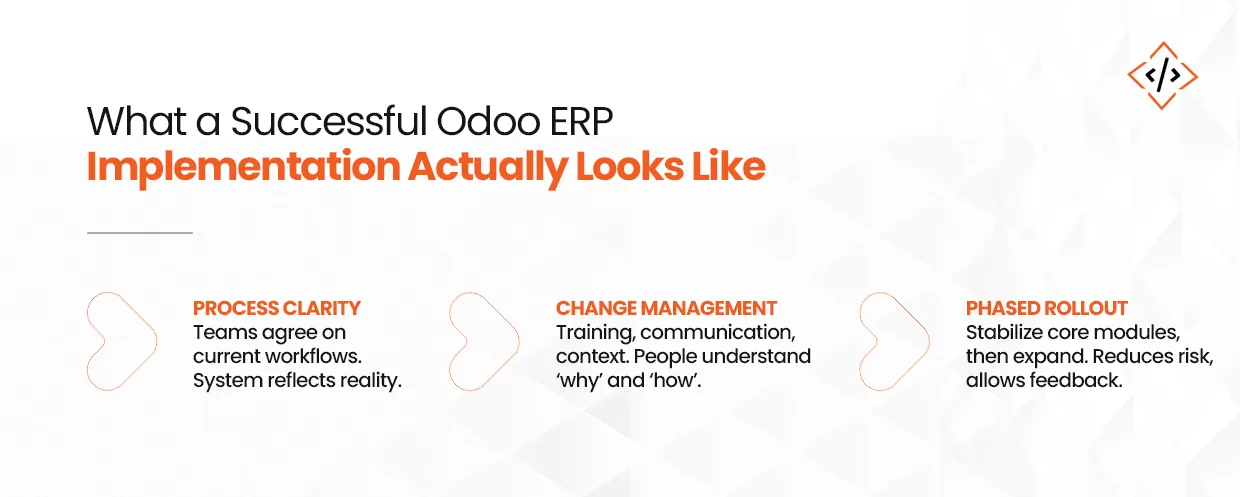
A successful Odoo ERP implementation does not mean installing software and hoping teams adapt. In reality, it works the other way around. The business gets aligned first, and the ERP is configured to support that alignment.
First, there is process clarity. Here, teams need to agree on how work should actually flow today, not how the old ERP forced it to flow. When workflows are mapped honestly, adoption becomes easier because the system reflects reality instead of resisting it.
Next comes a phased rollout. The smart approach is to stabilize your core modules first, then expand gradually, rather than launching everything at once. This will reduce the risk and give teams time to adapt. Plus, it allows feedback to shape the system as it grows.
Finally, change management happens. Training, communication, and context matter. When teams understand why the system exists and how it helps them, usage becomes natural instead of forced. ERP projects that treat people as central to the process consistently perform better than those treated as pure IT exercises.
In simple terms, successful Odoo implementations focus on alignment before automation, stability before scale, and people before platforms.
Even when businesses choose the right ERP platform, results can fall short because of how the migration is handled. These mistakes are common, and most of them happen with good intentions.
Trying to recreate the old ERP inside the new one
Many teams start by asking how to make the new ERP behave exactly like the old system. This usually leads to over-customization, added complexity, and slower adoption. Modern ERP systems are meant to simplify operations, not carry forward inefficiencies that already slowed the business down.
Assuming data will “sort itself out later”
When outdated, inconsistent, or incomplete data is moved into a new ERP, it creates friction from day one. Teams lose confidence early, and adoption suffers. Cleaning and validating data before migration is one of the simplest ways to reduce post-go-live frustration.
Treating migration as a finish line instead of a starting point
ERP migration is often treated as a one-time technical project. In reality, it is the beginning of an ongoing operational shift. Without continuous review and optimization, even a well-implemented ERP can slowly drift away from how the business actually works.
Avoiding these mistakes keeps the transition steady and prevents the same ERP problems from resurfacing in a different system.
Odoo’s flexibility is one of its biggest strengths, but that flexibility also means outcomes depend heavily on who is shaping the system.
Choosing the right team is rarely about speed or short-term cost savings. It is about building an ERP foundation that can adapt as the business grows.
Most ERP problems don’t show up all at once. They build slowly, through small adjustments teams make just to keep things moving. Over time, the system that was meant to support growth becomes something the business quietly works around.
Catching ERP failure warning signs early gives leaders breathing room. It allows time to think clearly, weigh options, and move forward without pressure. For businesses dealing with legacy ERP problems, this isn’t about chasing the next big platform. It’s about removing friction, restoring confidence in the numbers, and making decisions without second-guessing the system.
 Hardik Soni
 Hardik Soni
 Hardik Soni
 Hardik Soni
 Hardik Soni