






Salesforce
 Chand Prakash
05 November 2026
Salesforce performance optimization: how to improve CRM speed and user experience
 Chand Prakash

Customer information, sales activities, service requests, and business operations often sit across different systems.
As a business grows, managing all this information becomes harder. Teams spend more time updating records, switching between applications, and following up on tasks that could otherwise be automated.
For many businesses, Salesforce becomes the place where these activities come together.
Salesforce offers businesses a platform to manage customer relationships, streamline operations, and connect different business functions. However, its standard features may not cover every business requirement. Companies with specific workflows, complex processes, or existing software systems often need additional development to make the platform work as expected.
Salesforce development services help businesses configure, customize, extend, and integrate the platform according to their operational needs.
Whether you are implementing Salesforce for the first time or improving an existing CRM, understanding these services can help you make better technology decisions.
In this guide, we will explore what Salesforce development involves, the services businesses can use, its benefits, development costs, timelines, and how to choose the right development partner.
Salesforce development services involve building, customizing, integrating, and maintaining solutions on the Salesforce platform to meet specific business requirements.
While Salesforce provides ready-to-use CRM features, not every organization follows the same sales process, customer management approach, or operational structure. A business may need a custom approval process, an application for managing internal requests, or an integration that connects Salesforce with its ERP system.
Salesforce development helps address these requirements.
Depending on the project, developers may use Salesforce tools such as Apex, Lightning Web Components (LWC), Salesforce Flow, and APIs to extend the platform’s capabilities.
For example, consider a manufacturing company that receives orders through multiple channels. Its sales team uses Salesforce to manage customer enquiries, while the operations team tracks inventory in a separate ERP system.
Without integration, employees may have to enter the same information into both platforms. Salesforce development can connect these systems, allowing relevant information to move between them and reducing repetitive data entry.
In simple terms, Salesforce development makes the platform more useful to the people who rely on it every day.
Salesforce provides a strong foundation for customer relationship management. However, businesses often need more than standard CRM functionality as their operations become complex.
Here are some common reasons companies invest in Salesforce development.
Every organization has its own way of handling leads, managing customer accounts, processing orders, and approving requests.
Standard Salesforce configurations may not always support these processes.
For instance, a financial services company may require multiple approval levels before a customer application moves to the next stage. Custom development can introduce the necessary logic and workflows without forcing employees to follow an unsuitable process.
Companies often use separate applications for accounting, inventory, marketing, customer support, and enterprise resource planning.
When these systems operate independently, information becomes fragmented.
Salesforce integration services help connect these applications so teams can access relevant information without constantly switching between platforms.
Repetitive activities such as assigning leads, sending follow-up notifications, updating records, and generating reports take up valuable employee time.
Salesforce automation services can automate many of these activities using Salesforce Flow and other platform capabilities.
For example, when a new lead enters Salesforce, an automated workflow can assign it to the appropriate sales representative and trigger a notification.
Research also highlights the productivity gains possible through sales automation. A December 2025 study by Nucleus Research found that organizations adopting sales force automation reduced seller administrative time by 25–35%. These findings cover sales force automation platforms broadly, rather than Salesforce alone, but they highlight the potential value of reducing manual sales activities.
When customer interactions are spread across different channels, employees may not have a complete picture of the relationship.
Custom Salesforce CRM solutions can bring relevant customer information together, helping sales and support teams understand previous interactions, ongoing requests, and customer requirements.
Some businesses already use Salesforce but struggle with outdated configurations, slow processes, unused features, or limited platform adoption.
Salesforce development services can help improve the existing environment instead of requiring a complete replacement.
A Salesforce development company may offer a combination of consulting, implementation, customization, integration, and ongoing support.
The exact scope depends on the organization’s requirements and the condition of its existing Salesforce environment.
Let’s look at the major services.
Salesforce consulting services help businesses identify what they need from the platform and how to achieve it.
Before starting development, consultants assess existing business processes, technical requirements, system limitations, and long-term objectives.
This stage may include:
For example, a company planning to improve its customer support operations may need Service Cloud rather than a completely custom-built support application. Consulting helps identify the right approach before development begins.
Salesforce implementation services cover setting up and deploying the platform according to business requirements.
This includes configuring the Salesforce environment, setting up users and permissions, defining data structures, and preparing the platform for everyday use.
A typical implementation may involve:
A properly planned implementation gives employees a platform they can use without unnecessarily complicating their existing processes.
Sometimes, configuring existing Salesforce features is not enough. Businesses may need functionality that does not come with the standard platform.
Custom Salesforce development addresses these requirements by building additional features, applications, and business logic.
Developers may use:
For instance, a logistics company may need a custom application that allows its operations team to track delivery exceptions, update shipment details, and coordinate with customer support.
Developers can build this functionality within the Salesforce ecosystem.
Salesforce customization services focus on adapting existing platform features to match business requirements.
This may involve modifying layouts, configuring objects and fields, setting up validation rules, creating reports, and adjusting workflows.
Consider a company with separate sales teams for different regions. Each team may need access to specific customer information and reporting dashboards.
Salesforce customization can configure these views and permissions according to their responsibilities.
The objective is to make the platform easier to use while keeping business processes consistent.
Salesforce integration services connect the CRM with other business applications, allowing information to move between systems.
Common integration requirements include:
For example, when a customer places an order through an e-commerce platform, an integration can send relevant order and customer information to Salesforce.
The sales and support teams can then access the information without manually collecting it from another application.
The integration approach may involve Salesforce APIs, middleware, or platforms such as MuleSoft, depending on system architecture and business requirements.
Salesforce application development involves creating applications that extend the platform beyond its standard CRM functionality.
These applications may support internal business operations, customer portals, approval processes, or industry-specific requirements.
For example, a healthcare organization may need an application to coordinate internal service requests. While a retail business may require a custom application to manage customer enquiries and order-related activities.
Developers can build these solutions using Salesforce platform capabilities and connect them with relevant business data.
Automation helps businesses reduce repetitive work and improve process consistency.
Salesforce provides tools such as Flow Builder to create automated processes without writing code for every requirement.
Automation services may include:
More complex requirements may involve Apex or other custom development.
The right approach depends on the process. Not every automation needs custom code.
Businesses moving from another CRM or upgrading an existing Salesforce environment may need data migration services.
The process involves transferring customer records, contacts, accounts, transaction details, and other relevant information while maintaining data quality.
A typical migration process includes data assessment, cleansing, field mapping, migration planning, validation, and testing.
This is particularly important when multiple systems contain duplicate or inconsistent records.
Salesforce development does not end when a project goes live.
Businesses may need ongoing support to fix issues, improve performance, update existing features, manage platform changes, and introduce new functionality.
Maintenance services help keep the Salesforce environment aligned with changing business requirements.
Investing in custom Salesforce development can help businesses get more value from their CRM investment.
However, the benefits depend on how well the solution addresses actual operational problems.
Here are some important advantages.
Custom development allows businesses to address processes that standard CRM features may not fully support.
Instead of changing established workflows to fit the software, companies can extend Salesforce to accommodate their operational requirements.
Automated workflows, connected applications, and simplified interfaces reduce the time employees spend on repetitive tasks.
This allows teams to focus more on customer interactions, problem-solving, and business activities.
Integrating Salesforce with other business applications helps reduce information silos.
Sales, marketing, and support teams can work with more consistent customer information, improving coordination across departments.
When relevant business information is available in one environment, managers can get a clearer view of sales performance, customer activity, and operational progress.
Custom reports and dashboards can also help teams monitor the metrics that matter to their responsibilities.
Salesforce Research’s State of Sales report found that 76% of sales professionals using sales analytics said it improved their ability to provide customers with a consistent experience across channels.
The report also found that 70% reported improvements in sales velocity. These findings highlight how better access to and use of business data can support sales operations.
Business requirements change over time. Companies may introduce new services, expand into different markets, or add more employees.
A well-designed Salesforce solution can be extended as these requirements evolve, reducing the need to rebuild business systems from scratch.
A structured development process helps businesses avoid unnecessary changes, unclear requirements, and unexpected delays.
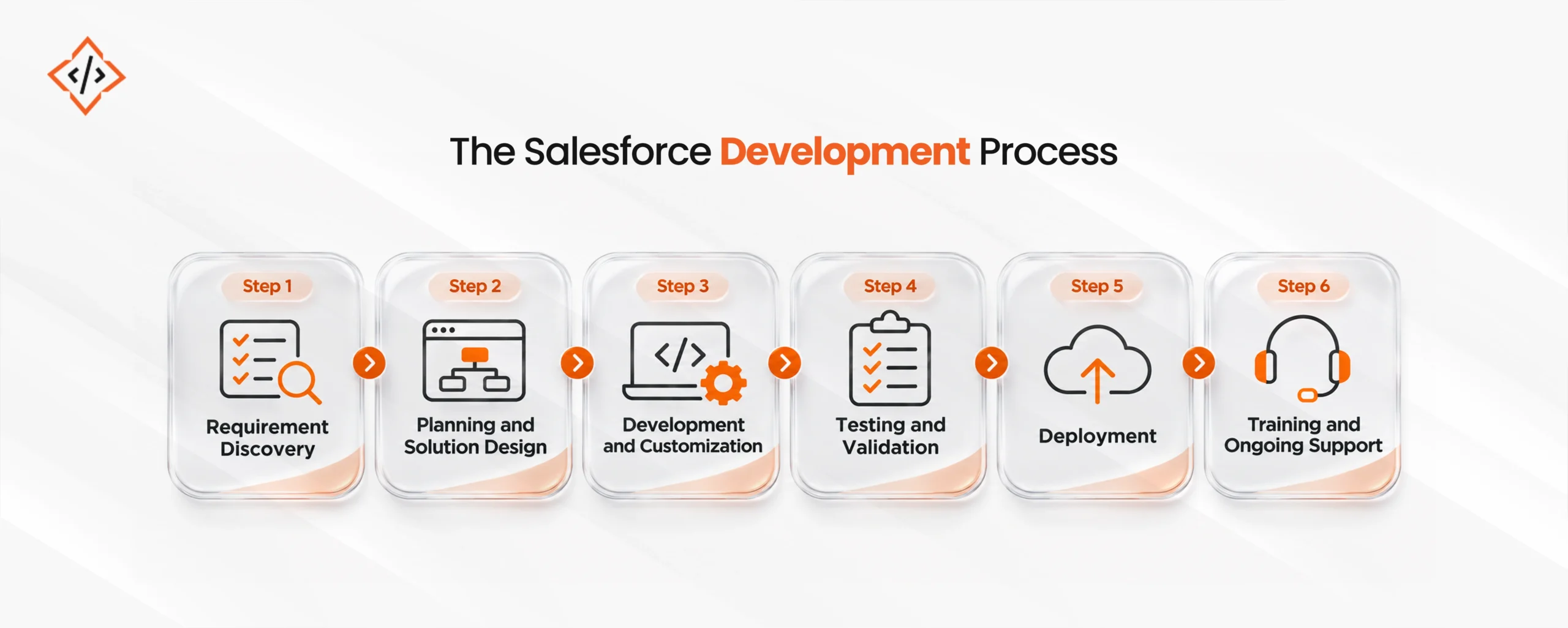
While the exact workflow varies by project, most Salesforce development solutions follow these stages.
The development team understands your business model, existing systems, operational challenges, and project objectives.
This helps identify what needs to be built, customized, or integrated.
The team defines the technical approach, Salesforce components, data structure, integrations, and project milestones.
The goal is to choose a solution that meets current requirements without creating unnecessary complexity.
Developers configure Salesforce, build custom functionality, create applications, and implement integrations according to the approved plan.
The solution is tested for functionality, performance, security, and compatibility with connected systems.
The team also checks whether the developed features work as expected for different user roles.
Once testing is complete, the solution is deployed to the production environment.
Deployment planning is important to minimize disruption to ongoing business operations.
Employees receive the necessary guidance to use the platform. The development team can also provide maintenance, technical support, and enhancements as business requirements change.
There is no fixed price for Salesforce development services. The total cost depends on the scope of work, technical complexity, integrations, and resources required.
A small customization project will generally require less effort than developing a complex Salesforce application connected to multiple enterprise systems.
Some of the main factors that influence development costs include:
The best way to estimate the investment is to define the requirements first and request a detailed project breakdown.
Businesses should also consider the cost of Salesforce licenses separately from development and implementation expenses.
Research by Nucleus Research published in January 2024 found that organizations generated an average return of $3.10 for every dollar spent on CRM. The analysis also found that individual productivity gains and improvements in process efficiency accounted for 51% of the total CRM return on investment.
This is an industry-wide CRM finding, not a guaranteed return from Salesforce development. It does, however, highlight why businesses should evaluate the operational value of a CRM investment alongside its initial cost.
Salesforce development timelines depend on the project’s scope, integrations, complexity, and testing requirements.
A basic configuration or small customization may take considerably less time than a complete CRM implementation or enterprise application.
For a general understanding, projects can be grouped into the following categories:
These are broad planning ranges, not guaranteed delivery timelines.
Clear requirements, timely feedback, access to existing systems, and stakeholder availability can all influence how quickly a project moves forward.
Choosing a Salesforce development company is an important decision because the quality of development affects how effectively your teams use the platform.
Before selecting a partner, consider the following factors.
Check whether the company has experience with the Salesforce technologies your project requires, such as Apex, Lightning Web Components, Salesforce Flow, APIs, and relevant Salesforce products.
Ask about previous Salesforce implementations, custom applications, and integration projects.
Experience with similar business requirements can help the team understand potential challenges before development begins.
A reliable partner should explain how it handles requirement gathering, solution design, development, testing, deployment, and ongoing support.
You should also understand who will be responsible for project communication and delivery.
Your development requirements may change over time. Look for a company that offers suitable engagement options, whether you need a complete project team, dedicated Salesforce developers, or support for ongoing enhancements.
Ask how the company handles user permissions, access controls, data migration, testing, and secure integrations.
These considerations are particularly important when Salesforce stores sensitive customer or business information.
Implementation is only one part of the engagement. Make sure the development partner can support future improvements, troubleshoot issues, and help your Salesforce environment evolve.
Choosing the right Salesforce solution requires more than technical implementation. Businesses need a development partner that understands their processes, existing technology, and long-term objectives.
CodeTrade provides end-to-end Salesforce development services to help businesses implement, customize, integrate, and improve their CRM environments.
With a focus on business requirements and scalable engineering, the team supports organizations at different stages of their Salesforce journey.
CodeTrade’s Salesforce capabilities include:
Businesses can also choose an engagement model based on their requirements. CodeTrade offers project-based development, resource-based engagement, and ticket-based support.
If you already have an internal team but need additional Salesforce expertise, you can also hire Salesforce developers to extend your development capacity.
To understand how CodeTrade can support your Salesforce requirements, explore its Salesforce development services.
Salesforce can do much more than manage customer records. With the right development approach, businesses can use it to connect departments, automate everyday processes, improve reporting, and build applications around their operational requirements.
However, getting these results requires more than enabling standard CRM features. Businesses need a clear understanding of their requirements, the right technical approach, and a development partner who can translate those needs into practical solutions.
Whether you are planning a new implementation, improving an existing CRM, or connecting Salesforce with other business applications, the right development strategy can help you get more value from the platform.
 Chand Prakash
 Chand Prakash
 Chand Prakash