






AI
 Chand Prakash
25 August 2026
Chand Prakash
25 August 2026
AI Automation For Shopify Store Operations: Features, Benefits And Use Cases
 Chand Prakash

Retailers relying on manual supply chain oversight are actively losing margins to competitors using agentic workflows. Manual inventory tracking simply fails against automated systems that predict returns and adjust pricing instantly. Implementing localized artificial intelligence infrastructure is the only reliable way to handle growing volumes of mobile-first consumers in the region. The financial impact of ignoring this operational shift is severe.
A 2026 McKinsey report shows retailers using AI for reverse logistics convert $200 billion in annual costs into business value. Modernizing existing ecommerce and retail solutions requires specific technical capabilities rather than basic chat interfaces. This guide skips theoretical definitions entirely.
Instead, it provides a strict technical and strategic roadmap for deploying intelligent systems that directly protect profits. Applying AI for retail and e-commerce in UAE means deploying autonomous agents to handle complex logistics and stop margin erosion.
The regional shift from oil-dependent revenues to digital trade forces companies to optimize operational efficiency immediately. Implementing AI for retail and e-commerce in UAE provides a direct defense against thinning profit margins.
Customer acquisition costs have spiked sharply across the GCC recently. This severe economic pressure makes margin protection through intelligent automation completely mandatory for long-term survival.
A 2026 Forbes report confirms companies using supply chain AI reduce logistics costs by 15% and improve inventory by 35%. Relying on manual oversight creates hidden logistical blind spots that modern predictive algorithms easily fix.
The government actively expands digital infrastructure under the ambitious D33 economic agenda. This massive framework rapidly increases the influx of cross-border online shoppers. Retailers must adopt advanced AI solutions for retail businesses to process this specific volume efficiently.
Traditional manual forecasting models simply break down under the weight of these new national digital targets. Automated systems ensure operations remain compliant and highly profitable.
Purchasing digital advertisements is no longer cheap anywhere in the Middle East. High advertising rates severely impact overall e-commerce profitability today. Effective AI automation for retail extracts a higher lifetime value from your current buyer base.
Predictive algorithms analyze past behavior to generate repeat purchases that offset high advertising spend. This strategy effectively replaces expensive new lead generation with reliable retention revenue.
Freight movement between Dubai, Riyadh, and Doha creates constant logistical friction for regional sellers. Standard customs processing often halts inventory movement without prior warning. Intelligent routing software analyzes historical transit data to predict these exact customs delays accurately.
The system immediately alerts dispatchers to adjust transit routes long before physical delays impact buyers. Early detection prevents expensive emergency shipping fees.
Basic dashboards only report past performance without stopping real operational waste. Modern artificial intelligence in e-commerce takes direct action to prevent financial loss across digital channels.
Advanced systems execute automated decisions within fulfillment pipelines rather than simply displaying static charts. Applying proven AI solutions for e-commerce directly protects product margins by eliminating manual errors across core operational workflows.
Product returns erode retail profits faster than almost any other regional expense. Intelligent algorithms track individual sizing history, purchase patterns, and brand-specific return frequencies across accounts. The system identifies high-risk fit issues before the customer completes the transaction.
If a shopper repeatedly returns a specific apparel cut, the platform displays a clear sizing warning on the product page. For severe return patterns, the engine deprioritizes high-risk inventory for that specific user profile. This targeted intervention prevents unnecessary reverse logistics and lowers return shipping overhead.
Merchandising teams waste hundreds of hours manually categorizing inventory variations and writing metadata. Computer vision models now scan incoming product photography to identify exact fabric types, cuts, and colors instantly. The system generates complete Arabic and English descriptions for search engine indexing without human drafting.
This automated tagging workflow eliminates manual data entry bottlenecks across large product catalogs. It ensures all product listings stay searchable, accurate, and ready for instant conversion.
Standard repricing tools only match competitor prices while ignoring internal fulfillment expenses. Modern AI automation for e-commerce calculates true unit economics before updating store rates.
The platform continuously monitors regional freight rates, custom packaging expenses, and active warehouse labor costs. If courier rates spike between regional distribution hubs, the system adjusts front-end pricing to maintain target profit margins. This approach protects net earnings on every order without requiring manual intervention from pricing managers.
Retailers must bridge the widening gap between physical mall stores and digital inventory systems. Modern AI-powered retail solutions UAE convert traditional physical locations into highly efficient micro-fulfillment centers. This transition maximizes space utility and significantly speeds up regional delivery times.
A 2026 Gartner forecast projects spending on supply chain software with agentic AI will reach $53 billion by 2030. Supply chain optimization drives this massive targeted investment. Physical retail footprints now act as active logistical nodes rather than simple display rooms.
Physical store layouts no longer rely on manual observation or basic intuition. Advanced systems utilize anonymized camera data to generate accurate heatmaps of retail floor plans. These models track exactly how shoppers navigate aisles and interact with specific product displays.
This precise spatial data directly dictates physical product placement and promotional endcap positioning. Store managers also use these predictive analytics to optimize staffing schedules automatically during anticipated peak hours.
Online-to-Offline synchronization completely unifies digital storefronts with physical warehouse stock. The process ensures that web catalogs perfectly reflect real-time physical availability across all regional locations. For example, a customer orders a popular electronic device online.
If the main Dubai fulfillment center registers as completely empty, the system reacts instantly. The software automatically routes the packing slip to a Sharjah physical store containing active stock for immediate courier dispatch.
Procurement teams face constant pricing fluctuations across international supply chains. Intelligent purchasing agents continuously track raw material costs and global shipping container rates simultaneously. The software analyzes historical pricing cycles against current global freight indices to predict future price drops.
The system then recommends the exact week to place bulk supplier orders for maximum financial savings. This automated negotiation strategy protects product margins before manufacturing even begins.
Basic decision-tree chatbots constantly frustrate VIP clients because they fail to resolve complex issues. These rigid systems only answer basic questions and force angry buyers through long automated menus. Modern AI-powered e-commerce solutions UAE completely replace these outdated models with intelligent agentic routing.
Advanced AI customer service for e-commerce handles high-stress post-purchase queries autonomously while protecting valuable client relationships. A late 2025 Gartner survey confirms over 80% of organizations expect to reduce contact center headcount using AI soon.
This massive financial shift happens because intelligent software resolves customer friction without requiring massive human call centers. Direct resolution quickly reduces the operational burden on your existing internal support staff.
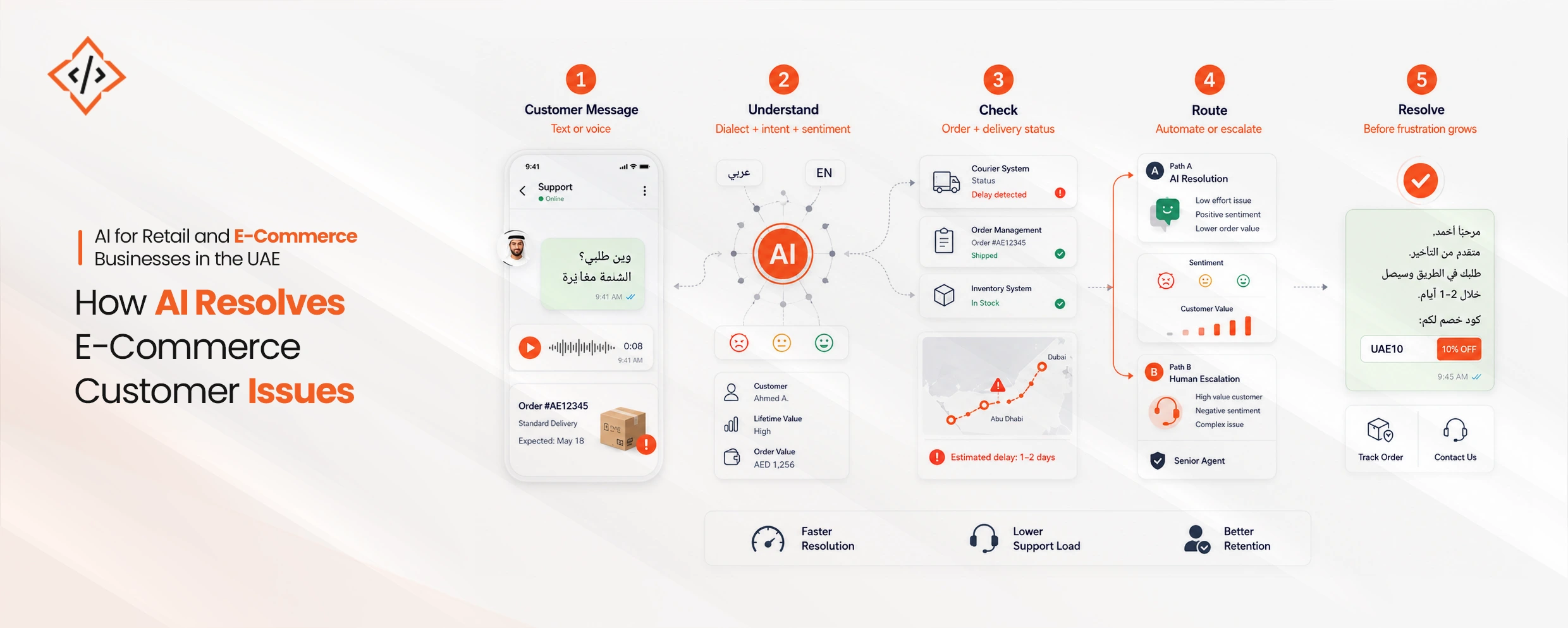
Standard chatbots struggle with regional Middle Eastern languages because they only understand formal Modern Standard Arabic. The UAE market demands systems that process regional Khaleeji dialects accurately to maintain consumer trust. Modern natural language processing easily comprehends local slang and unstructured voice notes sent by online shoppers.
This specific capability ensures that local buyers receive accurate support in their native conversational tone. Fast comprehension stops buyers from repeating their specific issues multiple times.
Angry high-value clients often abandon brands entirely if they wait too long for help. Intelligent routing systems actively scan incoming support tickets for specific frustration markers and urgency levels. When the software detects an angry VIP buyer, it bypasses the standard automated flow immediately.
The system automatically sends these high-stress tickets directly to a senior human agent for rapid de-escalation. This precise routing protects your most profitable client relationships from unnecessary operational friction.
Retail support operations historically rely on a purely reactive customer service model. Companies wait for a buyer to complain about a delayed order before taking any helpful action. Intelligent autonomous agents shift this dynamic entirely by tracking physical courier delays in real time.
The system automatically messages the buyer with a customized apology and a relevant discount code. It completes this proactive intervention before the buyer even notices the shipping delivery delay.
Selecting the right technology partner requires looking past surface-level interface demos. Many agencies simply wrap generic API calls without building actual backend business logic. A qualified AI development company UAE must construct resilient custom infrastructure that directly protects your bottom line.
Isolated automation tools create disconnected data silos and increase manual data entry. Your partner must build deep bidirectional connections with core enterprise platforms like SAP, Oracle, and Odoo. True integration allows autonomous agents to read live inventory levels and update financial ledgers instantly.
UAE data sovereignty regulations strictly govern how consumer information is gathered and managed. Qualified engineering teams deploy custom models on secure local cloud regions within the country. This setup guarantees enterprise data protection while preventing severe regulatory penalties.
Deploying a single isolated automation script will not support aggressive business growth. Technical partners must construct modular foundations capable of running multiple autonomous worker agents in parallel. This scalable architecture ensures your operational pipelines handle sudden seasonal traffic surges smoothly.
Retailers operating without artificial intelligence in retail UAE will soon face severe margin erosion from faster competitors. Lingering in endless planning cycles only gives market share away to agile operators. Technical leaders must stop auditing theoretical roadmaps and start testing functional systems immediately. Isolating one specific supply chain bottleneck for an automated pilot project this quarter provides the fastest path to measurable ROI.
Transitioning from standard analytics to autonomous workflows requires deep engineering expertise rather than generic plug-in tools. Deploying purpose-built infrastructure through proven AI development services ensures your core commerce channels remain resilient and profitable across the region.
CodeTrade builds high-performance custom infrastructure for businesses implementing AI for retail and e-commerce in UAE. The engineering team designs scalable agentic systems that integrate directly with enterprise platforms to protect operating margins.
 Chand Prakash
 Chand Prakash
 Chand Prakash
 Chand Prakash
 Chand Prakash