






AI
 Chand Prakash
25 August 2026
Chand Prakash
25 August 2026
AI Automation For Shopify Store Operations: Features, Benefits And Use Cases
 Chand Prakash
Top AI automation companies engineer intelligent systems that execute complex, multi-step workflows entirely without human supervision. This fundamental shift moves organizations away from passive software tools toward active enterprise AI automation. The financial commitment to this transition is substantial across global markets.
According to a May 2026 Gartner report, worldwide spending on artificial intelligence is forecast to reach $2.59 trillion in 2026. This significant enterprise investment is driven by the demand for autonomous, agentic task orchestration. Organizations now require AI-powered automation solutions that execute complex workflows independently rather than merely suggesting actions. Corporate executives are no longer interested in experimental chatbots or basic data routing scripts.
Decision-makers require dependable AI automation services that reason through live data to optimize backend logistics efficiently. Partnering with the right vendor is an effective route to streamline business operations automation and reduce structural overhead. Selecting the best AI automation companies ensures digital transformation translates into measurable financial returns.
Replacing manual oversight with intelligent business automation directly improves the bottom line by removing operational friction. Deploying these systems converts sluggish legacy workflows into fast, self-directed processes. This operational efficiency protects profit margins during unexpected shifts in market demand.
Automating repetitive administrative tasks lowers operating overhead immediately. As AI systems manage routine document sorting, invoice reconciliation, and compliance reporting, organizations can redirect human capital toward higher-value strategic initiatives.
Intelligent systems self-correct during unexpected supply chain delays or sudden market disruptions. The software recalculates logistics routes and updates operational schedules in real time, preventing isolated delays from causing systemic failures.
Deploying AI agents for business automation allows companies to manage expanding transaction volumes without adding headcount. Organizations expand their market footprint while maintaining lean, predictable administrative budgets across every department.
Automated validation ensures absolute precision across data entry, contract matching, and cross-system audits. Eliminating manual data entry dramatically reduces expensive billing mistakes and protects data integrity across the entire enterprise.
Autonomous workflows maintain round-the-clock execution across global time zones. Background systems manage transactions, monitor servers, and resolve operational bottlenecks continuously, ensuring that essential business functions never pause.
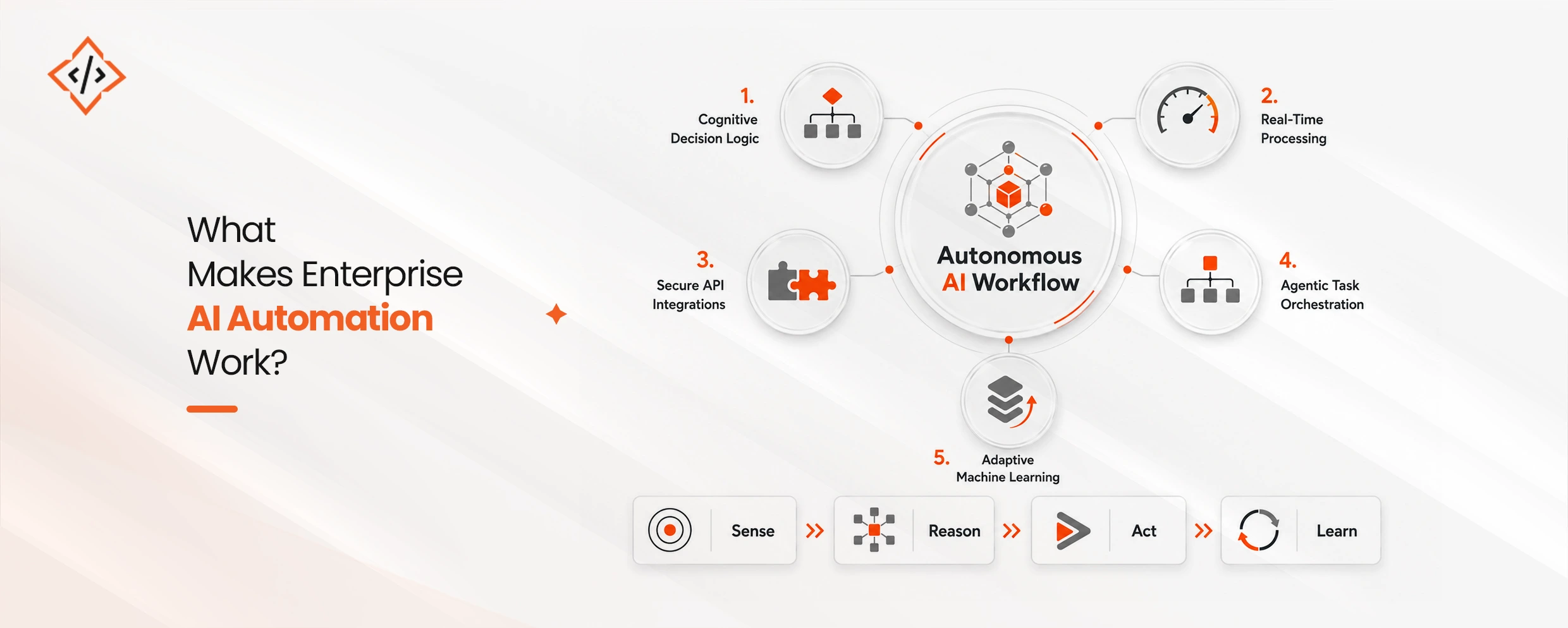
True AI automation solutions require dynamic reasoning capabilities rather than basic static rules to deliver measurable enterprise value. The best AI automation companies build autonomous systems that evaluate context and execute tasks independently.
Advanced platforms rely on an intelligent reasoning layer to manage complex corporate workflows. This cognitive logic evaluates multiple solution paths before acting, ensuring the chosen action aligns perfectly with established corporate policies.
Effective enterprise AI automation senses live data changes immediately across all connected operational streams. Systems process this incoming information instantly instead of waiting for scheduled batch uploads, preventing costly processing delays.
Intelligent business automation relies heavily on secure connections to existing digital infrastructure. Leading vendors build encrypted API bridges that integrate cleanly with corporate ERP platforms. This architecture protects sensitive data while enabling fast, cross-departmental workflows.
Agentic systems execute massive projects by distributing specialized workloads across multiple autonomous models. Primary agents hand off specific work to parallel sub-agents to achieve larger goals efficiently without requiring human intervention.
Top-tier platforms utilize models that continuously learn from ongoing business process automation. This adaptive intelligence refines system behavior and improves output accuracy over time, generating higher financial returns on the initial software investment.
Selecting the right partner from the best AI automation companies depends entirely on specific operational needs. Every enterprise requires a tailored approach based on its technical maturity and existing infrastructure. Some businesses need custom agentic systems to handle sensitive internal databases safely.
Other organizations benefit from fast cloud deployments that require minimal setup time. Working with the right enterprise AI automation vendor guarantees that digital investments translate into measurable bottom-line gains. Below is an objective analysis of the leading providers modernizing business operations in 2026.
Building custom intelligent architecture directly inside legacy enterprise infrastructure is where CodeTrade.io stands out. Rather than forcing clients into rigid pre-built templates, their team provides specialized AI automation consulting to engineer tailored agentic workflows. They begin every project by auditing backend data readiness, filtering out low-impact ideas before any development starts.
Their certified engineers construct autonomous models that integrate directly into existing ERP and CRM setups. Clients retain full source code ownership alongside dedicated post-launch support. This high-touch technical execution makes CodeTrade.io a dependable partner for mid-market and enterprise firms requiring bespoke AI automation solutions.
Scaling visual task automation across complex enterprise environments remains the core strength of UiPath. The platform has evolved beyond basic robotic process automation by adding large action models that manage end-to-end operational tasks. These autonomous capabilities allow software agents to evaluate unstructured documentation, detect workflow bottlenecks, and resolve exceptions independently.
Operations teams can track real-time agent activity through centralized management consoles. The platform is well suited for financial institutions and shared services teams that need to automate millions of repetitive transactions annually. UiPath continues to provide strong architectural stability for high-volume business process automation.
Eliminating on-premise server maintenance is a central advantage of the cloud-native platform from Automation Anywhere. Their serverless architecture removes heavy infrastructure burdens from internal IT teams, resulting in faster and more efficient system deployments. By utilizing intelligent API connections, their tools execute high-speed data exchanges across public and private clouds without processing delays.
Built-in generative features allow the system to summarize documents and trigger transactional sequences automatically. The platform scales computing resources instantly as corporate transaction volumes fluctuate. Organizations seeking rapid deployment without extensive hardware investments frequently turn to Automation Anywhere for modern AI workflow automation.
SS&C Blue Prism focuses primarily on meeting strict compliance requirements within heavily regulated sectors. Their architecture strictly separates workflow design from execution, granting security teams complete visibility into every automated process. Detailed audit logs track each decision made by their digital workers across banking, healthcare, and public sector deployments.
This controlled environment protects sensitive consumer data while automating mission-critical back-office administrative tasks. Operations leaders facing rigorous regulatory inspections rely on Blue Prism for reliable intelligent business automation. Their established governance model prevents unauthorized data transfers and maintains continuous operational compliance.
Modernizing massive legacy databases across hybrid cloud environments is where IBM demonstrates significant technical depth. IBM bridges legacy mainframe architectures with modern cloud applications to lower migration risks for established global enterprises. Their platform continuously monitors IT workflows to identify operational bottlenecks and recommend architectural improvements.
By combining open-source Linux reliability with enterprise-grade data protection, IBM executes automated tasks globally without downtime. Decision-makers managing complex IT environments value their structured approach to system stability. IBM remains a proven choice for global organizations needing secure AI-powered automation across distributed infrastructures.
Microsoft Power Automate provides deep native integration with Office 365, Teams, and Azure databases, making it highly accessible for corporate teams. Enterprise employees can construct automated workflows using visual drag-and-drop builders without extensive software development experience. The platform includes cognitive tools that automatically extract invoice details and route approvals efficiently.
This low-code accessibility reduces the daily administrative load across standard office environments. Companies with substantial investments in the Microsoft software stack gain fast access to AI automation services for businesses without adding separate licensing overhead.
Transforming raw enterprise data into accurate operational forecasts is the main capability of DataRobot. The platform automates complex machine learning stages, from data cleaning and feature engineering to model testing and deployment. Operations teams utilize these predictive capabilities to forecast inventory needs, evaluate credit exposure, and optimize supply chain schedules.
Real-time monitoring dashboards detect model drift immediately, preventing operational decisions based on inaccurate data. Companies that need to automate complex data analysis without hiring large internal data science teams find strong value in DataRobot. It serves as a specialized engine for enterprise AI automation development.
Flexibility and open-source transparency define the enterprise machine learning tools created by H2O.ai. Technical teams utilize automated machine learning engines to build proprietary AI models within private corporate infrastructure. This on-premise execution ensures that sensitive company data remains strictly behind internal firewalls.
The platform provides complete explainability for every automated prediction, which is essential for risk assessments and algorithmic audits. Internal engineering groups that prefer complete control over their software stack choose H2O.ai over closed proprietary systems. It provides an adaptable technical base for internal teams designing custom business operations automation.
Workato focuses on unifying disconnected enterprise applications into synchronized automated workflows. The platform provides thousands of pre-built connectors that link CRM, ERP, and human resources systems without requiring custom code. Operations teams can orchestrate complex, cross-platform sequences that update records across multiple systems simultaneously.
Enterprise security controls prevent data leakage while maintaining real-time data sync across cloud environments. By eliminating brittle custom API integrations, Workato reduces long-term software maintenance costs for IT departments. It remains a reliable choice among workflow automation companies managing multi-app enterprise environments.
Zapier provides accessible workflow automation for mid-market businesses by connecting standard web applications without custom coding. The platform features thousands of instant integration triggers that handle routine tasks across sales, marketing, and customer support departments. Teams can build multi-step conditional sequences that move lead information, generate customer notifications, and organize project folders automatically.
Recent additions include intelligent data parsers that extract relevant details from incoming emails instantly. Zapier allows agile operations teams to eliminate manual data entry quickly without relying on specialized software engineers, delivering immediate operational efficiency.
The most profitable applications of intelligent business automation replace high-volume knowledge work rather than complex human judgment. According to the November 2025 McKinsey State of AI report, 88 percent of organizations now use AI consistently in at least one business function. These leading enterprises deploy AI automation services to optimize daily logistics, finance, and support workflows effectively.
Hidden billing errors cost supply chain organizations millions annually. AI cross-references shipping invoices against contracted rate cards in real time. This immediate auditing process stops hidden overcharges before corporate payments clear.
Static delivery schedules fail when unexpected weather or traffic patterns emerge. Enterprise AI automation adjusts transit routes continuously based on live environmental data. This dynamic routing reduces fuel consumption and guarantees strict delivery timelines.
Handling routine support tickets drains valuable resources from customer service teams. Agentic systems manage multi-step ticket resolution requiring absolutely zero human intervention. They process refunds, update account details, and close service requests instantly.
Maintaining optimal stock levels requires anticipating market shifts accurately. AI predicts sudden demand spikes by analyzing historical purchasing data continuously. The system then adjusts procurement orders automatically to prevent warehouse stockouts entirely.
Financial institutions require absolute precision to prevent unauthorized monetary transfers. AI automation solutions monitor global transactions continuously to identify suspicious purchasing patterns. These systems immediately block operational anomalies to protect corporate assets securely.
The competitive window to build autonomous digital infrastructure is rapidly closing in 2026. Organizations that delay enterprise AI automation risk falling behind competitors who already operate self-directed workflows. To establish long-term operational resilience, technical leaders must audit internal bottlenecks and prioritize high-value use cases immediately.
Moving from manual coordination to intelligent business automation requires deep engineering expertise and structured system integration. Selecting an experienced development partner ensures that custom implementations deliver measurable financial returns without disrupting critical day-to-day operations.
CodeTrade stands out among top AI automation companies by building custom agentic workflows tailored to specific enterprise systems. Their specialized team guides organizations through every phase, from initial workflow validation to secure production deployment.
 Chand Prakash
 Chand Prakash
 Chand Prakash
 Chand Prakash
 Chand Prakash