







AI
FinTech & Banking
 Chand Prakash
21 May 2026
Chand Prakash
21 May 2026
Generative AI in Fintech: Top Use Cases, Benefits & Real-World Examples
 Chand Prakash
The projects that fail are almost never defeated by the technology. They fail because nobody could name the counterparty who needed convincing.
That’s worth leading with, because the justification for enterprise blockchain is narrower than a decade of marketing suggested.
It’s worth considering when multiple organizations must agree on the same facts, and none of them will accept another’s database as authoritative. Absent that, you’ve built a database with worse performance.
So this covers the test a project should pass, where production deployments actually exist, and how the integration problem rather than the cryptography decides outcomes.
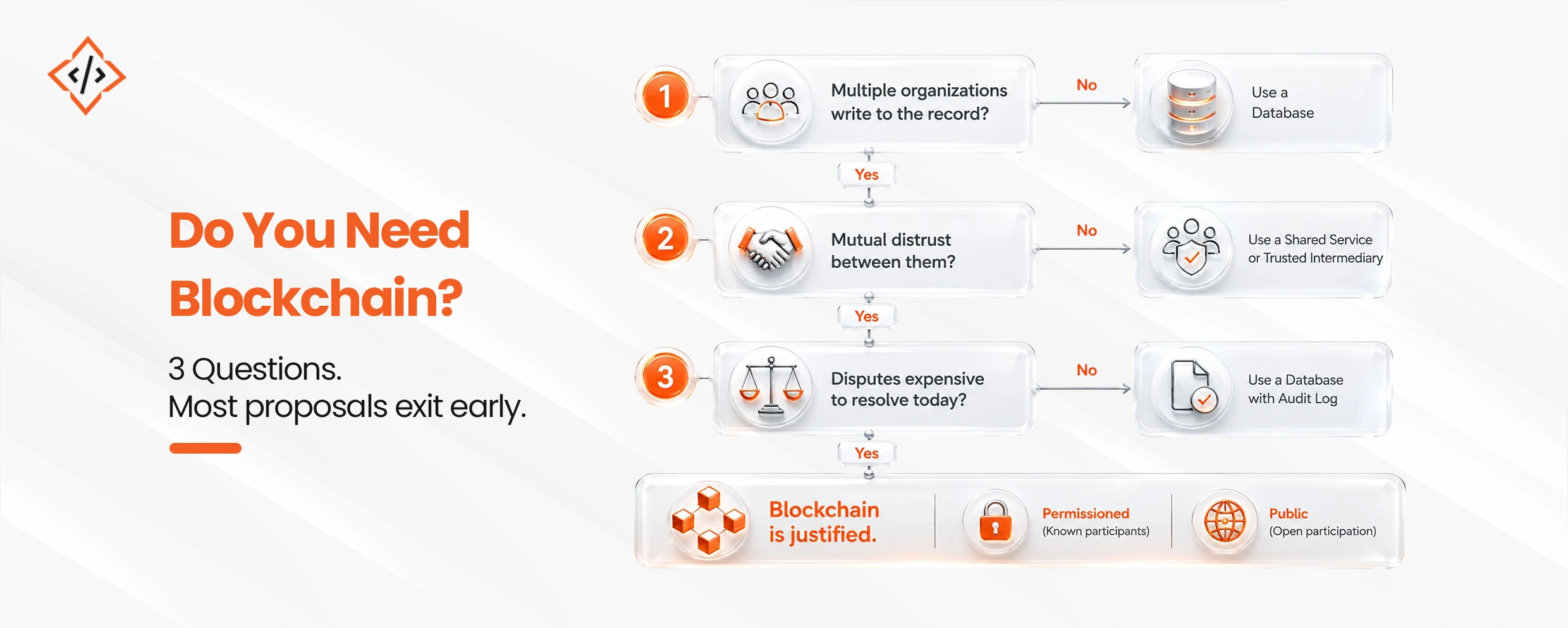
Most projects need to meet these four conditions to justify using blockchain.
All four hold in trade finance across banks, in multi-party supply chain provenance, and in securities settlement. There, a distributed ledger addresses something a database structurally can’t.
Where they don’t, the honest recommendation is Postgres with good audit logging.
One category has moved decisively beyond pilots, and being precise about it beats surveying everything.
Enterprise blockchain is easiest to evaluate through specific use cases rather than broad claims about the technology.
Tokenized treasuries, money market funds, and regulated deposit instruments are in production at an institutional scale.
This is the clearest example of blockchain in financial services moving from experimentation to a production setting.
The clearest signal came in May 2026, when JPMorgan filed to launch a tokenized Treasury fund on Ethereum.
A bank of that size committing to public-chain infrastructure for a regulated product is a different order of evidence from a consortium pilot.
Supply chain provenance is the second most credible category, and it’s more mixed.
For a blockchain supply chain project to work, the participating organizations must have a genuine reason to share and verify the same history.
Everything else deserves to be treated as unproven until a specific counterparty problem is named.
Internal record-keeping, document notarization for a single organization, and loyalty schemes all have cheaper answers.
Cryptography is rarely the problem. Most failures come from everyday business and engineering challenges.
The pilot ran with one organization and a friendly partner who participated as a favor. Production needs parties with commercial reasons to join, and recruiting them is a business-development problem the technology can’t solve.
The ERP still owns the record. The ledger holds a representation while the enterprise system holds the authoritative version, so the two drift.
This is the core blockchain ERP integration problem in many enterprise projects. Reconciling them recreates the cost the project was meant to remove.
Ownership of each field has to be decided explicitly, exactly as in any two-system integration, and the reasoning in Magento to Odoo integration applies unchanged.
A ledger guarantees a recorded fact wasn’t altered. It can’t guarantee the fact was true when recorded. Where data enters from the physical world, the weak link is entry rather than storage.
Who may join, who may write, who arbitrates disputes, and who pays for infrastructure. Consortiums stall on these far more often than on technical questions.
If one organization controls all the data, don’t build this. That is usually the wrong starting point for blockchain implementation. Not with us, not with anyone. You want Postgres with an append-only audit log, and you’ll get better performance and a smaller operations bill.
If the counterparties in your pilot are participating as a favor, stop before production.
The technology problem is solved and the business problem isn’t, and we can’t help with the second one.
And if what you actually need is provenance for a supply chain where you’re the dominant buyer, you can mandate a shared database.
Your suppliers will use it because you asked. That’s cheaper and it’s honest about the power dynamic.
The choice follows from who must be able to verify.
| Feature | Permissioned | Public |
|---|---|---|
| Participants | Known, admitted | Open |
| Verification by outsiders | No | Yes |
| Throughput and cost control | Predictable | Variable, fee-dependent |
| Data confidentiality | Straightforward | Requires cryptographic effort |
| Governance | Explicit consortium agreement | Protocol plus social consensus |
| Regulatory familiarity | Higher today | Improving, and now bank-adopted |
| Failure mode | Consortium politics | Fee volatility, protocol change |
Permissioned chains suit closed groups with regulatory or confidentiality constraints and a workable governance forum.
Public chains suit cases where verification by parties outside the group is the point and where confidentiality can be handled with hashing or zero-knowledge techniques.
The trend worth noting is that regulated institutions have stopped treating public infrastructure as automatically unsuitable, which wasn’t true two years ago.
It is also an important signal for blockchain adoption in enterprises, even though adoption remains selective.
Four steps can help you test the idea early and avoid spending heavily before you know it works. For enterprise blockchain implementation, these steps matter more than choosing a platform too early.
A pilot structured this way costs a fraction of a full consortium build and answers the only question that matters: whether the other parties will actually participate.
Good blockchain development services should support that validation without turning a pilot into a full-scale build too early.
Our position is simple. Start with the business problem, apply the test, and stay open to the evidence. If your project genuinely meets all four conditions, blockchain deserves a closer look, even if our initial assumption is to be cautious.
Not every business problem needs blockchain. In many cases, a well-designed database remains the better choice.
Blockchain makes sense when multiple organizations need a shared source of truth, face costly reconciliation issues, and require independent verification of records.
That is why some use cases are succeeding in production while others continue to struggle.
Before choosing a platform, focus on the fundamentals: who needs to participate, what problem is being solved, and how success will be measured.
Answering those questions early is often the difference between a successful project and an expensive pilot.