






Web Development
eCommerce
 Chand Prakash
12 October 2026
Chand Prakash
12 October 2026
Headless Magento: When PWA Studio Earns Its Cost
 Chand Prakash
Disagreeing stock figures and duplicated customer records plague many complex e-commerce systems. Prices revert overnight when automated jobs overwrite manual changes. Orders often appear twice after simple network timeouts. These issues are rarely actual software bugs. Each failure represents an unanswered data ownership question. That remains the fundamental design problem for any Magento Odoo integration.
The entire system works only when every field has exactly one owning platform. It fails predictably when both sides can write the same value. Selecting a Magento Odoo connector before mapping data ownership guarantees expensive future rebuilds. Transport mechanisms and scheduling tooling are entirely secondary to strict ownership rules.
This guide explains how expert Magento development services accurately assign data authority across both systems. It details the specific Magento Odoo synchronization patterns that fit each object perfectly. It also explores the critical failure modes worth designing against from the start.
Establishing precise data ownership prevents catastrophic integration failures and guarantees a single reliable source of truth across systems. Always define this structure before selecting any Magento ERP integration tooling. Designate one owner per field and make the other read-only.
| Object / Field | Owner | Direction | Notes |
|---|---|---|---|
| Product catalog structure | Odoo or a PIM | Odoo to Magento | Whichever system merchandising actually works in. |
| Product descriptions, images, SEO | Magento | None | Storefront content belongs strictly to the storefront. |
| Base price | Odoo | Odoo to Magento | This is where finance sets the price. |
| Contract / customer-specific price | Odoo | Odoo to Magento at runtime | Do not duplicate ERP contracts as price lists. |
| Promotional pricing, cart rules | Magento | None | Campaign logic belongs entirely in the commerce platform. |
| Stock quantity | Odoo | Odoo to Magento | Single source of truth without write-backs. |
| Stock reservation on order | Magento, then confirmed in Odoo | Two-step | The single place a handshake is actively warranted. |
| Orders | Magento | Magento to Odoo | Magento creates the order while Odoo fulfills it. |
| Order status, fulfillment, tracking | Odoo | Odoo to Magento | Odoo owns the entire physical fulfillment process. |
| Invoices and credit notes | Odoo | Odoo to Magento (read-only) | Accounting remains the authoritative source. |
| Customer master record | Explicit decision (usually Magento) | Magento to Odoo | This represents the most commonly fudged architectural decision. |
| Credit limit and payment terms | Odoo | Odoo to Magento | Enforce this at checkout via an API lookup. |
| Returns / RMA | Depends on the process | None | Follow whichever system actually operates the returns. |
Two specific rows deserve extra emphasis during Magento Odoo integration architecture planning. Stock quantity flows one way only. Magento must never write stock levels back to Odoo. Odoo tracks where goods physically move. This makes it authoritative. Magento simply holds a working copy for display and reservation purposes.
The customer master record requires an explicit decision. Most technical teams leave this ambiguous. This failure results in duplicated records. If Magento owns it Odoo creates partners from Magento data. Odoo then never edits those identity fields. If Odoo owns it Magento accounts get provisioned directly from Odoo. Either approach works perfectly well. Failing to choose produces two records for the same company with different addresses.
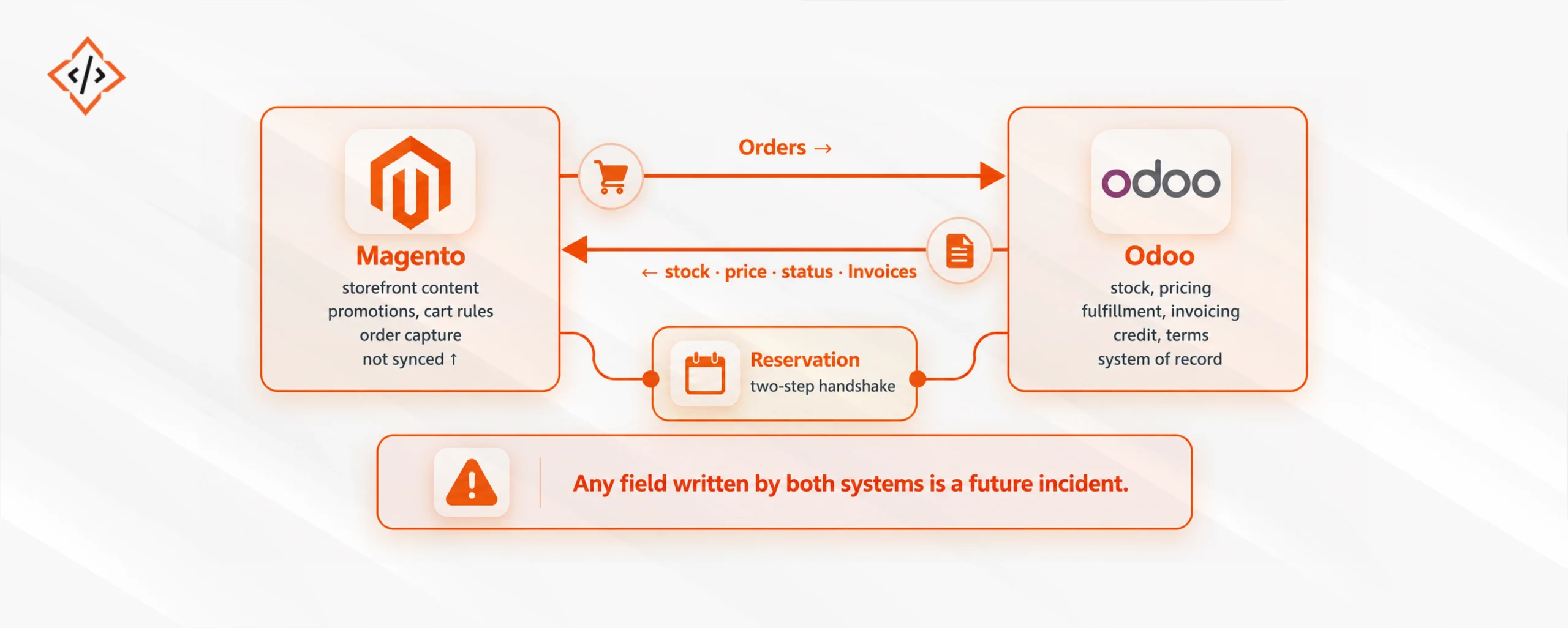
Maintain one flow per object always. Inventory reservation remains the single justified exception to this rule.
Selecting appropriate synchronization patterns for specific data objects ultimately determines the long-term stability of your entire system architecture. Different data objects require entirely different integration approaches. Applying one single pattern to everything remains a costly architectural mistake.
Effective Magento Odoo order integration captures the order and places a message onto a queue. A background worker then creates the corresponding sales order in Odoo. Never write to Odoo synchronously during the checkout process. Doing so makes checkout availability depend entirely on ERP uptime.
Every order must carry a unique idempotency key. The standard Magento order increment ID provides a natural choice here. Odoo checks this key before creating any new records. A system retry simply finds the existing record instead of creating a harmful duplicate. No single line of defense offers more value.
Resist chasing per-unit real-time accuracy during Magento Odoo inventory integration. That approach proves fragile and rarely necessary for operations.
A better pattern exists for stable stock management. Odoo pushes stock changes on a short regular interval. Magento holds a safety buffer on thin items. Low-stock thresholds absorb the natural timing window easily. Add synchronous availability checks at checkout only for genuinely scarce high-value items. Do not apply this check across the whole catalog. Accepting a small timing window represents a deliberate architectural trade. It remains the correct choice for almost every storefront.
Proper Magento Odoo pricing integration depends entirely on where your customer contracts live. If Odoo owns contract pricing Magento requests the applicable price at runtime. The system then caches that specific price briefly. Do not replicate contract pricing directly into native Magento price lists. This creates two conflicting sources of truth for billing.
A scheduled push into Magento works fine if pricing remains simple and rule-based. The B2B version of this decision involves native Magento B2B shared catalogs. Teams use those shared catalogs mainly for catalog visibility rather than strict pricing logic.
Magento Odoo customer synchronization requires a strict one-way flow from the owning system. Whichever platform owns identity sends data to the receiving system. The receiving system never edits those core identity fields. Always match records using a highly stable key. Email addresses work perfectly well for standard B2C storefronts. Magento B2B operations require a strict company-level identifier. Several different buyers often share one corporate account.
Odoo generates the invoice while Magento simply displays it. Magento Odoo accounting integration demands that commerce platforms never create accounting documents. Giving Magento the ability to generate invoices breaks ledger reconciliation immediately.
Identifying common failure points early prevents expensive operational disasters and ensures a stable commerce architecture across your systems. Six specific failure modes cover nearly every incident found within Magento Odoo data synchronization.
| Failure | Cause | Prevention |
|---|---|---|
| Duplicate orders in Odoo | System retries after a timeout without an idempotency check. | Implement an idempotency key on every order before creation. |
| Stock disagreement | Both integrated systems attempt to write stock data simultaneously. | Enforce a one-way flow from Odoo without Magento write-backs. |
| Duplicate customers | Lacking an agreed matching key or both systems creating records. | Define an explicit owner plus a stable company-level match key. |
| Prices reverting | Scheduled data pushes overwrite manual pricing changes unexpectedly. | Assign a single owner per price type while promotions stay in Magento. |
| Silent sync failure | A queue worker dies without triggering any system alerts. | Monitor queue depth and the age of the oldest message closely. |
| Order stuck mid-flow | A partial failure occurs without a clearly defined system state. | Build an explicit state machine with retry and dead-letter paths. |
The fifth failure causes the most damage per incident and deserves special emphasis. A stopped background worker produces absolutely no system errors. It just creates an absence of orders arriving inside the ERP. Nobody notices this until the fulfillment team asks where everything went.
Monitoring simple job success will not catch this specific issue. You must monitor queue depth and the age of the oldest unprocessed message. Set up strict technical alerts on both of these critical metrics.
Processing low order volumes with a simple catalog rarely requires complex custom architecture. A standard Magento Odoo connector usually serves these basic requirements perfectly. Test off-the-shelf solutions thoroughly before investing in custom Magento Odoo integration services.
Never start building if finance and operations disagree on the data ownership map. Avoid engaging CodeTrade or any software vendor until strict internal alignment exists. Business disagreements inevitably surface during user acceptance testing as technical defects. They are strictly organizational problems rather than actual system errors.
Fix messy ERP records completely before attempting any new synchronization project. An integration faithfully propagating bad master data simply makes those errors highly visible across both platforms simultaneously.
Sequence matters heavily during implementation. Starting with the largest data object remains a common and expensive architectural mistake.
Two strict operational requirements apply throughout the project. Build automated reconciliation reports from day one. Compare daily counts and totals across both sides constantly. A daily report catches data drift long before a frustrated customer complains. Log correlation IDs across both systems religiously. Tracing a failed order across a message queue without them proves thoroughly miserable.
Both approaches remain completely legitimate for enterprise teams. The final decision follows strictly from the data ownership map rather than standard feature lists.
Buy an off-the-shelf Magento Odoo connector when its assumptions match your ownership map perfectly. Choose this path if order volumes remain ordinary without complex contract pricing. This approach gets storefronts running in weeks rather than months.
Build custom Odoo eCommerce integration logic when your ownership map contains rules standard tools cannot express. Custom architecture handles runtime contract pricing effectively. It also provides essential dead-letter paths and robust reconciliation reporting that basic connectors lack.
The ultimate architectural trap involves buying a connector and customizing it heavily. This creates the heavy maintenance burden of custom code. It also forces a strict operational dependency on an external vendor and their specific release schedule during routine maintenance like the 2.4.8 upgrade guide.
“One owner per field with the other side read-only.” This rule appears in key takeaways and earlier sections frequently. The concept remains technically correct. However it looks cleaner in documentation than during an operations team’s actual working day.
Consider a standard operational scenario. Odoo owns stock completely. This remains a correct and highly defensible architectural decision. A warehouse supervisor managing Magento Odoo inventory integration notices Magento showing four units instead of twelve. An unposted goods receipt causes this discrepancy while items keep selling. The supervisor wants to fix the number directly inside Magento immediately.
The architecturally correct answer requires posting the receipt in Odoo first. Waiting for the next scheduled push feels genuinely slower. A direct storefront override would technically work much faster.
Enforcing strict read-only access forces operational teams to find creative workarounds. These include spreadsheet imports or direct database modifications. Sometimes teams deploy undocumented scheduled scripts silently.
Modern Magento Odoo API integration must provide a supported override mechanism. A Magento-side adjustment writes directly to Odoo via API. This registers as an attributed and logged inventory adjustment. It prevents editing the local storefront copy directly. This approach technically preserves single system ownership. Whether it preserves the true architectural spirit remains highly debatable. It introduces more complex machinery than the clean rule originally suggests.
A successful Magento Odoo integration remains a strict ownership challenge rather than a purely technical problem. Every single field requires exactly one owning system while the other remains read-only. Nearly every system failure during Odoo integration services traces back to unresolved data authority decisions.
Reliable Magento Odoo order synchronization requires asynchronous queues utilizing strict idempotency keys. Effective Magento Odoo inventory integration flows one way using scheduled buffers instead of fragile real-time updates. Dynamic pricing resolution depends entirely on where your actual customer contracts live.
Always finalize your data ownership map alongside finance and operations before writing any code. Sequence inventory updates first to secure an immediate and highly visible operational win. Monitor actual queue depth and message age because dead workers fail completely silently. Always run daily reconciliation reports to catch data drift before your customers ever notice.

 Chand Prakash
 Chand Prakash
 Hardik Soni
 Hardik Soni
 Hardik Soni