






AI
 Chand Prakash
06 August 2026
Chand Prakash
06 August 2026
Why US Enterprises Invest in Generative AI Development Services?
 Chand Prakash
Relying on human administrators to manage routine enrollment, grading, and support bottlenecks limits institutional growth.
Integrating Open edX AI agents fundamentally shifts platform management from manual oversight to continuous automated execution. Legacy educational software relies on rigid rules that stall when student volumes spike during registration periods.
Modern edtech infrastructure requires cognitive architecture to process unstructured data and multi-step administrative tasks. An AI-powered Open edX platform uses deep learning models to handle complex verification and routing decisions independently.
According to an EDUCAUSE institutional survey, 80 percent of higher education administrators are motivated to adopt AI specifically for improved efficiency and productivity.
Manual processing slows down student onboarding and creates unnecessary backlogs across academic departments. Adopting Open edX AI automation eliminates these operational friction points while keeping administrative overhead low.
Partnering with an experienced Open edX development company ensures systematic scaling for enterprise learning platforms without expanding headcount.
Scaling an online learning environment breaks down when administrative headcount must grow alongside student enrollment. Open edX AI automation decouples operational growth from human labor costs. Legacy educational systems rely entirely on passive triggers.
These old systems wait endlessly for human approval before moving forward. An intelligent agent works autonomously instead. It reads incoming data and makes rapid decisions based on predefined logic. It then executes the required platform update without human supervision.
Manual edtech management carries high hidden costs for academic institutions. Human processing delays create immediate friction during peak enrollment periods.
These delays directly cause impatient students to drop off entirely. Different academic departments often handle disjointed learning modules manually. This manual processing creates massive data silos across the network.
According to a McKinsey report, transforming manual administrative operations reduces routine processing times by 46 percent.
An AI-powered Open edX platform eliminates these expensive administrative bottlenecks entirely. Intelligent systems connect these fragmented silos to ensure smooth institutional scaling.
Open edX generative AI reads unstructured data perfectly.
It instantly parses uploaded transcripts and complex email queries. There is a massive difference between basic software and agentic workflows. A simple Open edX AI chatbot only answers pre-programmed questions. True AI agents for Open edX actually execute structural database changes.
They approve enrollments and modify student records instantly. Partnering with an Open edX AI agent development company ensures safe integration. This specific approach builds a truly AI-powered learning platform for the future.
An Open edX intelligent assistant takes over the entire student onboarding sequence instantly.
It extracts text from application documents and verifies prerequisites against the course database automatically. This capability turns a sluggish multi-day review process into a seamless real-time transaction.
The AI uses Retrieval-Augmented Generation to cross-reference incoming student data directly with the institutional knowledge base.
It verifies payment gateways, checks previous academic credits, and provisions secure login credentials simultaneously.
According to a 2025 Gartner analysis, 54 percent of IT operations leaders are adopting AI specifically to cut these administrative costs. This completely removes the traditional data entry burden from human administrators.
The Open edX AI integration scans uploaded PDFs and educational certificates for strict digital authenticity.
It eliminates the tedious need for manual database cross-referencing entirely. The intelligent agent reads the submitted document and validates the student record within seconds. Institutions handle thousands of applications instantly without hiring temporary staff.
This rapid processing prevents frustrating enrollment bottlenecks during peak registration seasons.
An Open edX virtual assistant accurately maps approved students to specific digital cohorts based on their unique profile data. Students receive immediate confirmation emails outlining their next academic steps.
The system constantly balances class sizes by monitoring real-time platform capacity. It automatically triggers a waitlist notification when server capacity or course limits are reached.
This precise automation ensures smooth operational scaling without requiring additional human IT support.
Open edX LLM integration evaluates rubric-based assignments with near-human accuracy. This automation provides students with immediate performance data.
It frees instructors to focus strictly on complex curriculum development. A 2025 academic study demonstrates this capability clearly. Researchers found that AI models match human instructor exam scores within a 10 percent margin in 70 percent of cases.
An AI learning assistant does not just assign a simple grade. It reads the full submission and compares it against strict educator rubrics. The system then generates specific contextual feedback pointing out exact errors.
Platform administrators feed specific grading parameters directly into the AI model. The Open edX generative AI evaluates short-answer and essay questions objectively. This consistent approach removes human fatigue from the grading equation entirely.
The technical architecture includes a highly sophisticated confidence-scoring system. Highly ambiguous answers are automatically flagged for manual human review.
This routing ensures complex edge cases receive proper academic attention.
Receiving academic corrections seconds after submission holds massive pedagogical value.
Students retain complex knowledge better when they view their mistakes instantly. An AI tutor for Open edX recommends personalized study materials immediately.
These unique recommendations map directly to the specific questions a student failed. This rapid intervention prevents learners from falling behind in difficult courses.
The continuous assessment cycle builds a truly responsive AI-powered learning platform.
An Open edX virtual assistant operates as a continuous multilingual first-line support tier for both technical troubleshooting and academic queries. It resolves routine friction immediately so human IT teams only handle critical escalations.
Global learning platforms operate around the clock across every time zone.
When a student forgets a password or cannot locate a syllabus module, waiting hours for an email response degrades the learning experience.
Open edX conversational AI resolves these administrative issues directly within the active chat interface.
A secure API connection bridges the chat interface directly with the backend infrastructure. This integration allows the Open edX AI assistant to execute real-time database updates safely.
The agent handles routine password resets, course module navigation, and verified deadline extensions without human intervention.
According to Gartner research, intelligent IT support agents reduce enterprise helpdesk operational costs by up to 30 percent.
The model translates technical instructions and academic guidelines for international learners instantly.
It retains memory of past interactions so students never need to repeat prior technical issues. This contextual awareness delivers reliable continuous support across global student populations.
Deploying AI agents for Open edX requires mapping existing institutional data architecture first. Administrators must establish secure API endpoints before writing any automation logic.
Dropping a generic model into an enterprise LMS causes immediate data leaks and system failures.
Partnering with an Open edX AI agent development company ensures safe deployment. These experts isolate the models and train them strictly on proprietary platform data. This necessary governance layer keeps the system compliant with strict student data privacy regulations.
Clean legacy databases completely before attempting any AI deployment. Messy data structures confuse the AI model and generate incorrect administrative actions.
Removing obsolete records and standardizing user profiles ensures the cognitive engine operates with maximum precision.
IT directors must establish secure API webhooks immediately after data cleaning is complete. These custom webhooks connect the external AI engine and the core Open edX backend safely.
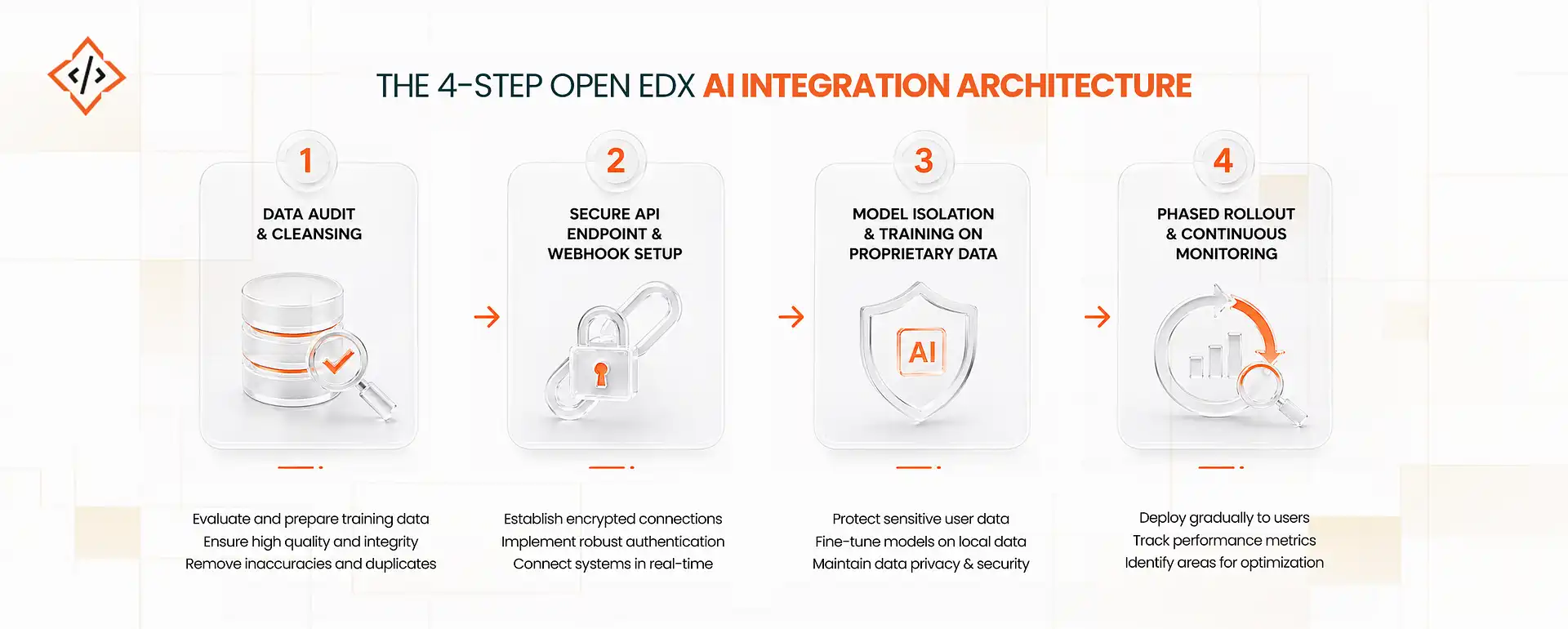
Execute a phased rollout instead of launching everything simultaneously. Start with low-risk workflows like tier-1 technical support first. Administrators can migrate to automated grading once the support agent proves stable.
Open edX AI integration requires continuous monitoring after the initial launch. IT teams must build strict feedback loops into the active system.
These specific loops refine the agent’s accuracy over time to ensure long-term operational reliability.
Once this phased deployment stabilizes, the true value of intelligent automation becomes clear across your institution. Clinging to manual data entry creates an artificial ceiling on how far an educational ecosystem can scale.
Upgrading to an agentic architecture turns heavy administrative overhead into a streamlined background process.
Audit your current enrollment and grading workflows today to locate the most severe operational delays.
Identifying these specific friction points helps you deploy an Open edX intelligent assistant effectively. This strategic technology shift finally allows your educators to focus entirely on teaching.
CodeTrade operates as a leading Open edX AI agent development company for global educational institutions.
The engineering team builds precise Open edX AI integration solutions tailored to your existing infrastructure. By leveraging professional AI agent development services, this careful architectural approach safely delivers a reliable AI-powered learning platform.
 Chand Prakash
 Chand Prakash
 Chand Prakash
 Chand Prakash
 Hardik Soni