






Odoo Development
Hire Developers
 Hardik Soni
14 September 2026
Hardik Soni
14 September 2026
How to Hire Odoo Engineers Without Derailing Your ERP Implementation?
 Hardik Soni
Custom AI agents for Odoo provide the critical reasoning layer needed to handle complex workflows that traditional rules simply cannot. Most Odoo workflow automation executes repetitive tasks flawlessly but stalls when a process requires actual judgment.
Integrating intelligent models directly into the backend bridges this operational gap. This structural upgrade turns standard modules into proactive problem-solving systems. The financial and operational benefits are highly measurable.
A 2025 Gartner report projects agentic AI will autonomously resolve 80% of routine customer issues by 2029 while cutting costs by 30%. Building a reliable AI agent architecture in Odoo demands strict data governance and secure routing. Technical leaders must deploy these enterprise AI agents carefully to maintain system stability and long-term scalability.
Odoo Business Automation handles predictable daily tasks flawlessly but stalls when complex business decisions require interpretation rather than execution.
Standard logic relies heavily on scheduled actions and trigger-based workflows. These server actions execute perfectly under rigid conditions. However, fixed logic limitations prevent the system from adapting to unexpected anomalies. The ERP stalls when a business process falls outside predefined parameters.
This rigidity creates severe bottlenecks across critical operational areas. Lead qualification and complex supplier negotiations require deep contextual understanding. Standard modules cannot handle nuanced proposal creation or manage dynamic Customer Support with AI WhatsApp Automation channels. These tasks demand interpretation rather than just basic automated routing. A 2025 McKinsey report notes organizations gain greater value from workflow-level AI deployments compared to isolated automation initiatives.
Integrating Odoo AI Agents directly addresses these specific operational blind spots. They evaluate the current context and constraints before taking any action. These intelligent systems apply logical reasoning to unstructured business data. AI-driven ERP solutions effectively manage complex process exceptions autonomously. This architecture moves beyond simple triggers to deliver intelligent problem resolution.
The right AI agent architecture in Odoo depends strictly on your scalability requirements, governance needs, and operational complexity.
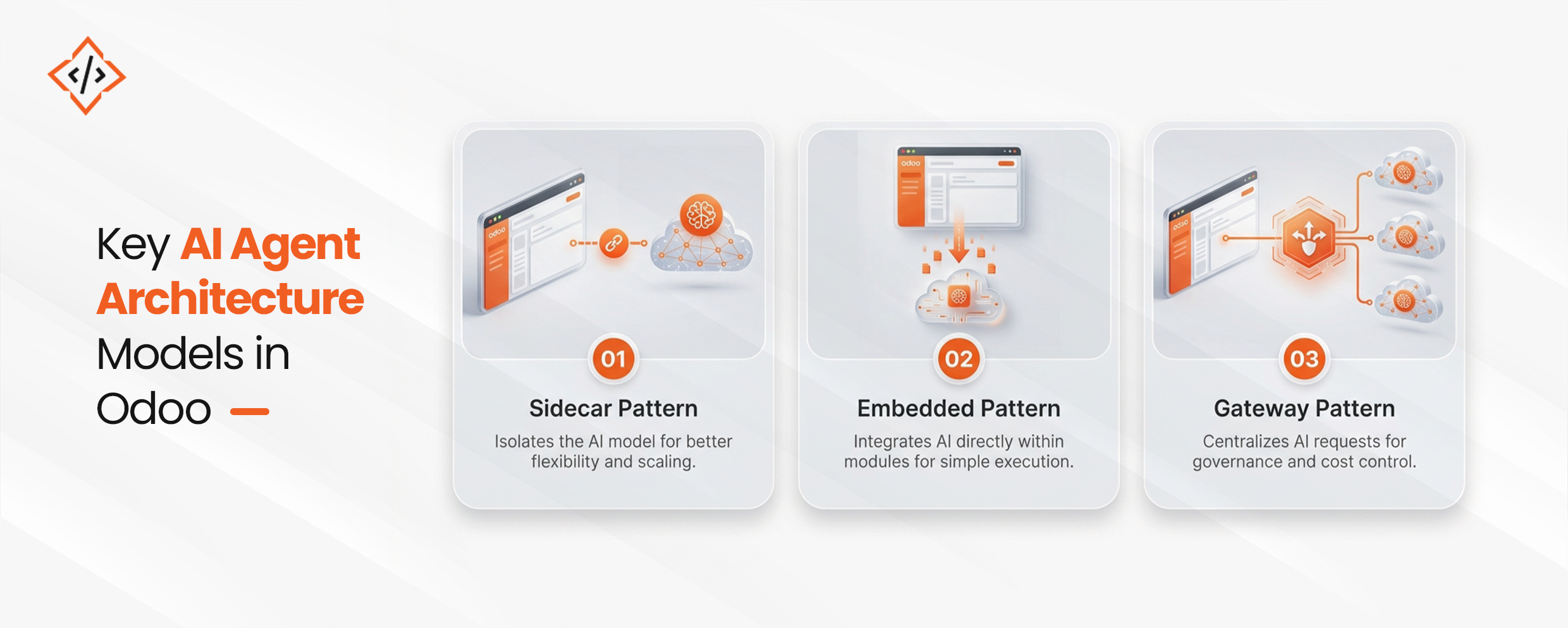
The sidecar approach isolates the language model from core ERP functions. It routes requests through an external API layer connecting to LangChain. This independent deployment ensures better system isolation and much easier scaling. It provides highly flexible model selection for development teams. This structure works best when building Custom AI Agents for Odoo.
This approach embeds the intelligence directly inside the application module. A specific module makes direct calls to the external language model. This creates a simpler workflow for standard Odoo integration services with considerably lower infrastructure overhead. However, this tight coupling creates significant technical debt. Harder system upgrades make this specific Odoo AI Implementation slightly risky.
Complex organizations need centralized governance for their automation strategies. The gateway pattern routes all requests through a dedicated AI gateway. This gateway orchestrates actions across multiple models to ensure strict cost optimization. This architecture handles heavy enterprise orchestration seamlessly. It remains the standard for deploying Enterprise AI Agents globally.
Architecture decisions directly affect system performance, operating costs, data governance, and your future flexibility within the ERP platform.
Embedded architectures deliver the lowest latency by keeping all model calls directly within the local application environment. Sidecar architectures introduce minor network delays but scale significantly better under heavy enterprise load. Gateway architectures prioritize complex enterprise routing capabilities over raw transaction processing speed.
Deploying Generative AI in Odoo requires careful and proactive budget management. Model usage fees escalate quickly during high-volume data processing tasks. Infrastructure costs scale linearly alongside your increased server demand. A 2026 IDC report forecasts global AI infrastructure spending to reach $487 billion as organizations operationalize workloads. Technical teams must also budget for continuous system monitoring expenses.
Intelligent data routing requires robust system observability to prevent silent operational failures. Detailed agent tracing helps developers identify specific performance bottlenecks quickly. Continuous prompt monitoring ensures the underlying language model receives clean instructions. Maintaining comprehensive workflow logs and strict audit records ensures complete operational transparency.
AI-Powered Odoo ERP environments must actively avoid strict technology vendor lock-in. Proprietary models offer immediate capability but severely restrict long-term architectural control. Open-source models provide complete data ownership but require significant internal maintenance overhead. Hybrid deployment approaches balance immediate high performance with essential long-term strategic flexibility.
An intelligent Odoo AI Copilot automates sales workflows by analyzing customer data to generate highly accurate quotes instantly.
The autonomous agent reads inbound lead information and cross-references the data with active opportunity details. It parses extensive customer history to understand purchasing patterns before building the commercial quote context. This intelligent ingestion layer forms the foundational baseline for successful Odoo ERP AI integration.
The integrated Odoo AI Assistant automatically generates comprehensive proposal drafts and accurate scope summaries. It evaluates past winning contracts to provide precise commercial pricing recommendations for the sales team. This execution proves how generative AI in Odoo optimizes high-volume transactions without manual intervention.
Every generated proposal remains securely parked inside the enterprise backend for mandatory human approval. Internal account executives review the technical scope and commercial terms before finalizing customer delivery. This strategic checkpoint guarantees complete operational compliance across all client-facing documentation.
Following manual validation, the underlying system automatically updates CRM records and advances the corresponding deal stages. The agent writes comprehensive activity logs to maintain a fully auditable database history. This complete execution shows how AI-driven ERP solutions manage standard operations from start to finish.
Securing your Odoo ERP AI integration requires embedding strict technical guardrails into the backend architecture before deployment begins. Security architecture should be designed before deployment, not after implementation.
Autonomous Odoo AI Agents must explicitly operate under the existing framework of standard user roles. The system enforces record-level permissions to ensure that the agent never reads restricted accounting data or unauthorized personnel files. These strict access rights limit data visibility automatically based on user context. This granular approach prevents unauthorized cross-department data parsing during execution.
A secure AI Agent Architecture in Odoo actively blocks excessive data access by utilizing aggressive context trimming. Developers configure strict input filters to minimize sensitive record exposure during bulk data processing tasks. Implementing robust semantic security layers prevents accidental prompt leakage of corporate intellectual property to public models. This continuous data protection strategy secures enterprise operational pipelines.
Every automated decision requires comprehensive monitoring through independent agent logs to maintain regulatory compliance. Dedicated activity tracking systems capture every external API call alongside the exact context of the transaction. The architecture inserts mandatory structural approval checkpoints for high-risk system updates. This historical data trail provides complete transparency for administrative security reviews.
Enterprise AI Agents must function with bounded autonomy rather than operating completely unmonitored across the network. System governance policies force critical financial transactions or database schema changes to halt for manual confirmation. This intentional human checkpoint protects corporate stability while maximizing structural efficiency elsewhere. Maintaining this structured oversight guarantees reliable long-term business system operations.
Deploying intelligent models remains completely unnecessary when simple deterministic rules perfectly govern highly predictable enterprise resource planning environments. AI is not the best solution for every workflow. Many ERP processes perform better using deterministic automation.
Standard Odoo Workflow Automation excels at executing strict operational tasks. Routine invoicing and inventory synchronization require absolute mathematical certainty. Complex tax calculations rely entirely on predefined statutory parameters without deviation. These rigid operations simply do not require the probabilistic reasoning capabilities of advanced models.
Regulatory frameworks demand completely predictable system outcomes during financial audits. Standardized business processes must guarantee uniform data output across transactions. Intelligent algorithms introduce unnecessary computational variables into rigid compliance workflows. Deterministic logic ensures strict adherence to essential corporate governance standards efficiently.
Processing thousands of identical daily records strains expensive infrastructure unnecessarily. Simple repetitive workflows cost significantly less through standard scheduled automation. Triggering external language models for basic data entry wastes valuable computing power. Traditional schedulers handle bulk data modifications with vastly superior technical efficiency.
On one hand, use professional AI Agent Development Services when dynamic workflows require active reasoning. On the other hand, rely exclusively on traditional Odoo Business Automation when operational processes follow fixed logic. As a result, this simple architectural division optimizes overall system performance while strictly controlling operational budgets.
The future of Odoo AI Automation focuses strictly on deploying intelligent models where business decisions require actual reasoning. A governance-first AI Agent Architecture in Odoo ensures secure deployment across your entire system environment. Technical leaders must build scalable agent frameworks that maintain long-term model flexibility. This structured approach guarantees complete operational visibility across all automated enterprise workflows.
Approaching AI Agent Development Services through architecture-first planning prevents severe technical debt. Organizations can scale their AI-Driven ERP Solutions safely without introducing critical governance risks.
CodeTrade builds resilient Enterprise AI Agents for complex business environments. Our technical teams deliver secure Odoo AI Implementation strategies tailored to specific operational requirements. We construct intelligent backend architectures that perform reliably under heavy production workloads.

 Hardik Soni
 Hardik Soni
 Chand Prakash
 Chand Prakash
 Chand Prakash