






Odoo Development
ERP
 Hardik Soni
03 September 2026
Hardik Soni
03 September 2026
How Should Mid-Market Teams Plan an Odoo 18 to Odoo 19 Upgrade?
 Hardik Soni
Enterprise databases contain large volumes of operational knowledge, yet employees often spend valuable time searching for customer records, transaction histories, or project information. Although most organizations store critical business data inside their ERP systems, retrieving precise answers during day-to-day operations remains difficult.
Connecting a large language model directly to an ERP database rarely solves this problem. Generic models lack awareness of relational structures, business context, and user-specific access controls. As a result, retrieval quality declines as data complexity increases.
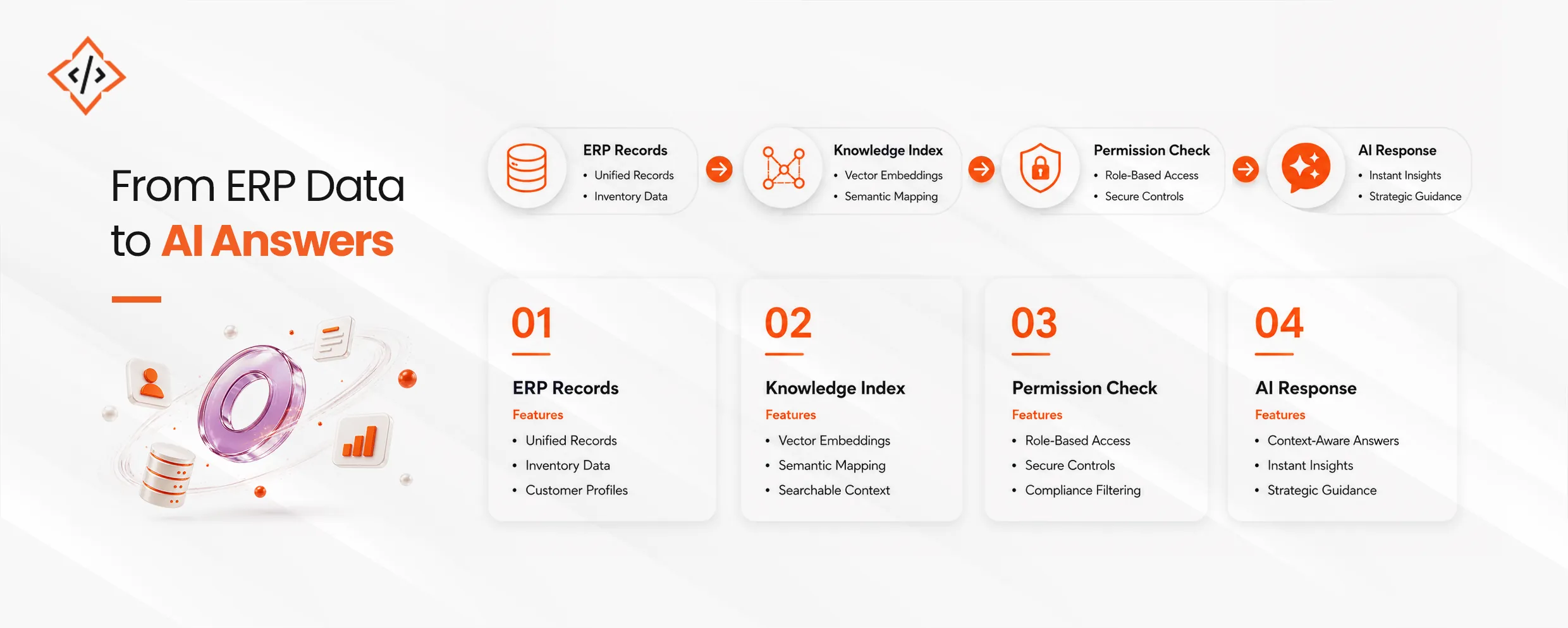
An Odoo RAG Implementation provides a structured approach to secure knowledge retrieval across ERP records. By combining semantic search with permission-aware access controls, organizations can surface relevant information without exposing sensitive business data.
The challenge is larger than model selection alone. Research published in 2026 found that global corporate AI investment reached $252.3 billion in 2024, yet only 6% of organizations reported a significant earnings impact from their AI initiatives.
This gap highlights how data architecture, governance, and system integration often determine success more than the underlying model itself. According to the study, organizations frequently struggle to transform AI investments into measurable outcomes when foundational systems are not prepared for production-scale deployment through effective generative AI development services.
Building Retrieval Augmented Generation for Odoo requires addressing challenges that traditional document-based RAG systems rarely encounter. ERP environments introduce complex record relationships, strict permission models, and continuously changing datasets that demand a different architectural approach.
Standard out-of-the-box pipeline builds lack the precise context-mapping layers required to parse interdependent enterprise resource records.
Standard vector databases remain completely blind to internal security parameters and operational permissions by default. This limitation means a basic semantic query could mistakenly pull sensitive CRM pipeline data, payroll records, or executive financial summaries for an unauthorized user.
According to Cisco’s 2025 Data Privacy Benchmark Study, 64% of organizations are concerned about unintentionally exposing sensitive information through generative AI systems.
Document retrieval crawls flat text blocks, whereas enterprise database infrastructure relies entirely on strict multi-table relational dependencies. Disconnected vector models strip away vital connections between active invoices, open projects, and specific customer profiles during standard tokenization.
An optimized Odoo Retrieval Augmented Generation framework must utilize metadata-aware vector matching to preserve these structural logic links safely. Isolating numerical variables from their qualitative categories corrupts accounting balances and inventory definitions.
Corporate operational data updates continuously, rendering static knowledge snapshots obsolete within minutes of generation. Relying on outdated embeddings directly degrades answer quality and causes internal users to lose faith in an automated system.
Maintaining an efficient Odoo Knowledge Management pipeline demands low-latency vector synchronization to ensure real-time transactional updates reflect instantly. If semantic indexes fall behind live warehouse changes, conversational agents will deliver invalid stock counts to active clients.
Selecting the correct combination of data infrastructure layers prevents processing friction and long-term resource bottlenecks within transactional pipelines.
pgvector keeps infrastructure within the existing database environment and reduces operational complexity. Pinecone lowers infrastructure management requirements but increases subscription costs and external dependency. Weaviate supports larger deployments through combined keyword and vector search capabilities. The right choice depends on scale, security requirements, and expected query volume.
OpenAI embedding models provide strong multilingual performance across business content. Open-source alternatives offer greater flexibility for training on internal terminology, product codes, and industry-specific language. Embedding quality directly influences retrieval accuracy. Poor terminology mapping can reduce search relevance and affect response quality.
ACL-aware retrieval validates user permissions before retrieving information from the vector store. Metadata filtering ensures responses remain aligned with existing Odoo access controls. This protection layer is essential for an Odoo Knowledge Base AI. Without access validation, users could retrieve information beyond their authorized scope.
Failing to establish a real-time data synchronization pipeline causes retrieval components to serve stale transactional records to active downstream users.
Database mutations require absolute coordination across create, update, and delete actions to keep vector layers completely valid. A structural framework captures these baseline database transformations via customized PostgreSQL triggers or built-in Odoo customization services.
Capturing a deletion event must execute an immediate corresponding deletion within the target vector space to maintain system accuracy. If field modifications fail to trigger automated updates, the language model processes invalid warehouse quantities and closed pipeline opportunities.
Executing large embedding transformations directly within main application loops slows down user sessions and limits general processing efficiency. An event-driven architecture handles this background overhead safely by offloading raw text payloads into asynchronous task management queues.
A production-grade RAG Architecture for Odoo relies on tools like Celery or Redis to orchestrate data distribution tasks during heavy traffic spikes. Systematically monitoring active task queues prevents worker backlogs from causing noticeable semantic index synchronization delays across operations.
Dividing database fields demands distinct chunking decisions because relational record data structures differ entirely from loose document layouts. Record-level methods isolate individual model lines, whereas field-level architectures split single long descriptive boxes into granular semantic segments.
Implementing a tailored Odoo Document Intelligence solution typically requires a hybrid strategy combining core relational metrics with unformatted internal text notes. Grouping adjacent ledger fields prevents downstream parsing models from losing context during multi-table vector space searches.
Incremental updates ensure that only recent database changes consume external parsing resources and token quotas during routine synchronization. Maintaining strict version tracking numbers protects system integrity when simultaneous record corrections hit asynchronous pipeline workers at once.
According to a landmark technology infrastructure report by Gartner, at least 30% of generative AI projects face complete abandonment after the proof-of-concept phase due to poor data quality or escalating backend execution costs. Establishing firm automated re-embedding policies keeps internal Custom Odoo AI Solutions accurate without draining server power on unchanged structural records.
An Odoo AI Assistant should pass the active user identity into the retrieval layer before processing any query. When a warehouse manager searches shipment records, the system applies their assigned role, business unit, and location permissions to ensure only authorized information is considered.
Metadata filtering validates permissions before records are retrieved from the vector store. If a sales representative searches financial information, the system checks access rights and excludes restricted data automatically. This layer prevents unauthorized users from accessing confidential operational or financial records.
Every retrieval request should be logged to support compliance and security monitoring. Audit records help administrators identify unusual search behavior, review access patterns, and investigate potential misuse. Continuous monitoring strengthens governance and reduces risk across Odoo ERP AI Integration environments.
Balancing infrastructure expenditure against actual business requirements prevents runaway operational overhead across large conversational data processing networks.
| Architecture Tier | Annual Spend (Per 1,000 Employees) | Core Cost Drivers | Infrastructure Requirements | Maintenance Effort | Scalability |
|---|---|---|---|---|---|
| Premium Tier (Commercial LLM Integration) | $35,000 | • External token fees • Commercial vector hosting • API usage billing | Minimal local footprints; relies entirely on third-party cloud infrastructure. | Minimal | Instantaneous cloud-managed scaling |
| Hybrid Tier (Commercial Embeddings + Open-Source LLM) | $18,000 | • Data parsing fees • Mid-tier vector index processing • Base infrastructure storage | Semi-managed cloud environments combined with secondary local data nodes. | Moderate | Balanced infrastructure provisioning |
| Open-Source Tier (Self-Hosted Technical Stack) | $8,000 | • Local server hardware cost • Internal optimization engineering • Routine dataset management | Fully localized compute nodes; requires dedicated server deployments. | High | Manual cluster expansion and fine-tuning |
A production enterprise implementation requires tight synchronization across database event triggers, data-encoding mechanics, and AI development services orchestration layers.
| Component Layer | Target Objective | Implementation Scope | Reference Architecture Focus |
|---|---|---|---|
| Python Pipeline | Raw Data Preparation | Technical execution of semantic chunking, data vectorization, and multi-tenant tagging routines. | • Batch text processing and formatting • Dynamic vector generation • Relational metadata field assignment |
| Odoo Controller | Secure Application Routing | Processing runtime client requests through strict native authentication and object-level permission checkers. | • Custom web controller query endpoints • Session cookie and token validation • Database-level record access controls |
| LangChain Flow | Contextual Prompt Assembly | Coordinating data fetching pipelines with primary language processors to generate accurate answers. | • Conditional vector retriever routing • Access-vetted payload injection • Non-deterministic answer compilation |
Successful Retrieval Augmented Generation for Odoo relies on precise retrieval mechanics, strict permission checking, and structured synchronization updates. Standard conversational pipelines fall short because they fail to honor relational database constraints or complex enterprise access records.
Implementing an access-aware RAG Architecture for Odoo creates a highly reliable foundation for long-term scalability and secure operational search deployment. Future architectures will blend contextual accuracy with conversational logic to establish a fully unified corporate knowledge base.
CodeTrade provides deeply specialized engineering experience to deliver robust Odoo Generative AI Solutions for modern enterprises. Technical infrastructure squads build secure data pipelines that map complex database fields into scalable vector indexes without exposing private assets. Contact our senior solutions architecture team today to design an optimized enterprise retrieval engine that fits your unique business framework.
 Hardik Soni
 Chand Prakash
 Abhishek Karad
 Hardik Soni
 Hardik Soni