Recently Added

Summarize with AI


Custom MVP Development: A Complete Guide for Startups
Key takeaways:
- A custom MVP tests one risky business assumption with real users and real code that can grow into the full product.
- No-code fits early demand tests, while custom builds fit products with complex logic, integrations, or data needs.
- Scope discipline matters more than speed, since most MVP budgets break on features that never needed to ship.
- MVP development cost depends on scope, integrations, compliance, and the engagement model rather than a fixed price.
- Validation needs kill criteria set before launch, so results cannot be reinterpreted afterward.
- The right partner protects the runway by cutting scope and planning for scale from the first sprint.
For most startups, the money runs out before the product has had a fair chance to prove itself. Early funding has also become harder to win.
According to Carta’s State of Private Markets report for Q1 2026, startups on its platform closed 381 seed rounds in the quarter, down from 481 a year earlier. With fewer rounds available, every dollar spent on the first build has to produce evidence.
Custom MVP development is built for exactly that problem. Rather than building a full product on assumptions, a startup builds the smallest working version that answers one question: will people pay for this and keep using it?
This guide covers MVP development for startups end to end, including the process, cost drivers, validation methods, and how to choose a partner that builds for scale.
What custom MVP development means
A minimum viable product is a working release with only the features needed to test a core business assumption. The word “custom” changes what gets built.
Rather than adapting a template, a custom MVP is designed around the startup’s own users, workflows, and data model.
That distinction matters because templates test generic behavior. In minimum viable product development, the goal is to test the specific behavior the business depends on. As a result, the feedback says something useful about the product.
It also helps to separate three terms founders often mix up:
- Proof of concept: Confirms that something is technically possible, usually for an internal audience.
- Prototype: Shows how the product will look and flow, often without working logic behind it.
- MVP: Puts working software in front of real users to collect behavioral data.
Custom MVP vs no-code MVP: Choosing the right path
No-code platforms are useful for early validation. A landing page or clickable flow can measure interest within days. However, these tools tend to struggle once a product needs custom logic, third-party integrations, or strict data handling.
Custom MVP software development makes more sense when:
- Core logic is the product: Pricing engines, matching algorithms, and AI features rarely fit inside no-code limits.
- Integrations are essential: Payment gateways, ERPs, and external APIs need dependable, testable connections.
- Data ownership matters: Regulated sectors such as fintech and healthtech need full control over where data lives.
- Growth is the plan: A codebase designed for scale avoids a full rebuild after the first traction.
On the other hand, no-code remains the better choice for testing raw demand before any product logic exists. Many startups use both, first validating interest with a no-code page and then moving to a custom build once the signal is strong.
The step-by-step MVP development process
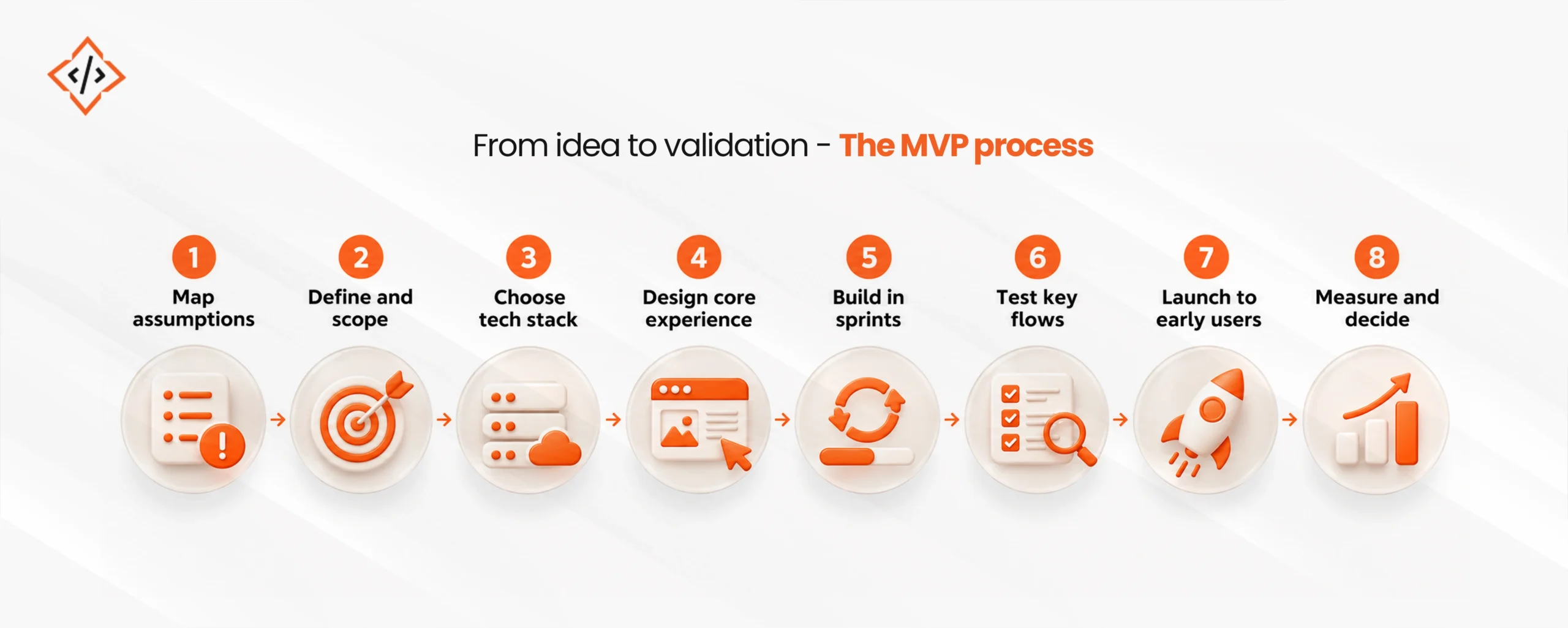
A structured process keeps an MVP focused. Although timelines vary, most successful builds follow the same sequence.
- Assumption mapping: List every belief the business depends on, then rank each by risk. The riskiest becomes the MVP’s purpose.
- Discovery and scoping: Define the target user, the core workflow, and the smallest feature set that tests the assumption.
- Architecture and stack: Choose technology that supports the current build and future growth, such as a modular backend on scalable cloud infrastructure.
- UX for the core path: Design only the screens a user needs to complete the main task.
- Sprint-based build: Ship working increments every one or two weeks, so stakeholders review real software instead of status reports.
- QA on critical flows: Test the main journey thoroughly, since a broken core flow corrupts validation data.
- Controlled launch: Release to a defined early group rather than the open market.
- Measure and decide: Compare results against success criteria, then choose to scale, pivot, or stop.
For most startups, a focused MVP takes eight to sixteen weeks from discovery to launch. Products with compliance needs or multiple user roles take longer.


How to keep MVP scope small
Scope creep is the most common reason MVPs miss deadlines and budgets. Founders add “one more feature” because each request sounds reasonable in isolation. Added together, though, those requests push back the one thing the MVP exists to collect: feedback from real users.
Two habits keep scope in check:
- Feature-to-assumption mapping: Every feature must link to the assumption under test. Otherwise, it moves to the post-launch backlog.
- Prioritization frameworks: Methods such as MoSCoW or RICE give teams a shared, documented reason for each inclusion.
Holding that line is what keeps custom MVP development lean. Otherwise, an MVP that grows before it validates spends runway on features nobody has asked for yet.
MVP testing and validation
Testing an MVP differs from testing a finished product. The goal is to learn whether the core assumption holds, and bug hunting comes second to that.
Before launch, set measurable success and kill criteria. Writing these down early prevents teams from reshaping the story after results arrive. Useful signals include:
- Activation rate: The share of new users who complete the core action at least once.
- Retention: How many users return after the first week and the first month.
- Willingness to pay: Pre-orders, paid pilots, or letters of intent from target customers.
- Qualitative feedback: Short interviews that explain why users behaved the way they did.
A weak result does not automatically mean a failed idea. More often, it points to the wrong audience or a confusing onboarding flow, and a second, smaller iteration can fix both.
Building AI into an MVP
AI has changed what an MVP can test.
Recommendations, document processing, and conversational support can now be validated early by calling existing foundation models instead of training new ones. Investors have followed the shift.
According to the PitchBook-NVCA Venture Monitor for Q2 2026, AI accounted for 86% of the $412.7 billion in U.S. venture capital deployed in the first half of 2026.
Similarly, Carta’s Q1 2026 data shows that more than 60% of venture capital raised by companies on its platform went to AI companies.
Still, AI features need specific planning:
- Model choice: Start with hosted APIs for speed, then evaluate fine-tuned or open-source models once usage justifies the cost.
- Data readiness: Confirm that the data needed for quality output exists and can be used legally.
- Output evaluation: Define how accuracy will be measured, since AI responses can sound correct while being wrong.
- Cost control: Track per-request usage costs from day one, because they grow directly with adoption.
Startups planning AI-driven products benefit from a team that offers AI development services alongside product engineering, so model decisions and application architecture stay aligned.
What drives MVP development cost
There is no honest single figure for MVP development cost. Two products with the same label can differ widely in price, depending on what sits inside them.
However, the main cost drivers are:
- Feature scope: Each additional user role, workflow, or dashboard adds design, build, and testing time.
- Platform choice: Web MVPs usually cost less than native mobile apps, while cross-platform frameworks such as Flutter narrow the gap.
- Integrations: Payments, CRMs, and third-party APIs add development and QA effort.
- Compliance: Healthtech and fintech products need security reviews, audit trails, and data residency controls from the start.
- Engagement model: Fixed-price contracts suit clearly defined scope, whereas time-and-materials suits products that will evolve through feedback.
The most reliable estimate comes from a short paid discovery phase. It produces a defined scope, a feature list, and an architecture plan, which make quotes comparable across vendors.
Scalable MVP development: avoiding the costly rewrite
Many startups validate quickly and then discover their MVP cannot handle growth. Rebuilding at that stage burns the runway the MVP was meant to protect. Scalable MVP development avoids this through a few early decisions:
- Modular architecture: Clean module boundaries let teams extend features without breaking others.
- Cloud-native setup: Managed databases and auto-scaling infrastructure absorb traffic spikes without manual work.
- Clean API layer: A documented API allows a web app, a mobile app, and partner integrations to share one backend.
- Code ownership: The startup should own the repository, infrastructure accounts, and documentation from the first commit.
That last point is often overlooked in startup product development. Before signing, confirm that intellectual property, source code, and cloud credentials transfer fully to the startup.
How to choose an MVP software development company
A strong partner does more than write code to a specification.
In practice, the best MVP development services teams push back on scope, ask about business goals, and plan for life after launch.
When comparing partners, look for:
- Product thinking: The team challenges features that do not serve the core assumption.
- Relevant experience: Case studies in a similar domain, user type, or technical stack.
- Transparent delivery: Regular demos of working software and direct access to developers.
- Process maturity: Documented delivery and QA practices that hold up when deadlines get tight.
- Post-launch support: A clear path from MVP to full product, including scaling and maintenance.
CodeTrade’s MVP development services cover the full path from first build to scale, backed by 180+ engineers and CMMI Level 3 processes:
- Web and mobile MVPs: Core user flows for web apps and iOS or Android apps, built with frameworks such as React, Flutter, and React Native.
- SaaS MVPs: Multi-tenancy foundations and subscription workflows, ready for the first paying customers.
- API and backend MVPs: Infrastructure designed to handle early traffic without a rewrite at scale.
- Prototyping and validation: Interactive prototypes that test core assumptions before the full build begins.
- Post-MVP iteration: Real usage data guides the next development cycle once the product is live.
Startups can choose project-based, time-and-materials, or resource-based engagement, depending on how defined the scope is.
Conclusion
Custom MVP development gives startups a disciplined way to test their riskiest assumption with real users before committing the full budget.
When scope stays tight, validation criteria are set in advance, and the architecture is ready to scale, the MVP becomes the base the full product grows from.
For founders, this is the practical value of MVP development for startups: each next decision rests on what real users did.
FAQs