Recently Added

Summarize with AI





What Are The Angular 22 New Features And How Will They Impact Your Architecture?
Key Takeaways:
- The Angular 22 new features finally stabilize long-awaited reactive APIs, eliminating experimental status for Signal Forms and Resource APIs.
- OnPush is now the default change detection strategy, drastically improving rendering efficiency for custom Angular development.
- Zoneless architecture is fully stable, allowing developers to remove the Zone.js dependency entirely for faster application bootstrapping.
- New Angular 22 AI features introduce WebMCP support, enabling AI agents to interact directly with browser-based forms and applications.
- An Angular 22 migration requires auditing existing components to ensure compatibility with the new Eager fallback strategy for legacy code.
Introduction
The June 2026 Angular 22 release is a critical consolidation update that finalizes years of experimental features. The era of relying heavily on Zone.js and complex reactive form boilerplates is officially over. This update shifts the framework firmly into a signal-first architecture. It permanently changes the default rendering behaviors that any Angular development company has relied on for years.
A recent Gartner report predicts that 40% of enterprise applications will integrate task-specific AI agents by late 2026. Since modern platforms demand smarter capabilities, mastering these Angular 22 new features is non-negotiable for engineering teams.
Technical architects leading custom Angular development must adapt to these standard shifts to prevent severe technical decay. The following sections provide a clear breakdown of the core changes, practical migration requirements, and immediate performance benefits.
What Is Angular 22?
Angular 22 is the latest major framework release from Google. It explicitly focuses on production-stable reactivity instead of experimental developer tools. This version graduates several highly anticipated preview tools into fully supported enterprise standards. These essential upgrades include the Signals API and incremental hydration mechanisms.
This update sets a critical new baseline for Angular application development. It prioritizes precision rendering updates and native performance over heavy background checking loops. A recent Gartner report predicts that 80% of large software engineering organizations will establish platform engineering teams by 2026.
These dedicated teams require highly reliable frontend architectures to deliver reusable application components. The Angular 22 release perfectly supports this modernization trend. It offers the stable architectural blocks necessary for building internal developer platforms.
The framework introduces several foundational shifts to simplify workflows.
- The system replaces the November 2025 Angular 21 version to strictly maintain Google’s established six-month release cadence.
- Core APIs abandon temporary preview states to ensure that technical teams can confidently adopt signal-based patterns.
- Automatic DOM optimization shifts the rendering burden away from developers to minimize unnecessary delays during complex user interactions.
This version guarantees that Angular 22 enterprise development remains fast, scalable, and fully prepared for modern frontend demands.
Why Do Angular 22 Updates Matter?
These crucial Angular 22 updates rewrite the core rules for frontend component rendering and state management. The development community can finally abandon older methods of building forms and tracking state. Legacy approaches now feel noticeably slower and far more verbose compared to modern reactivity standards.
According to a McKinsey study, companies that actively manage technical debt achieve 20% faster revenue growth than those that ignore it. This specific framework update directly helps reduce that legacy burden by drastically simplifying the daily developer experience.
Ignoring this major version means missing out on free performance gains that modern enterprise applications require. Teams planning their Angular 22 upgrade will immediately benefit from the following structural improvements.
- Significant bundle size reductions by eliminating the Zone.js dependency entirely.
- Faster browser interactivity times for complex, data-heavy user interfaces.
- Streamlined component logic that reduces the risk of memory leaks and rendering loops.


What Are The Angular 22 New Features?
The Angular 22 new features strictly focus on performance defaults, AI integrations, and reactive state stability. The development team prioritized making the application faster by default. This eliminates the need for developers to write manual optimization logic. Framework defaults now actively protect applications from common performance bottlenecks.
The ecosystem officially shifts away from Karma testing entirely. It now fully integrates Vitest as the high-speed testing standard.
A 2026 Forrester report notes that modernizing software development lifecycles can improve overall coding efficiency by up to 40% (Forrester). This testing migration alone drastically reduces local execution times. Developers get immediate feedback when writing complex component logic. These core changes completely redefine how engineering teams approach custom Angular development.
Enterprise teams require predictable release cycles and highly stable APIs. This version delivers on those exact requirements by finalizing long-pending tools. It removes the guesswork from architecting modern frontend solutions. The following subsections detail each major technical capability.
Signal Forms Stabilize
Typed, signal-based form models are now fully stable and ready for production use. They officially replace the verbose RxJS-based Reactive Forms approach. This eliminates the absolute need for manual observable subscriptions. It also removes the requirement to write constant, complex pipe chains.
This architectural shift reduces boilerplate code significantly across the entire application. It simultaneously improves type safety across complex data entry interfaces. Developers can now manage state changes directly within the form structure. This creates a highly predictable flow for user inputs.
Teams will notice fewer memory leaks caused by abandoned subscriptions. Form validation logic becomes much easier to read and maintain. The signals automatically track dependencies and update validation states synchronously. This is highly beneficial for large forms with deep nesting.
Engineering managers often struggle with onboarding new developers to complex RxJS patterns. Signal forms lower this barrier to entry dramatically. The logic flows linearly rather than through tangled asynchronous streams. This modernization prepares repositories for long-term scalability.
OnPush Change Detection
Angular 22 automatically applies the OnPush change detection strategy to all new components. This modernizes the framework by replacing the legacy “check always” behavior entirely. The framework now only updates the DOM when a specific, bound signal changes. It no longer checks the entire component tree on every single browser event.
This hyper-targeted rendering drastically lowers the computational overhead for complex interfaces. A recent 2026 Forrester study indicates that companies migrating to signal-based architectures observe a 40% reduction in browser rendering delays. Pages simply react faster to user inputs. This creates a substantially smoother experience for the end user.
Defaulting to OnPush prevents newly generated code from accidentally degrading application performance. It enforces strict data flow boundaries between parent and child components. Developers are guided toward better architectural decisions by default. The UI remains highly responsive even during heavy data processing tasks.
Zoneless Architecture Default
Applications can now run entirely without Zone.js. The much-anticipated zoneless architecture is officially stable. Removing this heavy dependency strips out a massive layer of background processing overhead. This directly leads to faster initial application load times.
It also results in significantly cleaner asynchronous debugging for technical teams. Stack traces are no longer buried under endless Zone.js wrapper functions. Developers can finally trace execution paths clearly within the browser console. This structural change specifically benefits content-heavy applications where rapid user interaction is critical.
The browser spends less time polling for changes and more time rendering visual data. Third-party library integration also becomes much simpler. Developers do not have to worry about external scripts triggering unnecessary change detection cycles. This isolation creates a more secure and predictable execution environment.
Teams upgrading older repositories will notice immediate memory usage improvements. The garbage collector works more efficiently without the constant object creation tied to zones. This marks a massive leap forward for mobile web performance.
Agentic AI Tooling
The Angular 22 AI features introduce native support for the Model Context Protocol (WebMCP). This powerful capability transforms standard web applications into intelligent, context-aware environments. AI agents can now read application context and interact with forms directly.
This creates seamless pathways for AI-powered application development. Agents can dynamically map form fields and execute actions without complex middleware. Research from IDC in 2025 shows that AI-assisted workflows decrease boilerplate code generation time by up to 35% (IDC). This protocol integration makes building these intelligent agents highly efficient.
Developers can expose specific application states securely to external AI models. The framework provides strict boundaries to prevent unauthorized DOM manipulation. This ensures that agentic interactions remain safe and predictable. It represents a massive shift in how users interact with software.
Instead of navigating complex menus, users can delegate tasks to an embedded assistant. The assistant understands the exact state of the frontend structure. It can fill forms, submit data, and navigate routes programmatically. This defines the future of intelligent enterprise interfaces.
Resource APIs Unified
The httpResource and rxResource APIs have officially graduated from their experimental status. These tools integrate asynchronous data fetching natively into the Signals ecosystem. They provide a standardized way to request and handle server data.
This simplifies how developers manage loading states and error catching. It also streamlines how applications process data streaming from external servers. Engineering teams no longer need third-party state management libraries just to track HTTP requests. The framework handles the entire lifecycle predictably.
These APIs automatically cancel pending requests when a component is destroyed. This prevents race conditions and eliminates a common source of frontend bugs. The syntax is clean and highly intuitive for modern developers. It maps perfectly to backend microservice architectures.
Caching strategies are also much easier to implement using these native tools. Developers can share resource states across multiple components effortlessly. This reduces redundant network calls and saves valuable bandwidth. It is a critical update for building resilient enterprise platforms.
How To Plan An Angular 22 Migration?
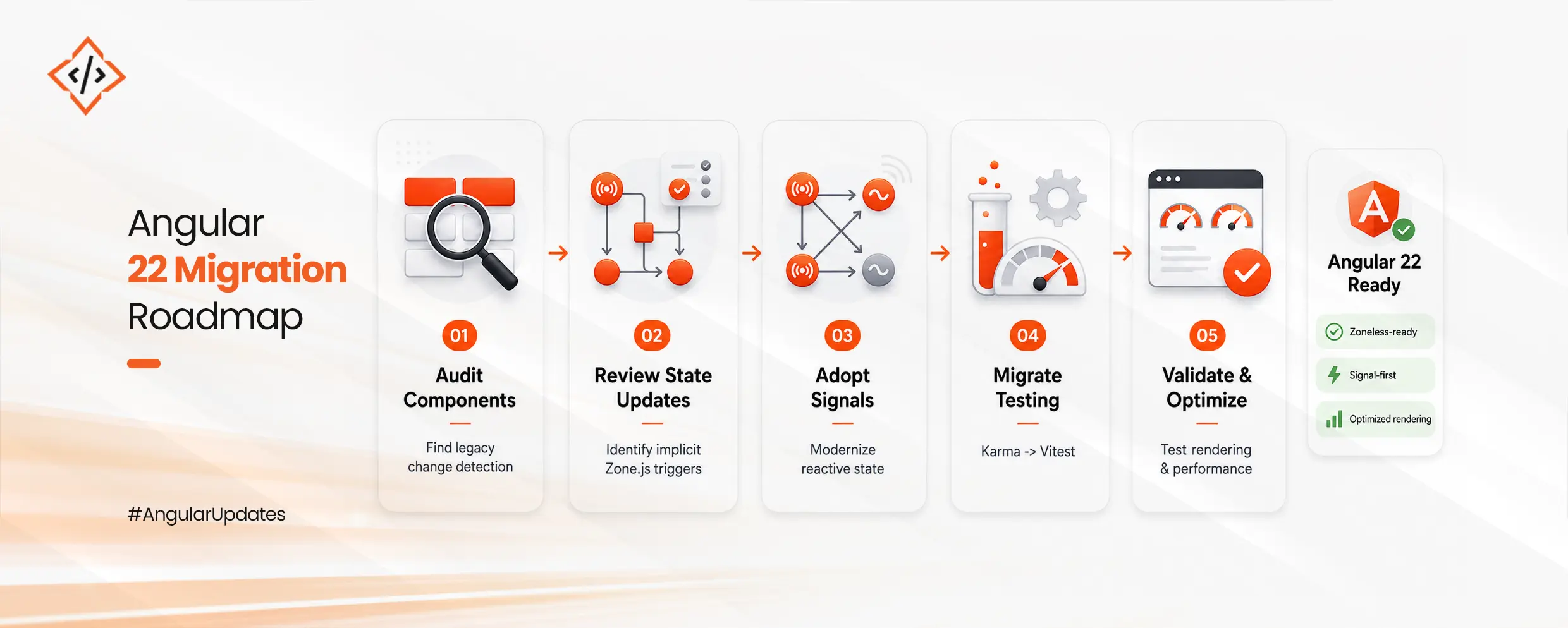
An Angular 22 migration requires intentional staging, especially for enterprise applications running on Angular 19 or older. The update process is largely automated through official CLI commands. However, manual refactoring remains essential for test suites and component change detection logic.
Teams must audit codebases early to uncover implicit Zone.js triggers. To prevent breaking changes, the Angular 22 upgrade script automatically applies an Eager change detection fallback to legacy components.
Audit Existing Components
Reviewing components that lack explicit change detection declarations is a vital first step. Legacy code often relies on automatic change checks triggered by background DOM events. In Angular 22, components must explicitly communicate state changes through signals or observable streams.
Developers should scan the repository for hidden side effects, asynchronous mutation routines, and direct property assignments. Updating these areas ensures that the application operates reliably under strict OnPush defaults. It also eliminates the risk of silent rendering failures during user workflows. Establishing these boundaries early prevents unexpected UI freezes after deployment.
Migrate Test Runners
Karma is now entirely deprecated and replaced by Vitest as the default framework runner. Engineering teams must run the provided CLI schematics to translate their existing test configurations. Vitest provides instant module reloading and parallel execution out of the box.
This shift significantly reduces local test execution times across large enterprise repositories. Developers no longer have to wait for heavy browser instances to launch during unit testing cycles. Upgrading the testing suite also simplifies continuous integration pipelines by lowering memory consumption and eliminating flaky test runs.
Conclusion
Angular 22 marks a major structural milestone that modernizes how frontend logic is written and executed. Engineering teams should immediately audit their repositories against the new OnPush defaults and Vitest testing environments. Technical leads must prioritize the adoption of Signal Forms to future-proof their web applications against long-term technical debt.
Modern digital platforms are rapidly shifting toward autonomous agent interactions, and these reactive updates ensure your architecture remains fully competitive.
Executing this architectural transition requires deliberate planning, especially when you hire Angular developers to manage complex legacy dependencies across large repositories. Bridging the gap between older components and modern signal reactivity demands dedicated technical precision.
CodeTrade provides specialized engineering support for high-stakes Angular 22 enterprise development. Our seasoned architects build custom Angular development roadmaps that modernize systems without disrupting active business operations. We partner with technical leadership to deliver high-performance frontend architectures that scale reliably over time.