






AI
 Chand Prakash
24 November 2026
Multi-Agent AI Systems: Architecture, Use Cases, Costs, and Implementation
 Chand Prakash

A doctor reviewing a patient’s medical history may need to go through several reports before deciding on the next course of action. Meanwhile, the hospital’s administrative team is handling appointment requests, updating patient records, and processing insurance documents. Each department has its own workload, and much of it involves information that needs to be collected, reviewed, or entered manually.
Healthcare organizations are looking at AI to reduce some of this workload and help professionals make better use of the information they already have.
For instance, an AI application can help radiologists flag unusual patterns in medical images, assist doctors with clinical documentation, or help hospital administrators predict patient admission volumes. The applications vary, and so do the technical requirements behind them.
However, healthcare is a particularly demanding environment for AI development. Patient information needs protection, clinical applications require careful testing, and software intended for medical use may fall under specific regulatory requirements.
For healthcare businesses considering AI adoption, the questions usually go beyond what the technology can do. They also need to understand what it takes to develop an application, how it will work with existing hospital systems, what it will cost, and which compliance requirements apply.
This guide covers these considerations, along with practical use cases of AI Development Services for Healthcare. As Artificial Intelligence in Healthcare becomes part of technology planning, organizations need to assess where it can support existing teams and where human review remains essential. Healthcare AI Development Services can help translate those requirements into applications that fit the organization’s clinical and operational environment.
AI applications in healthcare cover clinical work, patient services, and hospital administration. Some help doctors review information, while others take care of tasks that keep hospital operations running. The range of AI in Healthcare continues to expand, but each application needs to be assessed against its intended use and the people relying on its outputs.
Here are seven areas where healthcare organizations can consider using AI.
Radiologists review medical images to identify abnormalities and determine whether further examination is needed. Depending on the number of scans a hospital receives, reviewing them can take considerable time.
AI applications using computer vision and deep learning can examine medical images and flag patterns that may need a closer look.
For example, an application trained on suitable X-ray datasets may identify areas associated with certain lung conditions and bring them to a radiologist’s attention.
This is one of the common applications of AI in Medical Diagnosis. Similar systems are being developed for CT scans, MRIs, mammograms, and retinal images.
The application needs to be tested against appropriate clinical datasets and evaluated for false positives and false negatives. A radiologist should review its findings and make the clinical decision.
Hospitals collect information about previous admissions, diagnoses, laboratory results, medications, and treatment histories. Machine learning models can examine this information to identify patterns associated with potential health risks.
Healthcare Predictive Analytics can help organizations develop applications for:
Consider a hospital that wants to reduce avoidable readmissions. An AI model can examine relevant historical patient data and flag individuals who may need additional attention after discharge.
The care team can review these predictions and decide whether a patient needs further follow-up. The model provides information for consideration, rather than making the decision independently.
Two patients with the same diagnosis may have different medical histories, treatment responses, and follow-up requirements. Healthcare professionals need to consider these differences when planning care.
AI can help organize patient information and identify patterns that may be useful when reviewing individual cases.
Applications supporting AI-Powered Patient Care may include personalized health reminders, follow-up recommendations, patient monitoring, and tools that help doctors review relevant medical histories.
For example, an application connected to a patient’s wearable device can collect selected health measurements. If a reading crosses a predefined threshold, the system can notify the relevant care team.
The application needs clear rules for handling alerts. Patients should also know how their information is collected and used.
Doctors spend a significant part of their working day recording consultations, updating patient records, preparing reports, and documenting treatment decisions.
Speech recognition and natural language processing can help reduce some of this administrative work.
An AI-powered documentation tool can convert a consultation recording into a draft clinical note. It may also organize information under headings such as symptoms, medical history, examination findings, and treatment plans.
For example, a doctor can review a draft note generated from a patient consultation, correct any errors, and approve it before adding it to the medical record.
This is one area of Healthcare Automation Using AI where organizations can reduce repetitive documentation work. However, the application needs to handle medical terminology accurately, protect consultation data, and allow clinicians to review the generated content.
Hospital reception and support teams receive a large number of routine enquiries. Patients may want to book appointments, check consultation timings, understand preparation instructions, or find the right department.
A virtual assistant can handle some of these requests through a website, mobile application, or messaging interface.
Depending on its functionality, it can:
Generative AI can also help these assistants understand questions phrased in everyday language.
There should be clear limits on what the assistant can answer. Questions involving symptoms, diagnosis, medication changes, or urgent medical concerns may need to be transferred to a qualified professional.
Hospital operations involve coordinating staff, beds, equipment, appointments, and supplies. Poor planning can affect waiting times and the availability of resources.
AI can analyze historical operational data to help administrators plan these activities.
For example, a hospital may use past appointment records to estimate when patient no-shows are more likely. The administration team can use this information when planning appointment slots.
Similar applications can support staff scheduling, inventory forecasting, and resource allocation.
Doctors, researchers, and hospital staff often need to find information across large collections of clinical guidelines, research papers, internal documents, and institutional policies.
Generative AI in Healthcare can support this work through applications that retrieve relevant information and prepare summaries.
One approach is retrieval-augmented generation (RAG). The application searches an approved collection of documents, retrieves relevant passages, and uses them to prepare a response.
For example, hospital employees could ask an internal assistant about a particular administrative procedure and receive an answer based on the hospital’s approved documentation.
The application should provide access to its source material, respect document permissions, and make it easy to verify the response. Generative AI can still produce inaccurate information, so clinical use requires appropriate review.
The development requirements depend on what the application is expected to do. A patient-facing appointment assistant has different technical and regulatory considerations from software that analyzes medical images. AI Software Development for Healthcare also needs to account for clinical workflows, patient data protection, system interoperability, and the level of oversight required after deployment.
Most projects involve the following stages. Healthcare AI Implementation should be planned around the application’s users, data sources, integration needs, validation requirements, and deployment environment.
Start with the problem the organization wants to address.
For example, does the hospital want to reduce documentation time, improve the review of medical images, predict patient admission volumes, or automate appointment management?
The development team should understand who will use the application, what information it needs, and what the expected outcome looks like.
AI applications depend on the quality and suitability of their data.
Depending on the use case, the data may include electronic health records, medical images, laboratory results, consultation notes, or information from connected devices.
Before development begins, the team needs to check where the information is stored, whether it can legally be used for the intended purpose, and whether it is complete enough for the project.
Patient information also needs appropriate protection during collection, preparation, storage, and processing.
Different applications require different AI approaches. Healthcare AI Applications may use different models and technologies depending on whether they support clinical review, patient communication, or administrative work.
Computer vision is commonly used for medical image analysis. NLP can process clinical notes and other text-based information. Machine learning can support predictive applications, while generative AI can help with document retrieval and summarization.
Healthcare Machine Learning Solutions should be selected according to the problem, available data, and required level of accuracy.
Using a more complex model does not automatically make an application better. The development team should be able to explain why its chosen approach is suitable.
Once the data and technology are ready, the team can train, configure, or fine-tune the model.
Testing should cover more than overall accuracy. Depending on the application, the team may need to measure sensitivity, specificity, false positives, false negatives, and performance across different patient groups.
Clinical applications also need evaluation against the conditions in which they will be used. A model tested on one dataset may perform differently when introduced into another hospital or patient population.
Healthcare organizations may already use electronic health records (EHRs), hospital information systems (HIS), laboratory software, pharmacy applications, and patient portals.
The AI application may need to exchange information with several of these systems.
Developers can use APIs and healthcare interoperability standards such as HL7 and FHIR, depending on the existing software and integration requirements.
Access permissions and data flows should be planned before integration work begins.
After testing and approval, the application can be deployed in its intended environment.
The team should monitor system performance, access activity, model outputs, and unexpected errors. Models may also need evaluation when patient populations, clinical practices, or incoming data change.
For applications that support clinical decisions, there should be a clear process for reviewing questionable outputs and reporting problems.
The AI Development Cost for Healthcare varies according to the application’s functionality, data requirements, integrations, and testing needs. The cost of Healthcare AI Solutions can also differ based on the level of clinical validation, security controls, and system interoperability required.
A virtual assistant that answers routine hospital enquiries will generally involve less development work than an AI application that analyzes medical images or supports clinical decision-making.
Here are the main factors that affect the budget.
Before requesting a project estimate, define the application’s purpose, expected users, data sources, integrations, and deployment environment.
Keep initial development expenses separate from recurring costs such as hosting, AI API usage, infrastructure, and maintenance. This will give the organization a clearer picture of the investment involved.
A healthcare AI application may process patient records, medical images, consultation transcripts, and other sensitive information. If the application supports diagnosis or treatment decisions, additional regulatory considerations may apply. Healthcare AI Compliance should be considered from the start, rather than treated as a final review before launch.
The requirements depend on where the application will be used, the type of information it handles, and its intended purpose.
In the United States, the Health Insurance Portability and Accountability Act (HIPAA) establishes requirements for protecting certain health information.
Covered entities and their business associates must follow the applicable HIPAA requirements when handling protected health information.
For developers working on HIPAA-Compliant AI Solutions, the project should account for:
The US Department of Health and Human Services (HHS) explains that cloud service providers handling electronic protected health information may qualify as business associates, even when the information is encrypted and the provider cannot access its contents.
A healthcare application does not automatically become HIPAA-compliant because it uses a particular AI model or cloud provider. The organization needs to review the complete process, including data collection, storage, processing, access, and sharing.
In the United States, the Food and Drug Administration (FDA) regulates certain software functions that meet the definition of a medical device.
An AI application intended to diagnose a condition, support treatment decisions, or perform another regulated medical function may fall under FDA requirements.
Depending on its classification, the product may need to follow a regulatory pathway such as 510(k) clearance, De Novo classification, or Premarket Approval.
The FDA also addresses lifecycle management for AI-enabled medical devices. Developers may need to document intended use, evaluate model performance, manage changes, and provide evidence supporting the product’s safety and effectiveness.
Not every healthcare AI application is a medical device. The intended purpose and functionality need to be assessed before deciding which requirements apply.
Organizations processing personal information belonging to individuals in the European Union need to consider the General Data Protection Regulation (GDPR).
Health information is classified as special category personal data under GDPR. Its processing is subject to additional conditions.
Healthcare applications should account for:
Organizations should also review how external AI providers store, process, and retain patient information.
The EU AI Act introduces additional requirements for certain AI systems classified as high-risk.
Some AI systems used in medical devices may fall within this category, depending on their intended purpose and the applicable medical device legislation. AI-Powered Healthcare Solutions that influence clinical decisions may therefore need more extensive risk assessment and oversight than applications limited to administrative support.
Requirements can include risk management, data governance, technical documentation, record-keeping, human oversight, accuracy, and cybersecurity.
Under the current EU AI Act implementation timeline, the relevant high-risk requirements for AI systems embedded in regulated products are scheduled to apply from August 2, 2028.
Healthcare organizations should assess the intended use and classification of their applications early in the project. This helps the development team account for regulatory requirements while planning the software.
Compliance documentation is one part of the project. The application also needs to work reliably in the environment where doctors, nurses, and administrative employees will use it.
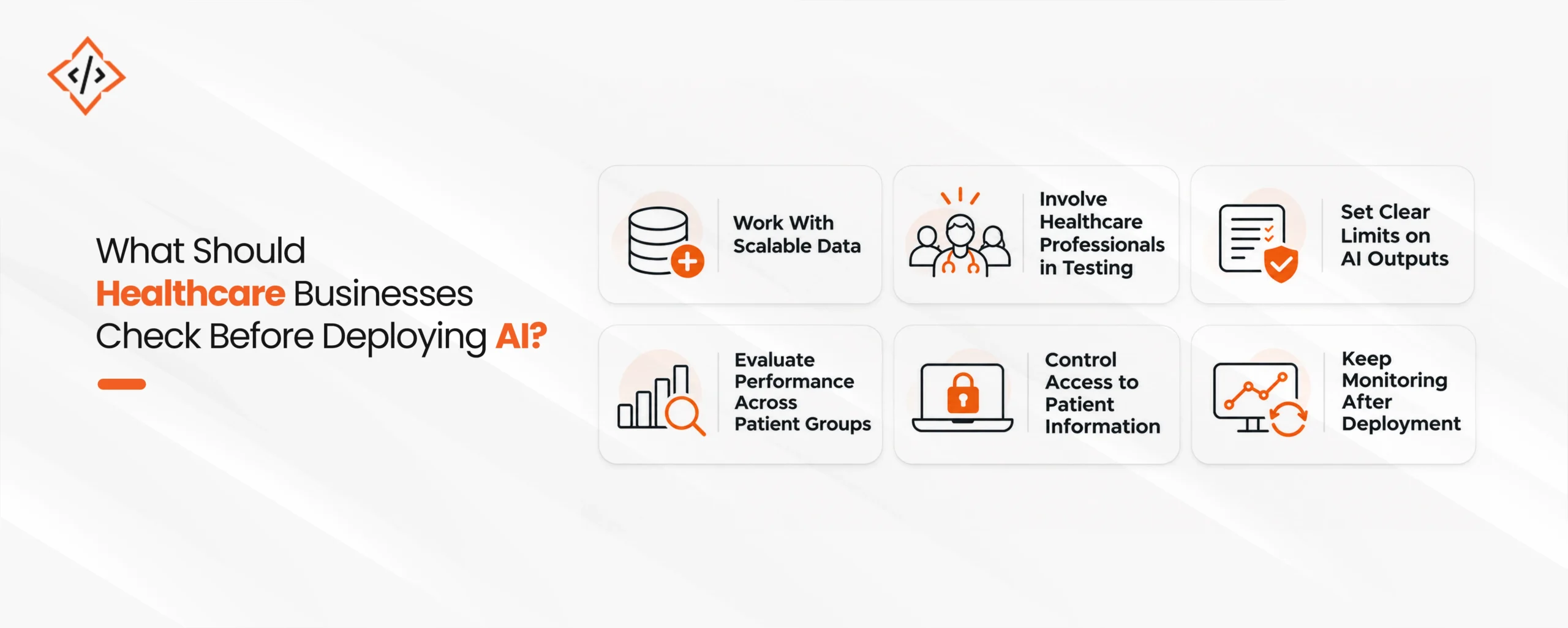
A few practices deserve attention during development and deployment.
The model needs data that represents the people and conditions it is intended to support. If the training dataset excludes certain patient groups, the application may perform poorly for those groups.
Doctors, nurses, and other healthcare professionals should review the application during development. They understand the clinical workflow and can identify problems that may not be apparent to the engineering team.
Applications that produce recommendations, summaries, or predictions should have defined boundaries. Clinical decisions need appropriate professional oversight, particularly when incorrect information could affect patient safety.
Check for false positives, false negatives, and differences in model performance across relevant populations. Testing should reflect the application’s intended use and operating conditions.
Use encryption, authentication, role-based permissions, and audit logging. Review the data practices of third-party AI providers before sending patient information to their services.
Track model performance and investigate unexpected outputs. Changes in incoming data or clinical practices can affect how well a model performs over time.
A healthcare AI project involves software engineering, data management, integrations, and regulatory considerations. Before selecting a development partner, businesses should understand what the team can handle and how it approaches the work.
Here are six areas worth discussing.
A development partner should also be clear about the work it can take responsibility for and where specialist clinical, legal, or regulatory advice may be needed.
Healthcare organizations may have different reasons for investing in AI. A hospital may want to automate documentation, while a healthcare technology company may be developing a patient-facing application or a diagnostic support tool.
CodeTrade provides AI development and healthcare software development services for businesses working on these requirements. Its work can support Healthcare AI Solutions across clinical, patient-facing, and operational use cases, depending on the project scope.
Its healthcare technology capabilities include applications for clinical decision support, medical image analysis, predictive analytics, automated documentation, and virtual health assistants.
The development team works with machine learning, deep learning, computer vision, NLP, and generative AI, depending on the application.
For organizations with requirements that existing healthcare platforms cannot fully address, Custom AI Solutions for Healthcare can be developed around specific workflows and technical needs.
CodeTrade’s AI capabilities also cover data engineering, custom AI agents, RAG-based applications, predictive AI, and AI-powered automation.
You can explore CodeTrade’s Healthcare Solutions to learn more about its healthcare technology capabilities.
If you are planning a new AI application or need engineering support for an existing project, visit CodeTrade’s AI Development Services page.
Healthcare organizations have several opportunities to use AI, from reviewing medical images and identifying patient risks to handling documentation and managing hospital resources.
The right application depends on the problem, the information available, and the people who will use the software. A hospital introducing an AI documentation tool will have different development and compliance requirements from an organization building software that supports medical diagnosis.
Businesses should assess these requirements before selecting a technology or starting development. Data quality, system integration, patient privacy, clinical validation, and applicable regulations all need attention during the project.
CodeTrade can help businesses assess their requirements and develop AI applications suited to their healthcare operations.
 Chand Prakash
 Chand Prakash
 Chand Prakash
 Chand Prakash
 Chand Prakash