







AI
eCommerce & Retail
 Chand Prakash
21 August 2026
Chand Prakash
21 August 2026
How AI in Ecommerce Helps Retailers Drive More Sales and Conversions?
 Chand Prakash
Key Takeaways:
Generative AI production fails when engineering teams select the wrong customization technique for their data architecture. Moving an AI project from pilot to deployment with an experienced AI development company in USA requires strict governance over model knowledge and output behavior. Choosing between RAG vs fine-tuning is a core architectural decision that directly impacts your cloud infrastructure.
According to a 2026 Gartner report, worldwide end-user spending on AI models and platforms will reach $64 billion as technical teams prioritize usage efficiency. Despite this massive investment, the fine-tuning vs RAG cost debate still stalls many technical leaders. This guide breaks down exactly where RAG implementation makes the most sense for complex enterprise systems.
It also details the specific scenarios where teams must commit to permanently altering a foundation model. Engineering leaders can use this breakdown to make the right infrastructural choice for RAG vs fine-tuning for production.
Retrieval Augmented Generation updates what your model knows, while AI model fine-tuning permanently alters how it natively behaves.
| Comparison Point | Retrieval Augmented Generation (RAG) | AI Model Fine-Tuning |
|---|---|---|
| Core Mechanism | Acts as an external knowledge pipeline to supply facts. | Acts as an internal structural change to the system. |
| Knowledge Processing | Queries a secure vector database for relevant documents. | Adjusts the internal weights of a large language model. |
| Execution Timing | Injects retrieved facts into the prompt at runtime. | Learns from high-quality examples long before live deployment. |
| Model Architecture | Leaves the underlying foundation model completely untouched. | Permanently alters the foundational neural network parameters. |
| Data Dependency | Relies on the dynamic orchestration of external databases. | Requires hundreds or thousands of domain-specific training examples. |
| Information Freshness | Reflects data updates instantly when the database changes. | Requires a complete model retraining cycle to learn new facts. |
| Behavioral Impact | Uses the default tone and reasoning of the base model. | Natively changes how the model processes specialized logic tasks. |
| Hallucination Mitigation | Forces the model to cite retrieved external factual sources. | Deepens contextual understanding to reduce structural formatting errors. |
| Infrastructure Needs | Requires vector storage setup and retrieval pipeline management. | Demands intensive GPU compute resources and manually labeled datasets. |
| Primary Advantage | Solves strict data privacy and real-time knowledge gaps. | Solves rigid output formatting and brand tone consistency requirements. |
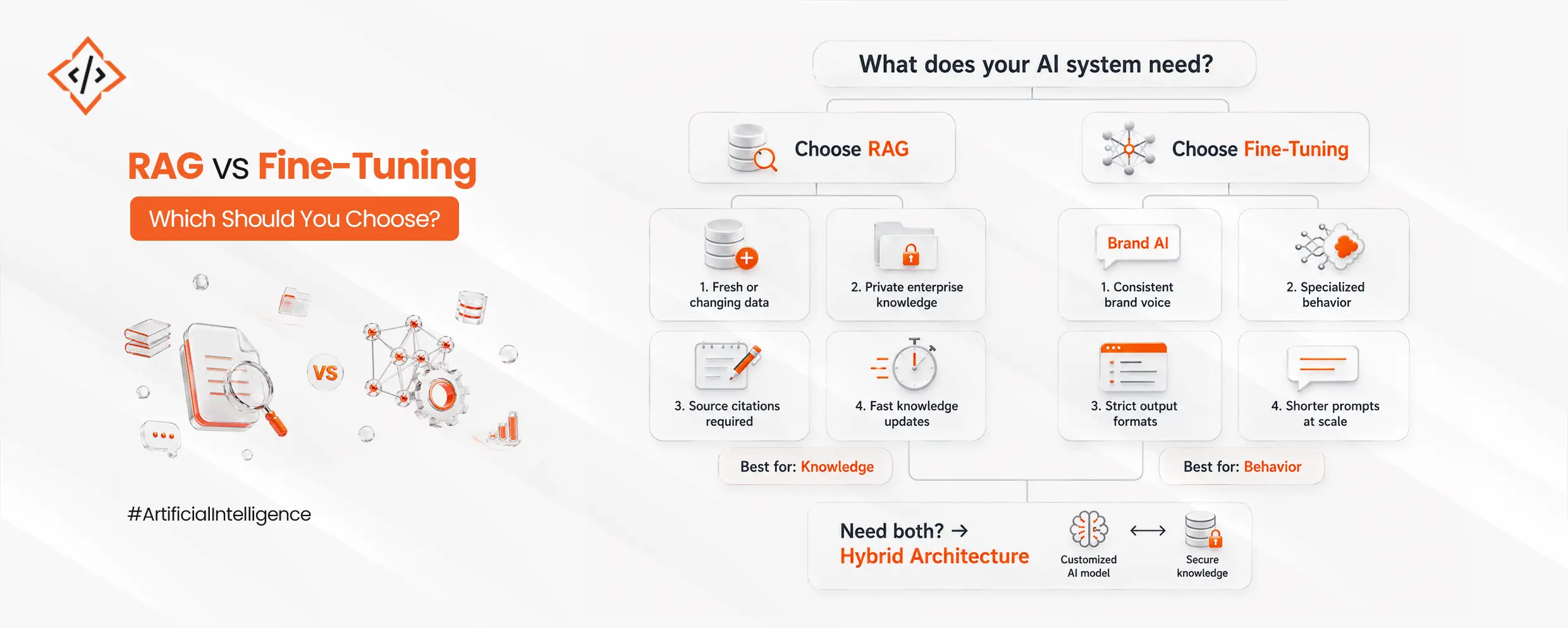
RAG implementation is the default enterprise choice when factual accuracy, data privacy, and immediate knowledge updates are strictly non-negotiable. This framework keeps all proprietary data safely inside your enterprise boundary. It completely avoids the heavy upfront compute costs associated with foundation model training. Instead of changing the model itself, this pipeline dynamically supplies external facts to ground the generated response.
According to a 2026 McKinsey report, 67 percent of production LLM deployments now use some form of retrieval augmentation. This massive shift proves that engineering teams prioritize secure, auditable knowledge over expensive architectural rebuilds. For leaders evaluating RAG vs fine-tuning AI, retrieval systems offer immediate return on investment by maximizing current data utility.
The primary advantage of retrieval systems is immediate data freshness. If your product catalogs or internal compliance policies change daily, RAG handles these updates effortlessly. A customized model would require continuous, expensive retraining to learn these new facts. Retrieval Augmented Generation vs fine-tuning ensures that rapid business changes never break your AI infrastructure.
RAG systems excel at hallucination mitigation through strict source grounding. This framework forces the generative model to cite specific internal documents for every claim it makes. Human operators can then verify the exact source of truth behind every generated answer. When analyzing RAG vs fine-tuning for production, verifiable traceability is often the deciding factor for enterprise teams.
AI model fine-tuning becomes mandatory when enterprise applications demand specialized reasoning, extremely low latency, and zero deviation in output formatting. Cramming complex behavioral rules into a prompt via a retrieval pipeline slows down response times significantly.
According to a 2026 Deloitte enterprise AI report, worker access to AI rose by 50% as organizations push to scale production workloads and eliminate operational bottlenecks. A natively trained model operates much more efficiently for rigid tasks because the behavioral logic is baked directly into its weights. For engineering leaders comparing RAG vs fine-tuning for production, understanding these rigid operational thresholds is critical.
Brand voice consistency requires deep structural alignment that standard prompt engineering cannot reliably maintain at scale. Customer support bots or marketing automation tools perform much better when the system inherently understands specific vocabulary. The model must naturally grasp the exact empathy levels required by your specific brand guidelines.
Instead of attaching lengthy stylistic instructions to every single query, AI model fine-tuning embeds the persona into the neural network. This foundational change ensures the output remains completely stable over time. The generative AI production environment demands this stability so businesses avoid risks associated with inappropriate automated responses.
Fine-tuning guarantees flawless structured data generation for highly technical use cases like code generation or JSON parsing. Standard foundation models frequently break strict formatting rules when they get distracted by complex or lengthy retrieval contexts. By manually adjusting the internal weights, developers ensure the system consistently outputs perfectly structured syntax.
This level of reliability completely removes the need for complex, fragile error-handling logic in your backend architecture. In the ongoing debate of RAG vs fine-tuning AI, rigid formatting requirements almost always tip the scale toward native model training.
According to 2025 MIT Technology Review data tracking enterprise AI solution cost, the average monthly spending on generative AI production reached $85,521.
| Cost Comparison Factor | RAG Implementation | AI Model Fine-Tuning |
|---|---|---|
| Initial Setup Costs | * Requires a $5,000 to $20,000 Day 1 investment in vector databases and data pipeline orchestration. | * Demands $50,000 or more for high-end GPU compute resources and thousands of manual data labeling hours. |
| Ongoing Operational Spend | * Inflates inference API costs because every generated prompt constantly carries large retrieved text snippets. | * Lowers the inference cost per query over time because the natively trained system processes much shorter prompts. |
| Total Cost of Ownership | * Remains significantly cheaper to launch initially for most standard enterprise AI applications. | * Becomes much more cost-effective at a massive scale due to heavily reduced per-token processing fees. |
| Maintenance Expenses | * Involves highly predictable, low-cost index updates ranging from $500 to $2,000 monthly for fresh data. | * Incurs highly expensive and prolonged compute cycles whenever the system needs to learn completely new facts. |
| fine-tuning vs RAG cost | * Protects initial budgets while scaling linearly alongside rising user queries and dynamic knowledge updates. | * Requires massive upfront capital but drastically cuts long-term token usage bills under heavy enterprise workloads. |
The most resilient enterprise systems do not simply choose one customization method. Instead, they strategically layer both techniques inside a unified, agentic framework. According to a recent Gartner forecast, worldwide AI spending will hit $2.52 trillion in 2026. This massive financial commitment forces engineering teams to adopt scalable, multi-layered data architectures.
Relying on a single infrastructure supported by custom AI development services limits your long-term production capabilities. You need an environment that adapts to different computational demands dynamically.
A hybrid approach delivers both structural reliability and real-time knowledge flexibility. Combining both methods allows a natively customized model to communicate in a highly precise format. Simultaneously, the system relies on a retrieval pipeline to continuously fetch the latest secure facts.
This dual setup ensures your generative AI production remains factually accurate without sacrificing behavioral consistency. Your engineering team effectively isolates the knowledge base from the behavioral logic layer.
Autonomous software agents take this hybrid infrastructure further by actively managing the underlying routing logic. An intelligent orchestration layer evaluates user intent before processing any information. It routes complex, reasoning-heavy queries directly to the fine-tuned model for specialized processing.
Conversely, the agent routes purely fact-based queries straight to the external retrieval pipeline. This dynamic separation prevents critical system bottlenecks and keeps cloud inference costs manageable. Intelligent routing ultimately maximizes the efficiency of your entire enterprise AI deployment.
The RAG vs fine-tuning for production debate comes down to prioritizing either real-time knowledge flexibility or strict behavioral consistency. Most engineering leaders achieve immediate business value by launching with RAG implementation to ground models in verified enterprise facts. You can then layer in AI model fine-tuning when specific workloads demand sub-second latency, rigid JSON formatting, or strict voice alignment.
Auditing your existing data workflows and token consumption metrics is the first practical step toward a stable deployment. Evaluating these constraints early ensures your generative AI production scales cleanly without creating unexpected cloud compute expenses. Aligning your infrastructure with actual operational demands prevents costly architectural rewrites as user adoption grows.
Building dependable hybrid pipelines and intelligent agentic routing requires deep engineering expertise. CodeTrade delivers US enterprises generative AI development services to help technical teams design, deploy, and scale production systems built for complex enterprise environments.
 Chand Prakash
 Chand Prakash
 Chand Prakash
 Chand Prakash
 Chand Prakash