






Odoo Development
eCommerce
 Hardik Soni
12 October 2026
Hardik Soni
12 October 2026
How Can You Safely Manage A Complex Magento Odoo ERP Integration?
 Hardik Soni
Performance is the most common reason given for choosing headless Magento, yet it rarely delivers on that exact promise. A properly built Magento headless frontend definitely runs fast. However, a well-tuned native theme matches that speed at a fraction of the headless Magento cost.
The true causes of slow stores remain completely unchanged across any storefront rebuild. These include poor cache hit rates, complex layered navigation, and heavy third-party scripts. The script problem often worsens because teams blindly reinstall them without questioning their actual necessity. What genuinely justifies Magento PWA Studio adoption involves entirely different business needs.
These involve deep content flexibility, true multi-channel delivery, or strict frontend team constraints. These represent valid organizational and architectural arguments rather than pure speed claims.
This guide explains what headless commerce architecture actually requires operationally. It details which specific business cases justify the investment in Magento development services and how to evaluate them before committing to a rebuild.
The platform becomes a commerce backend exposing the Magento GraphQL API and REST endpoints. A separate application consumes these APIs to render the storefront. Teams typically utilize Magento PWA Studio or frameworks like Next.js here.
This specific headless Magento architecture creates four ongoing consequences rather than one-off tasks.
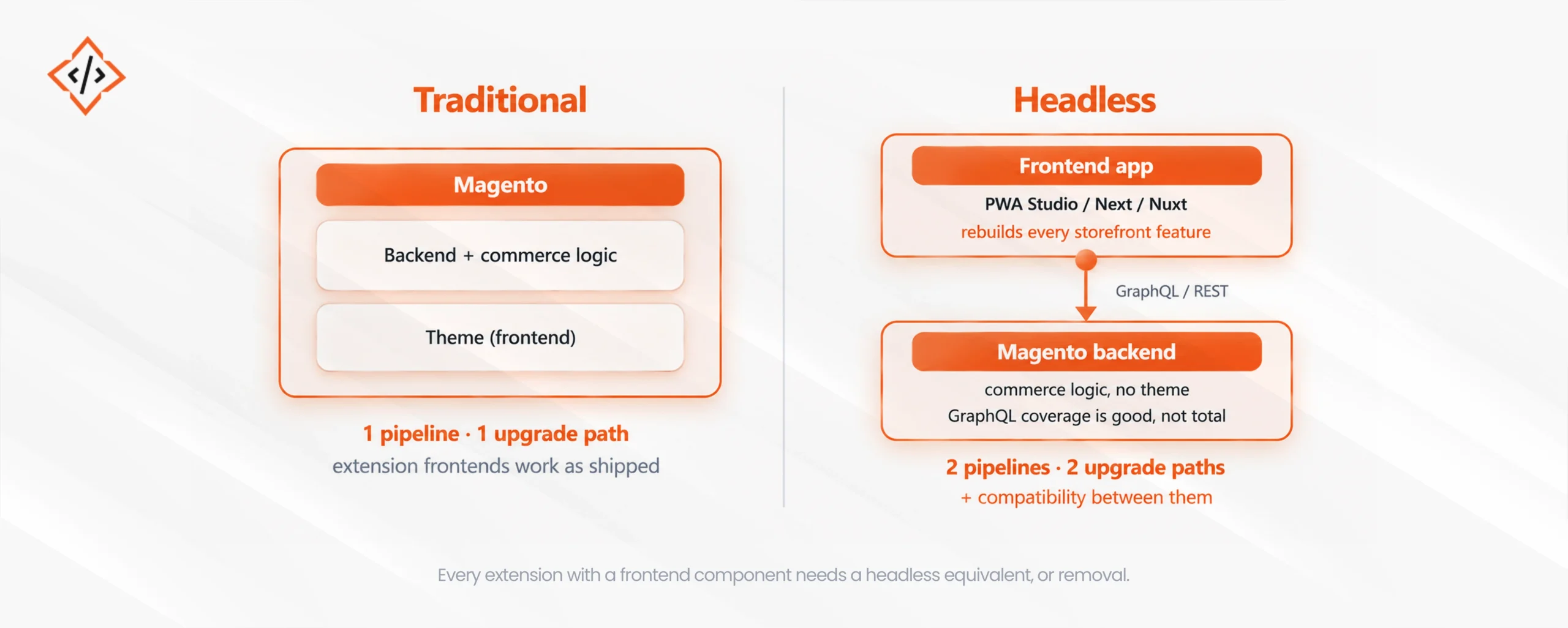
One application permanently becomes two. Managing the compatibility relationship between them represents the actual new workload.
Three specific business scenarios actively justify the substantial operational costs associated with migrating to a modern headless commerce architecture.
Editorial content often drives sales and lives inside a separate headless CMS. Composing content and commerce natively in one frontend remains genuinely easier. Pushing complex content into the native Magento CMS rarely works well. This fits publishers and brands running heavy campaign programs perfectly. It also suits businesses where content teams heavily outnumber merchandising teams.
A single commerce backend might serve web storefronts alongside mobile apps and in-store devices. An API-first approach represents the correct technical shape here. The Magento headless frontend simply becomes one standard consumer among several distinct endpoints. This specifically aligns with what headless eCommerce actually delivers. Note that building a mobile app alone never requires going headless. Standard REST endpoints serve mobile applications perfectly well. A traditional theme can simultaneously handle standard web traffic without issue.
A highly capable React or Vue team struggles with native Layout XML and Knockout configurations. This team often represents your primary delivery constraint. Letting them utilize modern Magento frontend development stacks justifies the heavy architectural cost. This represents a purely organizational justification rather than a strict technical necessity. It remains a completely legitimate reason to choose Magento PWA options.
Four specific cases exist where migrating your storefront makes absolutely no business sense. The first appears most frequently.
This quick reference guide helps technical decision-makers accurately evaluate whether migrating to headless commerce suits their specific business needs.
| Motivation | Verdict | Reasoning |
|---|---|---|
| Editorial content drives sales with a separate CMS | Justified | Composing content and commerce natively in one frontend remains genuinely easier. |
| A single backend serves web, mobile, and in-store channels | Justified | An API-first architecture delivers the correct shape for multi-channel operations. |
| A capable modern JavaScript team avoids native Magento templating | Justified | This represents a completely legitimate organizational decision. |
| The current website loads slowly | Not justified | Root causes follow the rebuild. Fix caching and scripts first. |
| A large third-party extension estate exists | Not justified | Every extension frontend becomes its own complex development project. |
| The team lacks permanent frontend engineering capability | Not justified | This produces a second application that nobody can effectively maintain. |
| A platform upgrade is due very soon | Not yet | Two unknown variables will interact poorly. Complete the upgrade first. |
If pure speed drives your decision, avoid commissioning CodeTrade for headless Magento development. Schedule a thorough cache and script diagnosis instead. Resolving those native performance issues prevents an unnecessary storefront rebuild entirely. CodeTrade gladly sacrifices a massive rebuild project to save your budget.
Organizations lacking permanent Magento frontend development capabilities should avoid this path entirely. Delivering an unsupported second application creates severe operational risks. Past deployments without dedicated internal maintenance teams aged incredibly poorly. Agencies must push back harder against unsupported architectural decisions.
Organizations expecting a core platform upgrade within six months must wait patiently. Two interacting unknown variables make every technical problem significantly harder to diagnose. Your business ultimately pays for that expensive architectural confusion.
The native Magento GraphQL API covers core commerce exceptionally well. It handles catalogs, search functions, carts, checkouts, and customer accounts natively. This specific API remains robust rather than partially complete.
Coverage gaps consistently appear across three highly predictable areas. Each missing component immediately requires custom Magento API integration work.
The practical next step requires listing all required storefront data. Teams must confirm every item possesses a valid query or mutation before committing. This technical audit takes days but prevents months of painful discovery.
Four specific questions and one practical exercise settle this architectural decision rapidly.
Then execute one practical exercise immediately.
Build a single category or product template using headless eCommerce technologies.
Connect this prototype directly against the real backend data.
This surfaces API gaps and extension problems within two weeks. It reveals the true headless Magento cost before committing fully. Teams running this test either proceed confidently or fail cheaply.
The three previous justifications remain technically clean. A fourth common motivation consistently challenges technical leaders. Hiring constraints present a complex architectural dilemma.
Magento frontend development talent grows scarcer daily. New engineers rarely learn legacy Layout XML and Knockout skills. A modern React storefront draws from a massively larger talent pool. These market realities remain completely true.
However, solving a hiring problem rarely justifies adopting headless commerce architecture independently. This approach permanently doubles your operational surface just to fill one role easily. It never removes the strict requirement for specialized backend engineering skills. It simply moves the talent scarcity to a different operational seat.
Conversely, failing to hire technical staff creates a genuine existential threat for any store. An elegant single-application architecture loses its value if nobody can staff it effectively.
Industry consensus suggests hiring challenges alone cannot justify the massive headless Magento cost. However, combining hiring constraints with any established architectural justification often tips the scale. Engineering leaders must weigh these operational realities carefully before committing budgets.
Adopting headless Magento permanently transforms your store into two separate applications. This technical structure requires managing dual pipelines and complex upgrade paths. Engineering teams must reimplement every single frontend feature completely from scratch.
The high headless Magento cost proves worthwhile for deep content flexibility. It also suits genuine multi-channel delivery and modern teams avoiding legacy native templating. However, this specific architecture never justifies chasing pure speed alone. Audit Magento GraphQL coverage against your actual data requirements before committing enterprise budgets.
Count all third-party extensions and Magento B2B features requiring custom frontends carefully. Confirm your organization possesses permanent Magento PWA development expertise for ongoing maintenance. Build one single template against the real backend first.
This practical exercise reveals true operational realities within a mere two weeks. This brief test remains cheap enough to execute even if the final architectural answer is completely negative.

 Hardik Soni
 Chand Prakash
 Chand Prakash
 Chand Prakash
 Chand Prakash