






Web Development
eCommerce
 Chand Prakash
12 October 2026
Chand Prakash
12 October 2026
Headless Magento: When PWA Studio Earns Its Cost
 Chand Prakash
The native Magento B2B module is highly opinionated. These functional opinions live strictly inside its core data model rather than standard documentation. Understanding this architectural reality before starting any configuration remains crucial. The Magento B2B ecommerce platform works perfectly when pricing directly matches company attributes.
The core architecture strains heavily when purchasing rules become highly conditional. Standard company records cannot always express complex external buying conditions. Knowing your exact system requirements before beginning Magento B2B development saves massive configuration rework. The actual operational boundary rarely matches generic marketing feature lists.
This guide details exactly how the underlying data model actually functions in production. It highlights precisely where real enterprise requirements exceed native system capabilities.
The following sections cover critical architectural decisions required before configuring Adobe Commerce B2B systems. These specific feature requirements usually dictate your final platform licensing choices between Adobe Commerce vs Magento Open Source.
Mastering this underlying architecture prevents catastrophic system failures and guarantees long term stability across your digital commerce ecosystem. Four core constructs exist. Their structural relationships matter significantly more than their isolated individual features.
The company represents the primary account entity. Magento B2B company accounts hold credit limits and standard payment terms. They store the assigned sales representative and specific shared catalogs. They also dictate the entire buyer hierarchy. Individual buyers act as members of a company rather than independent retail customers.
Everything downstream depends entirely upon this structure. Visibility and terms attach directly to the core company record. Anything varying within a single organization requires serious additional architectural thought. A subsidiary requiring different Magento B2B pricing from its parent demonstrates this exact challenge.
Specific roles define exactly what every individual buyer may execute. Users can place orders or view historical company orders. They can manage other users and see available credit information. These capabilities prove granular enough for most standard organizations.
Strict limitations appear quickly during complex approval chains. Roles strictly determine capability rather than operational sequence. Multi-step conditional rules require deep customization beyond native Magento B2B approval workflow settings.
A shared catalog defines visible products alongside exactly what that specific company pays. One single construct covers visibility and pricing logic together. This combination works efficiently across most common standard business cases. It becomes highly awkward during specific edge cases.
A customer might need full catalog visibility while receiving special pricing on limited subsets. Modeling this scenario cleanly takes extreme architectural care. This limitation remains a frequent early discovery during implementation.
A buyer requests a formal quote directly from their shopping cart. A sales representative responds with adjusted pricing and line changes. The buyer then accepts or declines the modified offer. An accepted proposal converts directly into a standard order.
Magento B2B quote management proves genuinely useful for negotiated sales processes. It strictly assumes a simple two-party negotiation structure. Multi-party internal reviews before sending a quote typically require heavy system extension.
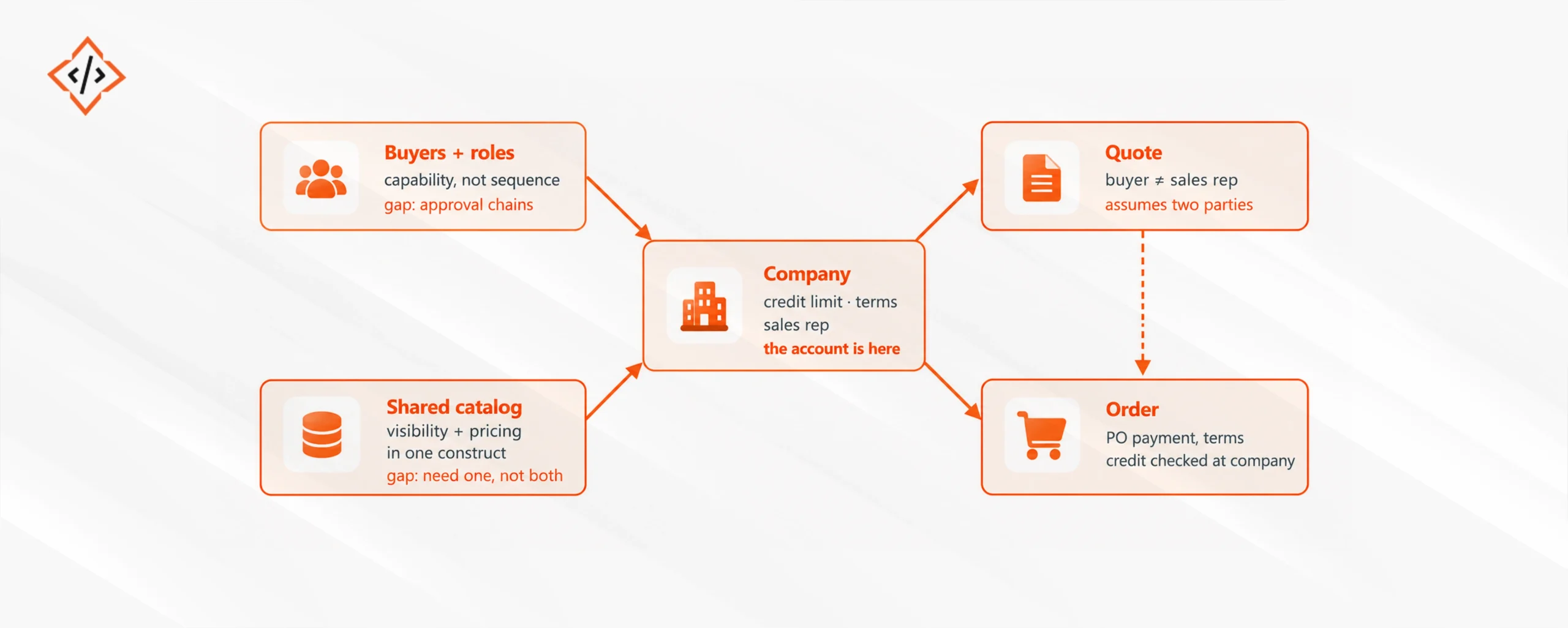
The company sits firmly at the absolute center of this data model. Complex approval sequences and nuanced pricing visibility represent where projects usually require custom extension.
Identifying specific operational gaps early protects your budget and prevents complex workarounds during major Magento B2B customization phases. Five specific gaps recur frequently. None prove fatal during implementation. Closing each one requires dedicated budget and time.
The most realistic approach requires testing your three hardest operational requirements during initial evaluation. Never assume a basic marketing feature list covers everything. This early testing costs very little upfront. It represents the exact difference between a cleanly scoped extension and a massive rescue project.
If basic customer-group pricing and simple logins define your requirements, the native Magento B2B module remains unnecessary. Standard Magento Open Source covers these basic needs perfectly. Implementing complex enterprise modules forces a data model your customers simply do not require.
If complex approval rules drive your Adobe Commerce B2B purchase, scope the custom workflow costs before buying licenses. The native module sometimes cannot execute the specific actions driving your initial purchase. Discovering these strict limitations early prevents expensive software licensing mistakes.
If an external ERP already owns pricing and credit terms, evaluate your implementation partners carefully. This scenario represents a strict Magento B2B integration project rather than a standard storefront build. Agencies prioritizing frontend configuration over deep backend integration often build elaborate shared catalogs. Those native catalogs then get uselessly overridden at runtime by external data.
Finalizing these critical structural decisions early prevents catastrophic system rebuilds and protects your entire enterprise technology budget completely. Four primary decisions require immediate attention. Getting them wrong proves incredibly expensive to unwind later. These specific choices permanently shape your underlying data model.
This remains the most consequential architectural question. Contract pricing and stock living inside an ERP should be fetched directly. The storefront must never duplicate this sensitive data. Configuring elaborate shared catalogs just to override them wastes valuable engineering hours. It also creates two conflicting sources of truth. Treat shared catalogs primarily as visibility tools when external systems hold authority. Runtime API calls must handle all final Magento B2B pricing logic. This represents a highly legitimate architecture seen frequently during complex Magento to Odoo integration projects.
Map the actual customer hierarchy carefully before generating any records. Parent groups and subsidiaries require clear architectural mapping. You must decide whether buying consortia represent one company or several distinct entities. This exact Magento B2B company structure decision fundamentally dictates future pricing and reporting outcomes.
Document all real approval rules alongside their specific operational exceptions. Check these requirements strictly against native role capabilities. The largest custom development surprises usually hide within this exact Magento B2B approval workflow mapping phase.
Determine exactly where credit limits get enforced across your systems. The storefront and the ERP can both execute this validation. Relying on both platforms remains common but requires strict defined precedence. Without clear rules managing Magento B2B credit limits an order might easily pass one check while failing another.
Many modern merchants sell across both consumer and commercial channels simultaneously. Three highly viable architectural patterns exist for this approach.
| Pattern | How it works | Fits when |
|---|---|---|
| Single store, company-aware | A unified storefront reveals specialized Magento B2B company accounts and features only after login. | B2B and B2C product catalogs overlap significantly. |
| Separate store views | Distinct store views operate on one installation utilizing entirely different themes and catalogs. | Presentation requirements and underlying catalogs differ meaningfully. |
| Separate installations | Two completely distinct platforms or independent instances run parallel operations. | Complex requirements diverge enough that shared configuration actively constrains both channels. |
A single store featuring robust company awareness represents the most common and effective starting point. Separate store views become highly justified when wholesale pricing must never remain publicly visible. They also work well when the respective retail and commercial catalogs genuinely differ.
Deploying separate installations occasionally proves correct but frequently causes long-term operational regret. Operating two distinct stores immediately doubles the ongoing software patching and integration burden. This heavy technical debt mirrors the exact complexities detailed within the 2.4.8 Upgrade Guide.
Technical architects advise organizations to document actual approval rules including exceptions. Those details rarely materialize during initial planning.
Organizations rarely withhold information intentionally. The problem involves how the actual Magento B2B purchase approval operates internally. Real operations rarely match official documentation. Procurement describes a formal policy containing specific thresholds. Meanwhile a purchasing manager holds informal authority to approve specific suppliers immediately. Nobody mentions this informal authority because it represents standard daily behavior rather than a strict rule.
This hidden informal layer dictates the actual custom workflow requirements. These invisible rules surface during user acceptance testing inevitably. Users simply report the new system blocks their standard daily tasks.
Observing three real orders getting approved yields better results than reading official policies. This observational approach often sounds unusual during standard discovery meetings. Companies frequently decline these requests due to simple calendar constraints.
No perfectly clean fix exists for this challenge. Undocumented processes remain entirely invisible to external technical teams. Surfacing these hidden Magento B2B approval workflow requirements relies entirely on internal stakeholders. Someone must actively volunteer that the official documentation remains incomplete.
The native Magento B2B module proves highly capable yet strictly opinionated. It establishes the company as the primary account entity. Essential elements like Magento B2B pricing attach directly to this central record. This creates efficiency for standard corporate structures. It feels awkward for organizations requiring deep variation within a single account.
Settle four critical operational decisions before beginning any configuration. Determine if an external ERP owns pricing and how customer hierarchies function. Map out informal workflows and decide where the platform enforces Magento B2B credit limits. These factors permanently shape your underlying data model.
Changing these structural decisions later requires expensive Magento B2B customization. Always test your three hardest requirements during the initial evaluation phase. Multi-step conditional rules frequently demand complex custom code. Identifying these architectural gaps early separates neatly scoped extensions from disastrous rescue projects.
 Chand Prakash
 Hardik Soni
 Chand Prakash
 Chand Prakash
 Chand Prakash