







Mobile App Development
 Abhishek Karad
03 September 2026
Abhishek Karad
03 September 2026
What Actually Drives Your True Flutter App Development Cost in 2026?
 Abhishek Karad
Evaluating cross-platform mobile app development tools often involves reading arguments against versions that no longer ship. When businesses evaluate professional mobile app development services, this outdated information represents a significant industry problem. React Native completely removed its asynchronous bridge to eliminate years of standard criticism.
The latest Flutter vs React Native architecture updates show that Flutter replaced its Skia rendering path with Impeller. This major update directly resolved the notorious shader-compilation jank. Both platforms successfully tore out the exact architectural components critics previously attacked. Unfortunately most comparison content still has not caught up to these facts.
A modern Flutter vs React Native 2026 evaluation reveals a surprising truth. Pure performance rarely decides anything between these tools anymore. The final choice actually depends heavily on existing team skill. Hiring market dynamics and platform-specific UI requirements also dictate the best path forward. This reality frustrates professionals seeking a purely technical verdict. However current production evidence strictly supports this pragmatic approach to the Flutter vs React Native debate.
Both major platforms completely overhauled their foundational underlying architectures to eliminate historic technical limitations during recent release cycles.
Impeller precompiles specific shaders entirely ahead of time rather than compiling them at runtime. This strict compilation approach completely removes the notorious first-run animation jank. This historic stuttering problem previously dominated every Flutter vs React Native performance debate. The current framework status remains much more specific than standard industry summaries suggest.
| Platform | Impeller status |
|---|---|
| iOS | The only supported renderer, Skia can’t be selected |
| Android | Default on API 29+; falls back to the legacy OpenGL renderer below that, or where Vulkan is unavailable |
| macOS | Available behind a flag, not yet default |
| Web | Not used, web still renders with Skia |
This architectural shift creates two highly practical deployment consequences for any team executing Flutter app development. Technical advice suggesting developers disable Impeller on iOS remains entirely obsolete. The underlying framework simply removed that specific configuration option. Additionally, engineers must evaluate any Flutter web deployment strictly against standard Skia characteristics rather than Impeller constraints.
The New Architecture officially swapped the legacy asynchronous JSON bridge for a direct synchronous interface layer. The development team also introduced a completely rewritten renderer alongside a lazily initialized native module system. JavaScript and native code now interact directly instead of heavily serializing messages across a queue.
This direct interaction effectively removes the specific technical mechanism behind historical lag complaints. React Native performance drastically improved after eliminating this major communication bottleneck. Consequently, older benchmarks evaluating Flutter vs React Native development describe an obsolete framework architecture that simply no longer exists.
Genuine technical differences definitely remain when choosing the best framework for cross-platform apps. These differences are much narrower than standard industry comparisons typically claim. They mostly focus on distinct architectural approaches rather than sheer execution speed.
| Dimension | Flutter | React Native |
|---|---|---|
| Rendering model | Draws every pixel itself | Maps to native platform components |
| Visual consistency across platforms | Stronger, identical by construction | Varies with platform component behavior |
| Native look and feel by default | Requires deliberate work per platform | Stronger, inherits platform behavior |
| Language | Dart, one more language for most teams | JavaScript / TypeScript, usually already known |
| Web code sharing with an existing app | Limited in practice | Stronger where a React web app exists |
| Custom and brand-heavy UI | Stronger, full control of the canvas | Achievable, more friction |
| Access to new OS UI features | Waits for Flutter implementation | Often faster, wraps native components |
| Hiring pool | Smaller, growing | Larger, any React developer is a partial hire |
| Binary size | Larger baseline | Smaller baseline |
| Text rendering and accessibility | Own implementation; good, occasionally divergent | Native by default |
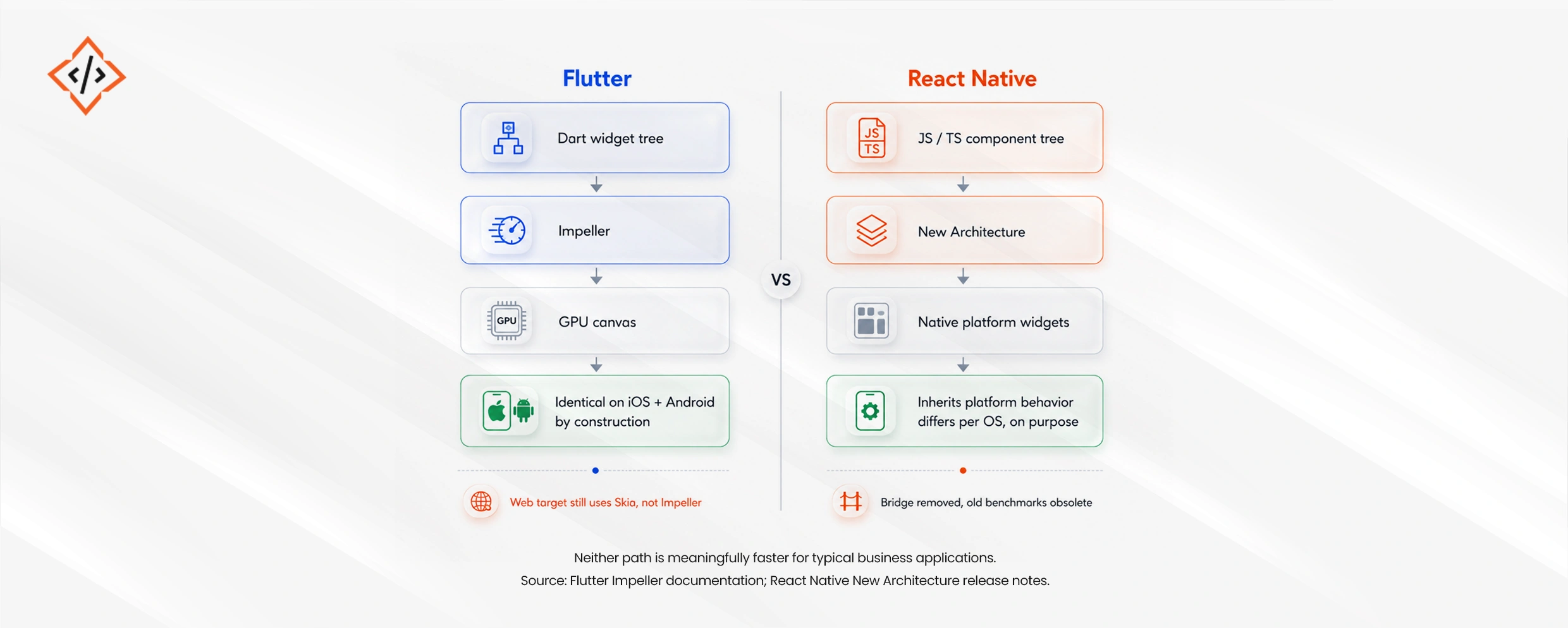
Evaluating Flutter vs React Native pros and cons reveals this real architectural divide. This core structural difference strictly determines how the interface looks and feels during React Native app development. It no longer dictates how fast the compiled software actually runs.
For most business applications, the answer is no. Both frameworks comfortably hold 60 frames per second during standard enterprise workloads. Typical list scrolling, form entry, navigation, and data display operate smoothly across modern devices.
Flutter vs React Native performance differences only emerge across a narrow band of complex use cases:
Two vital cautions apply to benchmark evidence when evaluating Flutter vs React Native for business apps. Most published comparisons predate Impeller, the New Architecture, or both architectural upgrades. Real-world application speed depends primarily on network efficiency, image caching, local storage, and list optimization. Competent engineering teams handle these operational factors effectively regardless of framework choice.
Teams already executing React Native mobile app development competently should never hire CodeTrade for a Flutter migration. Developers would certainly enjoy this architectural work. Organizations simply pay for a costly rewrite delivering only a different programming language.
Small applications depending heavily on platform-specific native SDKs require dedicated native contractors. Cross-platform mobile app development represents the completely wrong architectural approach here. Clients end up wasting valuable budget paying developers to write custom bridge code.
Never hire any development agency simply because a competitor recently launched a mobile application. Technical decision-makers must settle this fundamental product question first. Applications built purely for competitive vanity consistently suffer from zero actual user adoption.
Choosing between both platforms requires evaluating real business constraints instead of relying purely on theoretical architectural debates across engineering teams.
Address four specific questions in a strict order. The first two questions usually settle the decision completely.
When mobile software serves as an enterprise front end, framework choice matters less than architectural integration design. The Flutter and ERP backend integration patterns usually drive delivery cost more than the UI layer does.
This common architectural assumption deserves an honest re-examination because technical advisers frequently misjudge it. For years, consultants presented the strict visual consistency of Flutter as an outright advantage. Delivering identical interfaces across iOS and Android with a single design review sounds undeniably compelling.
However, shipping an enterprise logistics utility to mixed device users often exposes this limitation. While Android users remain satisfied, iOS users frequently find identical cross-platform interfaces subtly jarring. Core functionality remains completely stable. Yet subtle interactions like scroll inertia, navigation gestures, native share sheets, and date pickers feel unfamiliar. The development team delivered pixel consistency when end users actually expected platform familiarity.
Interface consistency and native platform familiarity represent two fundamentally different product goals. When evaluating Flutter vs React Native for mobile apps, product teams must determine which experience matters most. Deciding this UI requirement upfront should always happen well before selecting an underlying rendering engine.
It is worth stating plainly that cross-platform architecture is not always correct.
Go fully native when the mobile application remains small and deeply platform-specific. Native development makes sense when software depends heavily on a native SDK lacking maintained bindings. It also applies when the product needs day-one support for new OS UI features. Finally, stick to native if the existing engineering team remains exceptionally strong in Swift and Kotlin without any cross-platform pressure.
Reconsider building a mobile app entirely when the core requirement genuinely demands a responsive web application. Answer this fundamental product question first. Settle this specific issue well before debating Flutter or React Native rather than after. Identifying the best framework for cross-platform apps matters little if the product simply needs a responsive website.
Both major frameworks completely replaced the foundational layers that historically defined this architectural argument. React Native removed the problematic asynchronous bridge entirely. Flutter mobile app development replaced Skia with the Impeller engine. Impeller is now the only renderer on iOS and the default on Android API 29 and above. Meanwhile, Flutter web continues operating securely on Skia.
Performance no longer separates these tools for typical business applications. Most existing comparison content is simply fighting the last war. Before deciding to hire Flutter developers, organizations must choose their path based on existing team skill and the local hiring market first. Next, determine exactly how native the final product should feel.
Technical leaders must remember that visual consistency and platform familiarity are not the same goal. Flutter canvas control perfectly suits brand-led design systems. React Native component mapping perfectly suits applications that should feel like they belong on each specific platform.

 Abhishek Karad
 Abhishek Karad
 Abhishek Karad
 Abhishek Karad
 Abhishek Karad